Estradiol
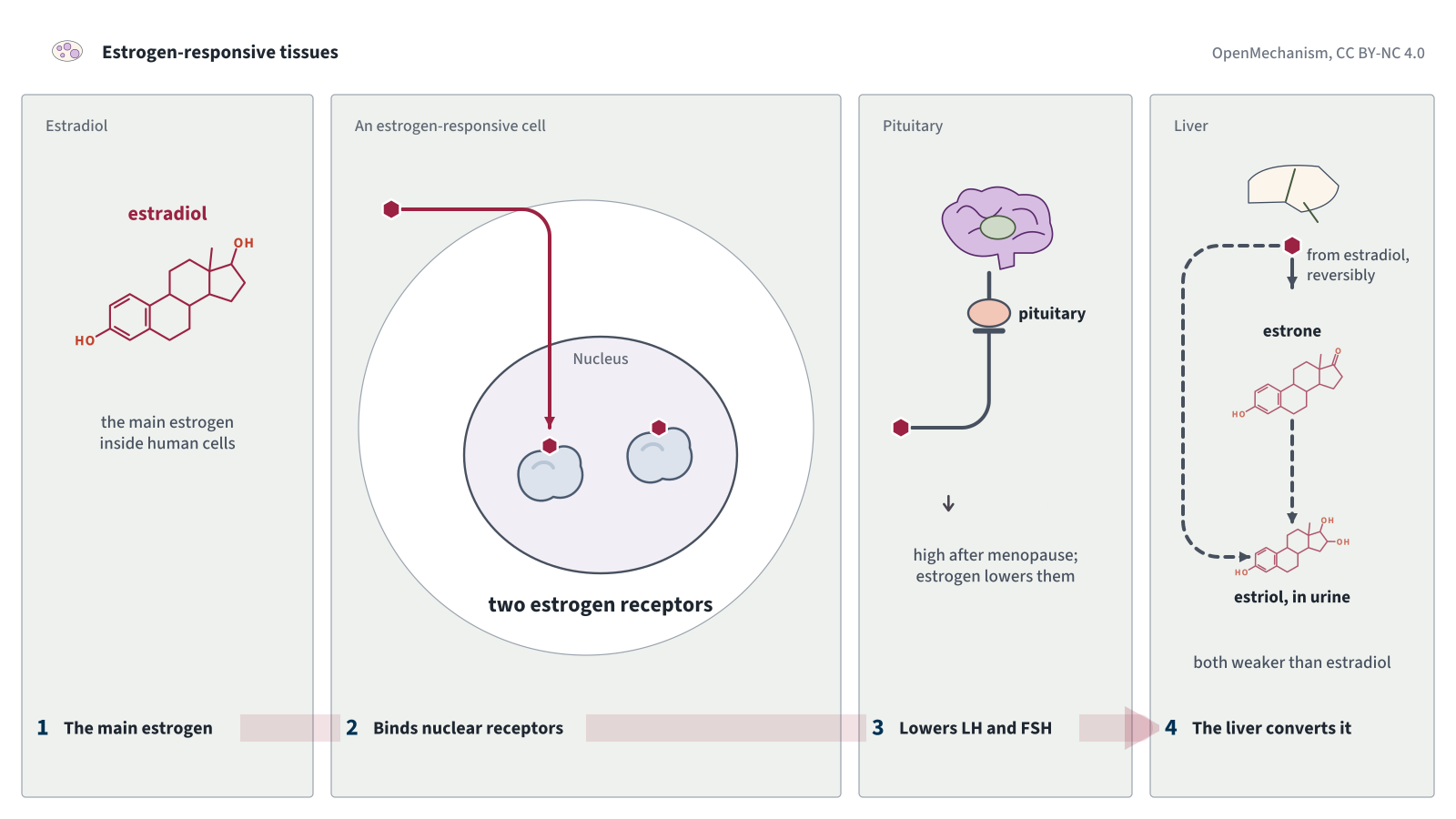
Estradiol is the main estrogen inside human cells, far more potent at its receptors than its metabolites estrone and estriol. It acts by binding nuclear estrogen receptors in estrogen-responsive tissues, and through negative feedback it lowers the pituitary hormones and , which are high after menopause. Mainly in the liver, it is converted reversibly to estrone, and both can be converted to estriol. Its label lists it for moderate to severe vasomotor symptoms and moderate to severe symptoms of vulvar and vaginal atrophy linked to the menopause; hypoestrogenism from hypogonadism, castration or primary ovarian failure; metastatic breast cancer, in appropriately selected women and men, and advanced androgen-dependent prostate cancer, both for palliation only; and the prevention of osteoporosis. When it is given only to prevent osteoporosis after menopause, the label says it should be considered only for women at significant risk of osteoporosis for whom non-estrogen medicines are not considered appropriate.
- Acts on
- Estrogen receptors (nuclear receptors) in estrogen-responsive tissues
- Where
- Estrogen-responsive tissues
- Medicine type
- Small molecule
- Used for
- Urinary & reproductive
Key terms in this drawing
- FSH
- Follicle-stimulating hormone. One of the gonadotropins, the pituitary hormones whose release estrogens hold back by negative feedback; large doses of added androgens may hold back FSH too. LH is the other.
- LH
- Luteinizing hormone. One of the gonadotropins, the pituitary hormones whose release estrogens hold back by negative feedback; added androgens hold back LH the same way. FSH is the other.
How it works
The main estrogen. Estradiol is the principal intracellular human estrogen and is substantially more potent than its metabolites, estrone and estriol, at the receptor level.1
Binds nuclear receptors. Estrogens act through binding to nuclear receptors in estrogen-responsive tissues; to date, two estrogen receptors have been identified, in proportions that vary from tissue to tissue.1
Lowers LH and FSH. Circulating estrogens modulate the pituitary's secretion of the gonadotropins LH and FSH through negative feedback, and reduce the elevated levels of these hormones seen in postmenopausal women.1
The liver converts it. Exogenous estrogens are metabolized like the body's own, mainly in the liver: estradiol is converted reversibly to estrone, and both can be converted to estriol, the major urinary metabolite.1
For teachers: download this drawing.
See also
Condition pages: breast cancer, osteoporosis, prostate cancer and absent periods (secondary amenorrhea).
Other sex hormones (estrogens, progestins, androgens): norethindrone and ethinyl estradiol; progesterone; and testosterone.
Body system: bladder & reproductive organs.
Sources
- 1Estradiol tablets: FDA labelIndications and Usage; Clinical Pharmacology; Boxed Warning
- 2ChEMBL CHEMBL135Target and action classification: Estrogen receptor alpha agonist
Spotted a mistake? Report an error (hello@openmechanism.com). Since launch, every published error we fix is listed on the corrections page.
Notes and limits
- A schematic teaching drawing: not to scale, not exact structures, binding poses or a complete pathway, and not a guide to dosing, treatment or how a person will respond.
- The steps are in the order that explains them; one step is said to cause the next only where the source says so.
- The estradiol label has a boxed warning: estrogens increase the risk of endometrial cancer (cancer of the womb lining). The same warning says estrogens, with or without progestins, should not be used to prevent cardiovascular disease, and that the Women's Health Initiative (WHI) study reported increased risks of heart attack (myocardial infarction), stroke, invasive breast cancer, blood clots in the lungs (pulmonary emboli) and deep vein thrombosis in postmenopausal women aged 50 to 79 during 5 years of oral conjugated estrogens (0.625 mg) combined with medroxyprogesterone acetate (2.5 mg), compared with placebo. The WHI's memory substudy (WHIMS) reported an increased risk of probable dementia in postmenopausal women aged 65 or older during 4 years of oral conjugated estrogens plus medroxyprogesterone acetate, compared with placebo; the label says it is unknown whether this finding applies to younger postmenopausal women or to women taking estrogen alone. The warning adds that other doses of oral conjugated estrogens with medroxyprogesterone acetate, and other combinations and dosage forms of estrogens and progestins, were not studied in the WHI clinical trials and that, in the absence of comparable data, these risks should be assumed to be similar.
All recorded limits are on the evidence page, and notes that apply to every page are on How to read a page. Version 1.0.1, medically reviewed by Daniel Tran, PharmD, on 14 November 2026.
Cite this page
Tran D. Estradiol [Internet]. OpenMechanism; 2026 [updated 2026 Nov 14; cited 2026 Nov 14]. Available from: https://openmechanism.com/medicines/estradiol