Enlarged prostate (BPH)
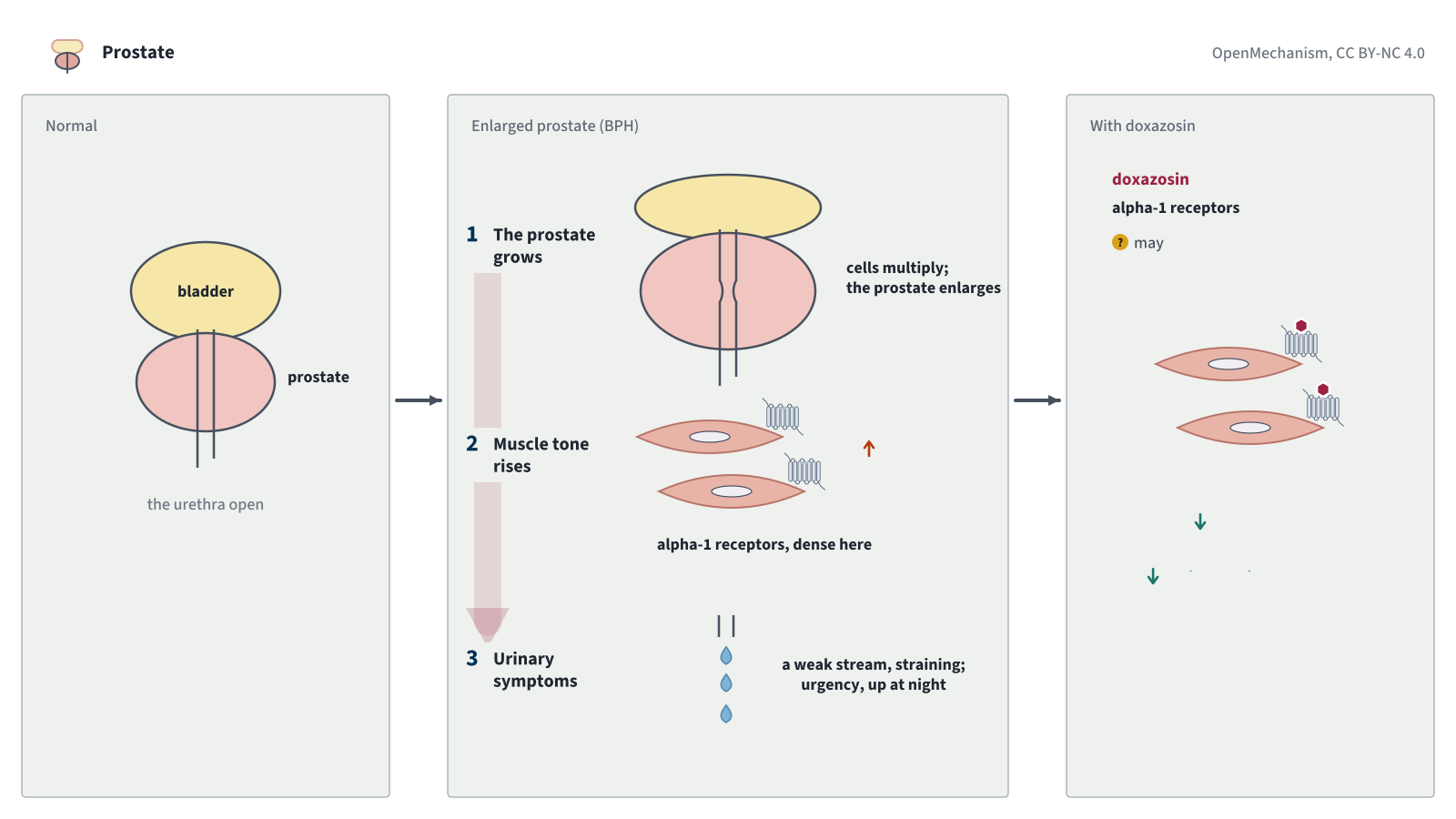
In benign prostatic hyperplasia (BPH), cells of the prostate multiply and it grows. Smooth muscle tone in the prostate and bladder neck, set by alpha-1 receptors, also rises. The result is urinary symptoms: a weak stream, hesitancy, straining, urgency and getting up at night. Doxazosin blocks alpha-1 receptors, lowering resistance in the urethra.
- Where
- Prostate
- Body system
- Bladder & reproductive organs
- Medicines
- 1 medicine
May
The Cardura (doxazosin) label says: Blockade of the alpha 1 receptor decreases urethral resistance and may relieve the obstruction and BPH symptoms and improve urine flow.
Source 2: Cardura (doxazosin): FDA label, 1 Indications and Usage; 12.1 Mechanism of Action
Clinical study: In a double-blind trial in 3047 men with benign prostatic hyperplasia, followed for 4.5 years on average; the trial measured symptoms and the progression of the disease, not urethral resistance: Doxazosin (P<0.001), finasteride (P=0.001), and combination therapy (P<0.001) each resulted in significant improvement in symptom scores
McConnell JD et al., N Engl J Med 2003 (PMID 14681504)
This study was picked with a literature search and is not yet checked by our reviewer.
For teachers: download this drawing.
Key terms in this drawing
- alpha-1 receptor
- Alpha-1 adrenergic receptor. Alpha-1 adrenergic receptors come in at least three subtypes, A, B and D; alpha-1A may have a main role in prostate obstruction, alpha-1B in tightening arteries.
- BPH
- Benign prostatic hyperplasia. Enlargement of the prostate, as its stromal and epithelial cells multiply.
What goes wrong
The prostate grows. In , cells of the prostate's transition zone multiply, perhaps driven by inflammation and sex hormones, and the prostate enlarges.1
What the source says
“BPH occurs when both stromal and epithelial cells of the prostate in the transitional zone proliferate by processes that are thought to be influenced by inflammation and sex hormones, causing prostate enlargement.”
Source 1Muscle tone rises. Smooth muscle tone in the prostate and bladder neck also rises; it is set by , which are dense there.2
What the source says
“The dynamic component of BPH is associated with an increase in smooth muscle tone in the prostate and bladder neck.”
Source 2“The degree of tone in this area is mediated by the alpha 1 adrenoceptor, which is present in high density in the prostatic stroma, prostatic capsule and bladder neck.”
Source 2Urinary symptoms. The result is urinary symptoms: hesitancy, a weak stream and straining, or urgency, frequency and getting up at night.1
What the source says
“The symptoms can be obstructive (resulting in urinary hesitancy, weak stream, straining or prolonged voiding) or irritative (resulting in increased urinary frequency and urgency, nocturia, urge incontinence and reduced voiding volumes)”
Source 1
Where medicines act
- A
Doxazosin: the muscle relaxes
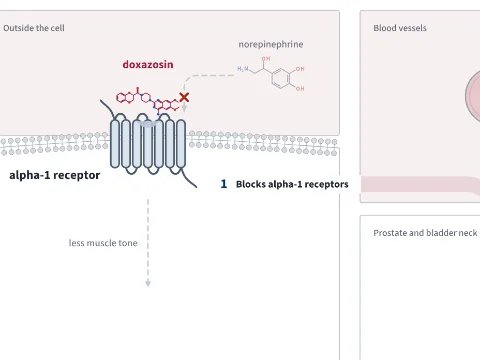
Doxazosin blocks alpha-1 receptors, lowering resistance in the urethra; this may relieve the obstruction and improve urine flow. It treats the signs and symptoms of BPH.2
See also
Body system: bladder & reproductive organs.
Zoom in: muscle tone in the prostate.
Related medicines: tamsulosin, finasteride and tadalafil.
Other conditions: low testosterone (male hypogonadism), erectile dysfunction and high blood pressure.
Interactions: PDE5 inhibitors and alpha-blockers.
The medicine in the body: why finasteride halves PSA.
Sources
- 1Benign prostatic hyperplasiaChughtai B et al. Nat Rev Dis Primers 2016 (abstract). Saved copy
- 2Cardura (doxazosin): FDA label1 Indications and Usage; 12.1 Mechanism of Action. Saved copy
- 3The long-term effect of doxazosin, finasteride, and combination therapy on the clinical progression of benign prostatic hyperplasiaMcConnell JD et al. N Engl J Med 2003 (abstract). Saved copy
Notes and limits
- How bad the symptoms are does not match the size of the prostate well.2
Notes that apply to every page are on How to read a page.
Spotted a mistake? Report an error (hello@openmechanism.com). Since launch, every published error we fix is listed on the corrections page.
Cite this page
Tran D. Enlarged prostate (BPH) [Internet]. OpenMechanism; 2026 [updated 2026 Oct 20; cited 2026 Oct 20]. Available from: https://openmechanism.com/conditions/enlarged-prostate