Oxybutynin
Oxybutynin blocks the muscarinic action of acetylcholine on smooth muscle and also relaxes it directly, so the bladder muscle relaxes. In people with involuntary bladder contractions, the bladder holds more, uninhibited contractions come less often and the first urge to void comes later.
- Acts on
- Muscarinic acetylcholine receptors of smooth muscle
- Where
- Bladder muscle
- Medicine type
- Small molecule
- Used for
- Urinary & reproductive
- Drug class
- Antimuscarinics (anticholinergics)
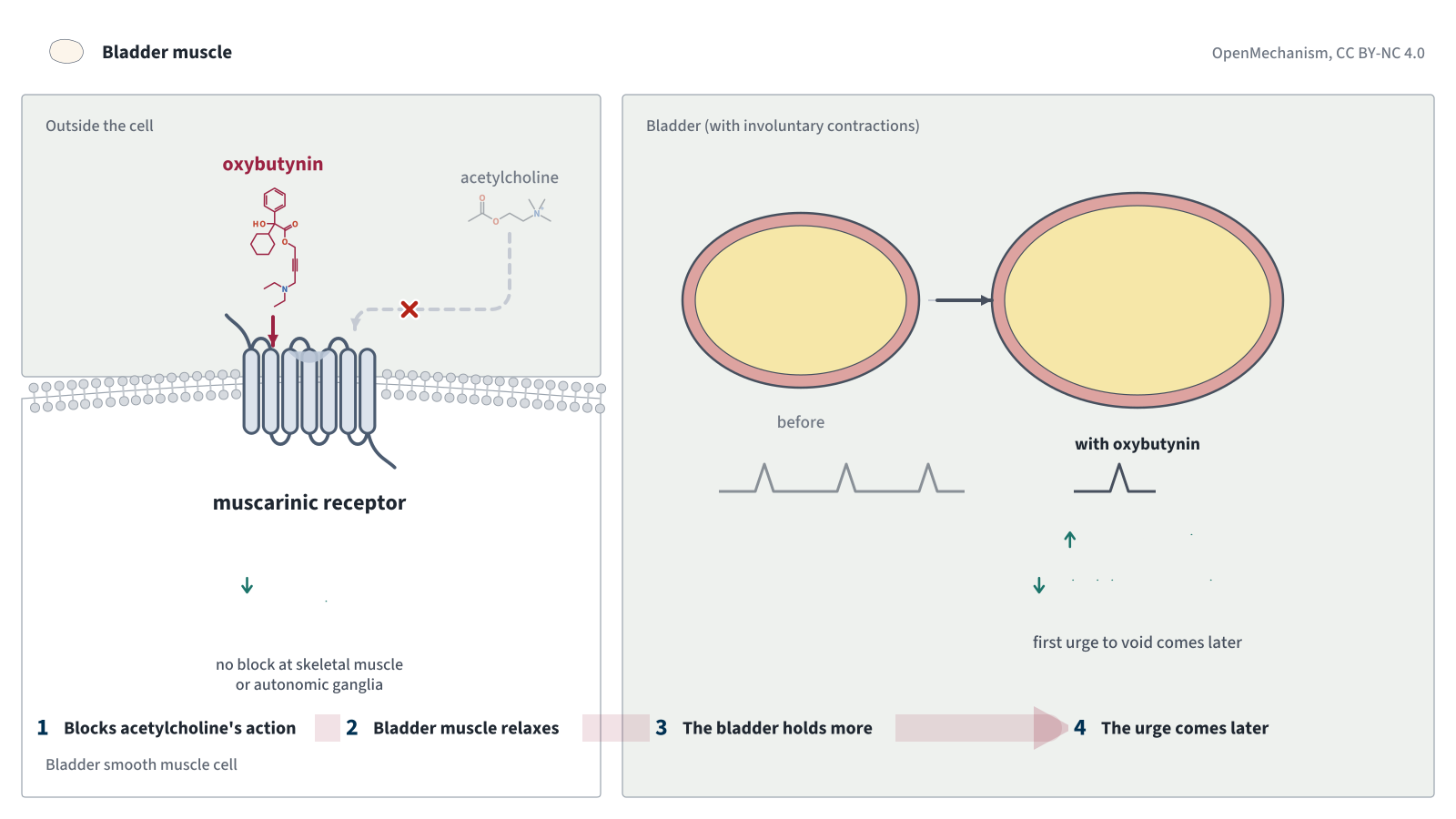
Key terms in this drawing
- muscarinic receptors
- Muscarinic receptors (M1 to M5). The receptors that antimuscarinic (anticholinergic) medicines block; they come in five subtypes, M1 to M5.
How it works
Blocks acetylcholine's action. Oxybutynin inhibits the muscarinic action of acetylcholine on smooth muscle; it has no blocking effect at skeletal neuromuscular junctions or autonomic ganglia.1
Bladder muscle relaxes. It relaxes bladder smooth muscle, with a direct antispasmodic effect on smooth muscle.1
The bladder holds more. In patients with involuntary bladder contractions, it increases bladder capacity and makes uninhibited contractions of the detrusor muscle less frequent.1
The urge comes later. It also delays the initial desire to void.1
For teachers: download this drawing.
See also
Condition pages: overactive bladder.
Other antimuscarinics (anticholinergics): atropine and tiotropium.
Explained: why anticholinergic medicines cause dry mouth, constipation and confusion.
Body system: bladder & reproductive organs.
Sources
- 1Oxybutynin chloride extended-release tablets: FDA label12.1 Mechanism of Action; 12.2 Pharmacodynamics
- 2ChEMBL CHEMBL1231Target and action classification: Muscarinic acetylcholine receptor M2 antagonist; Muscarinic acetylcholine receptor M3 antagonist
Spotted a mistake? Report an error (hello@openmechanism.com). Since launch, every published error we fix is listed on the corrections page.
Notes and limits
- A schematic teaching drawing: not to scale, not exact structures, binding poses or a complete pathway, and not a guide to dosing, treatment or how a person will respond.
All recorded limits are on the evidence page, and notes that apply to every page are on How to read a page. Version 1.0.0, not yet medically reviewed.
Cite this page
Tran D. Oxybutynin [Internet]. OpenMechanism; 2026 [updated 2026 Oct 11; cited 2026 Oct 11]. Available from: https://openmechanism.com/medicines/oxybutynin