Oxytocin
Oxytocin acts on its own receptors in the muscle of the uterus, which become far more numerous during pregnancy. It raises the calcium inside the muscle cells, and actomyosin forms under the influence of the calcium-dependent enzyme myosin light-chain kinase, so the uterus contracts, almost at once when it is given into a vein. Its label lists it for starting labor when there is a medical reason, not for elective induction; for strengthening labor; as an added treatment in managing an incomplete or inevitable abortion; and after delivery, for contracting the uterus and controlling bleeding.
- Acts on
- Oxytocin receptors of the myometrium
- Where
- The muscle of the uterus (myometrium)
- Medicine type
- Peptide
- Used for
- Urinary & reproductive
- Drug class
- Uterotonics
Also called Pitocin.
How it works
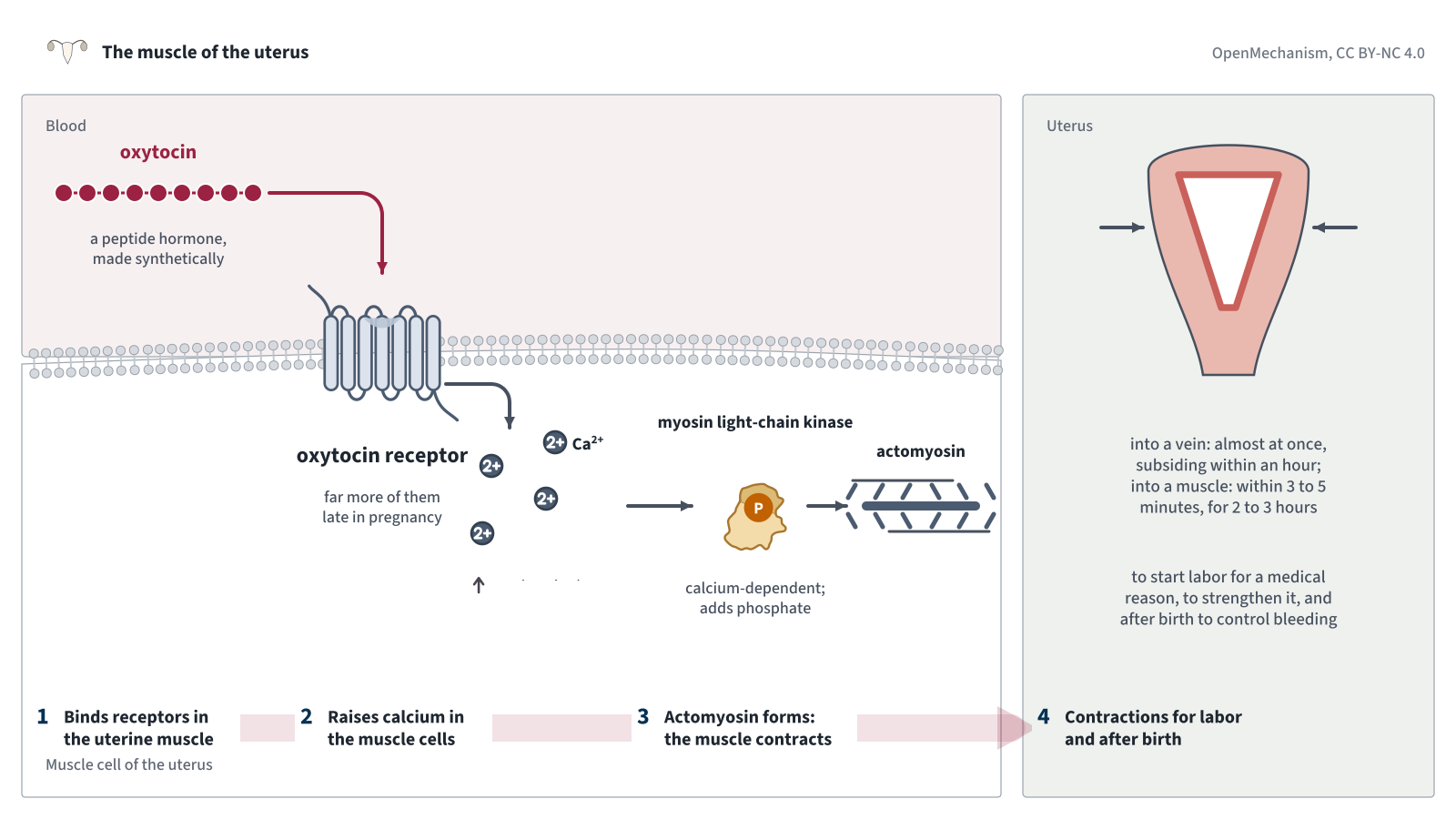
Binds receptors in the uterine muscle. Oxytocin, a peptide hormone made synthetically, has its own specific receptors in the myometrium, the muscle of the uterus. Their number rises greatly during pregnancy, to a peak in early labor at term, and sets how sensitive the uterus is; the response to a given dose depends on that sensitivity and is very individualized.1
Raises calcium in the muscle cells. Oxytocin promotes contractions by increasing the calcium inside the muscle cells.1
Actomyosin forms: the muscle contracts. The uterus contracts as the contractile protein actomyosin forms under the influence of the calcium-dependent enzyme myosin light-chain kinase, which adds phosphate groups.1
Contractions for labor and after birth. Given into a vein, the uterus responds almost at once and the response subsides within an hour; into a muscle, it starts within 3 to 5 minutes and lasts 2 to 3 hours. The label lists oxytocin for starting labor when there is a medical reason, not for elective induction; for strengthening labor; and after delivery, for contracting the uterus and controlling bleeding.1
For teachers: download this drawing.
See also
Condition pages: heavy bleeding after birth; and preeclampsia and eclampsia.
Other uterotonics: methylergonovine and misoprostol.
Related drawings: methylergonovine (also contracts the uterus, acting directly on its muscle).
Body system: bladder & reproductive organs.
Inside the body: labor and after birth.
Sources
- 1Pitocin (oxytocin injection): FDA labelIndications and Usage; Description; Clinical Pharmacology
- 2ChEMBL CHEMBL395429Target and action classification: Oxytocin receptor agonist
Also used for the drawing
The myosin light-chain kinase outline is traced from the crystal structure below.
- 3A human myosin light chain kinase (LOC340156)PDB 2X4F; Muniz, J.R.C. et al. To be Published
Spotted a mistake? Report an error (hello@openmechanism.com). Since launch, every published error we fix is listed on the corrections page.
Notes and limits
- A schematic teaching drawing: not to scale, not exact structures, binding poses or a complete pathway, and not a guide to dosing, treatment or how a person will respond.
- The steps are in the order that explains them; one step is said to cause the next only where the source says so.
All recorded limits are on the evidence page, and notes that apply to every page are on How to read a page. Version 1.0.1, medically reviewed by Daniel Tran, PharmD, on 14 November 2026.
Cite this page
Tran D. Oxytocin [Internet]. OpenMechanism; 2026 [updated 2026 Nov 14; cited 2026 Nov 14]. Available from: https://openmechanism.com/medicines/oxytocin