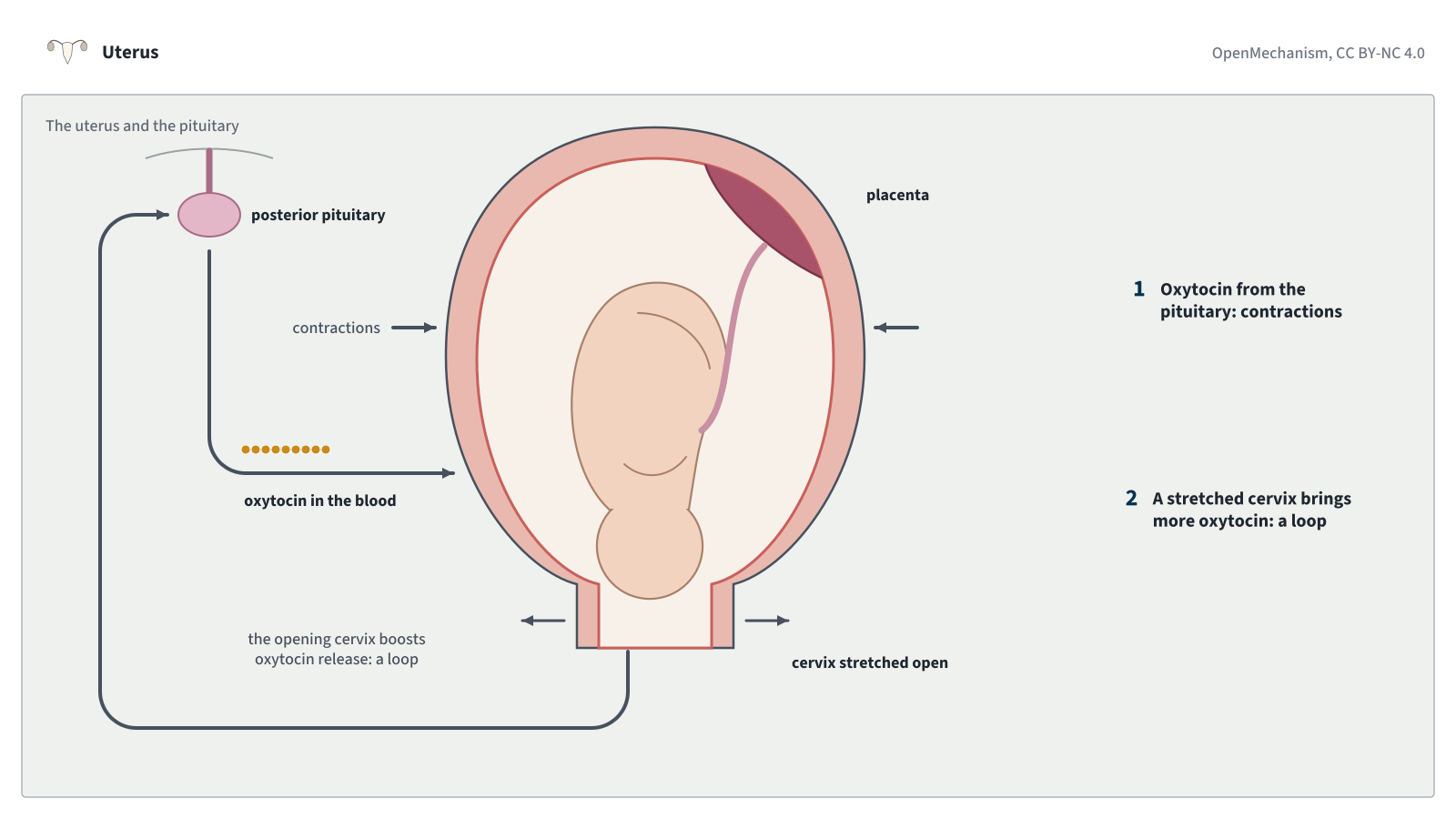
Oxytocin from the pituitary: contractions. Before labor the posterior pituitary releases more and more oxytocin, a hormone that makes the uterus contract; as labor nears, the contractions grow stronger.1
What the source says
“Meanwhile, the posterior pituitary has been boosting its secretion of oxytocin, a hormone that stimulates the contractions of labor.”
A stretched cervix brings more oxytocin: a loop. Labor runs as a positive feedback loop: contractions stretch the cervix and open it, and its opening makes the pituitary release more oxytocin, which brings stronger contractions.1
What the source says
“True labor progresses in a positive feedback loop in which uterine contractions stretch the cervix, causing it to dilate and efface, or become thinner.”
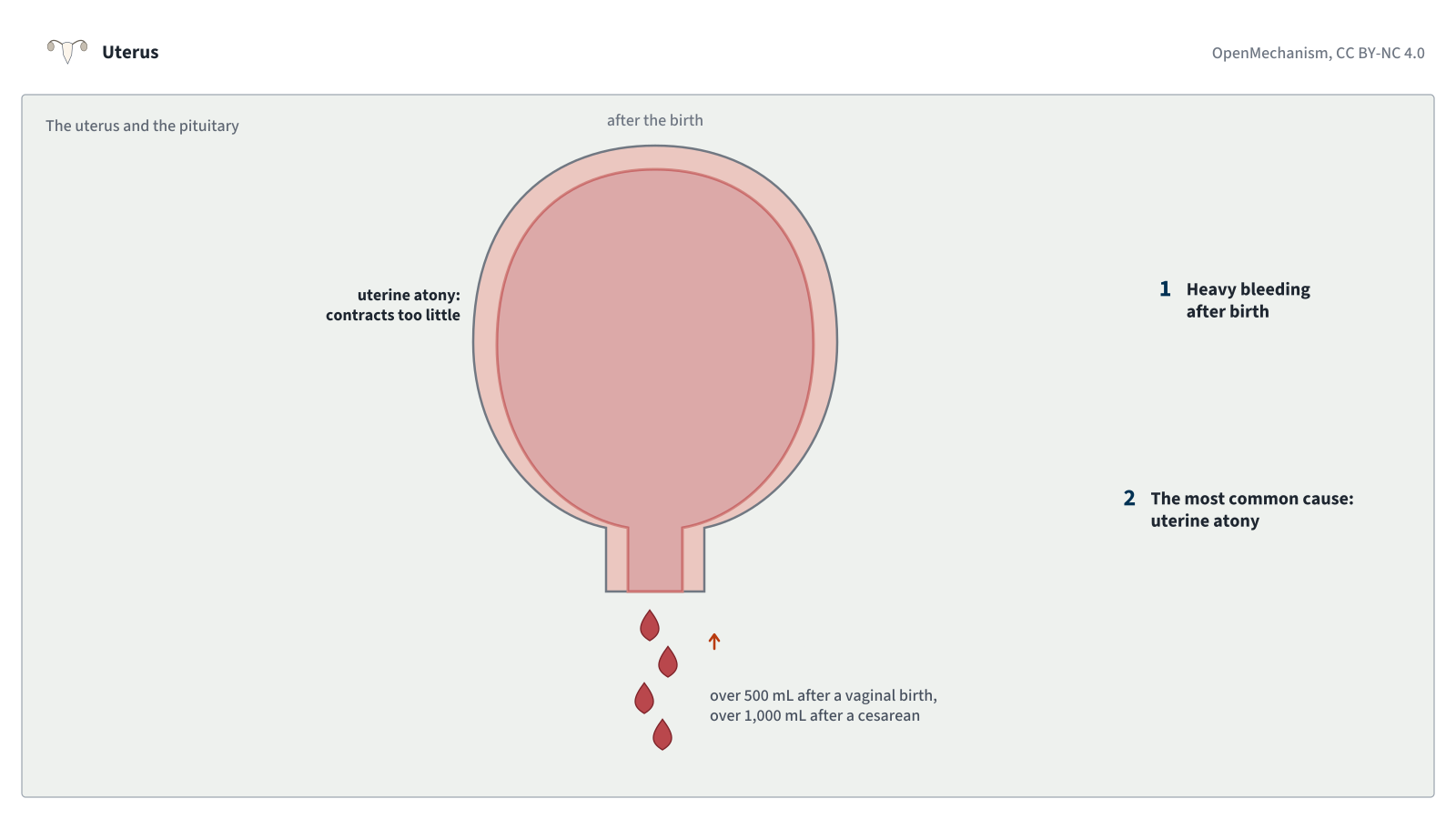
Heavy bleeding after birth. Postpartum hemorrhage is heavy bleeding after birth, defined in one review as a loss of more than 500 mL of blood after a vaginal birth, or more than 1,000 mL after a cesarean.2
What the source says
“Defined as greater than 500 mL blood loss after vaginal delivery, and greater than 1,000 mL blood loss after cesarean delivery”
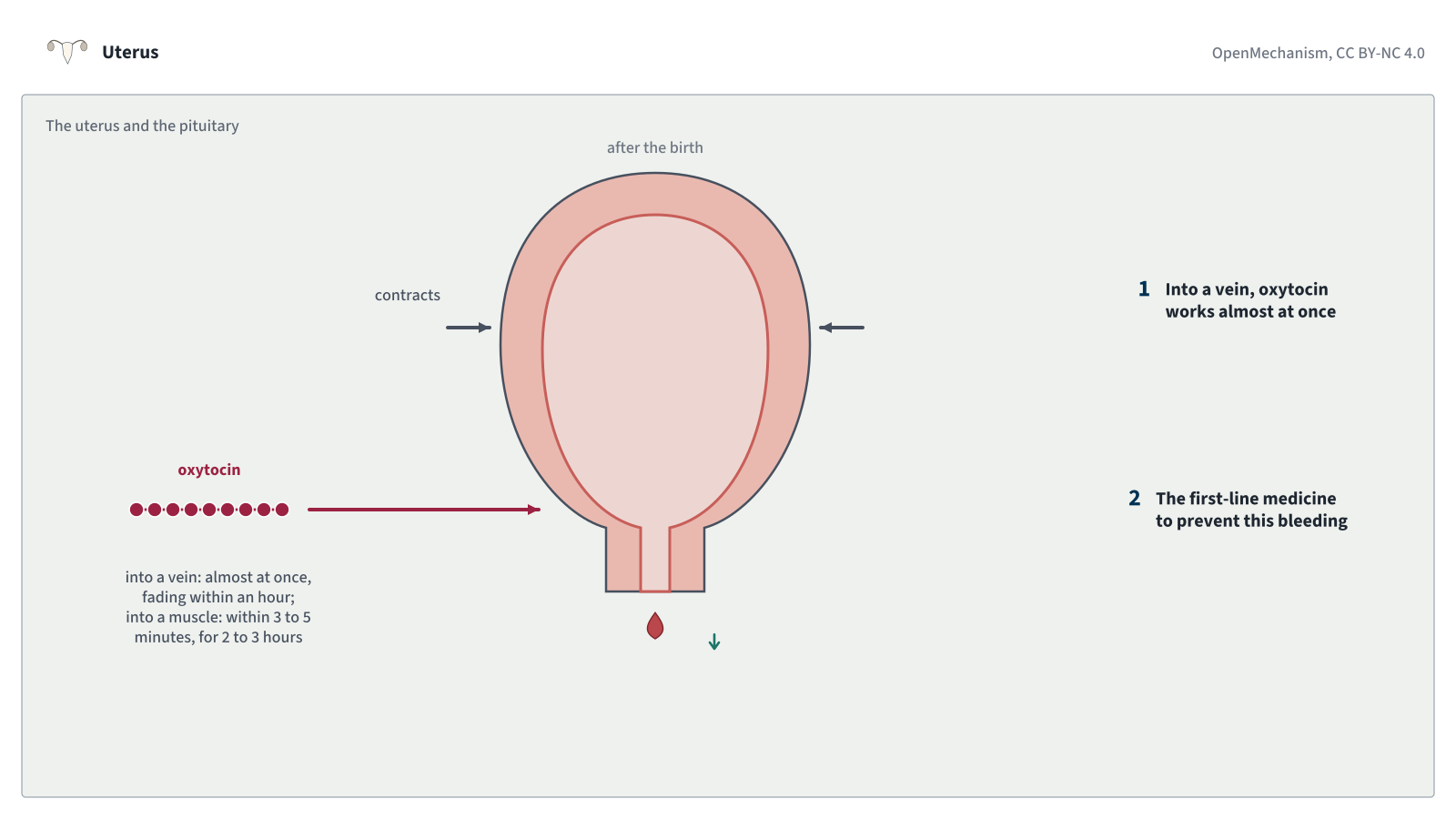
Into a vein, oxytocin works almost at once. Given into a vein, oxytocin makes the uterus respond almost at once, and the response fades within an hour; given into a muscle, it starts in 3 to 5 minutes and lasts 2 to 3 hours.4
What the source says
“Following intravenous administration of oxytocin, uterine response occurs almost immediately and subsides within 1 hour.”
The first-line medicine to prevent this bleeding. In the United States oxytocin is the first-line medicine for making the uterus contract to prevent heavy bleeding after birth, and the evidence for it is strong.3
What the source says
“Evidence is strong for the use of oxytocin, the first-line uterotonic agent in the United States for prevention of postpartum hemorrhage.”
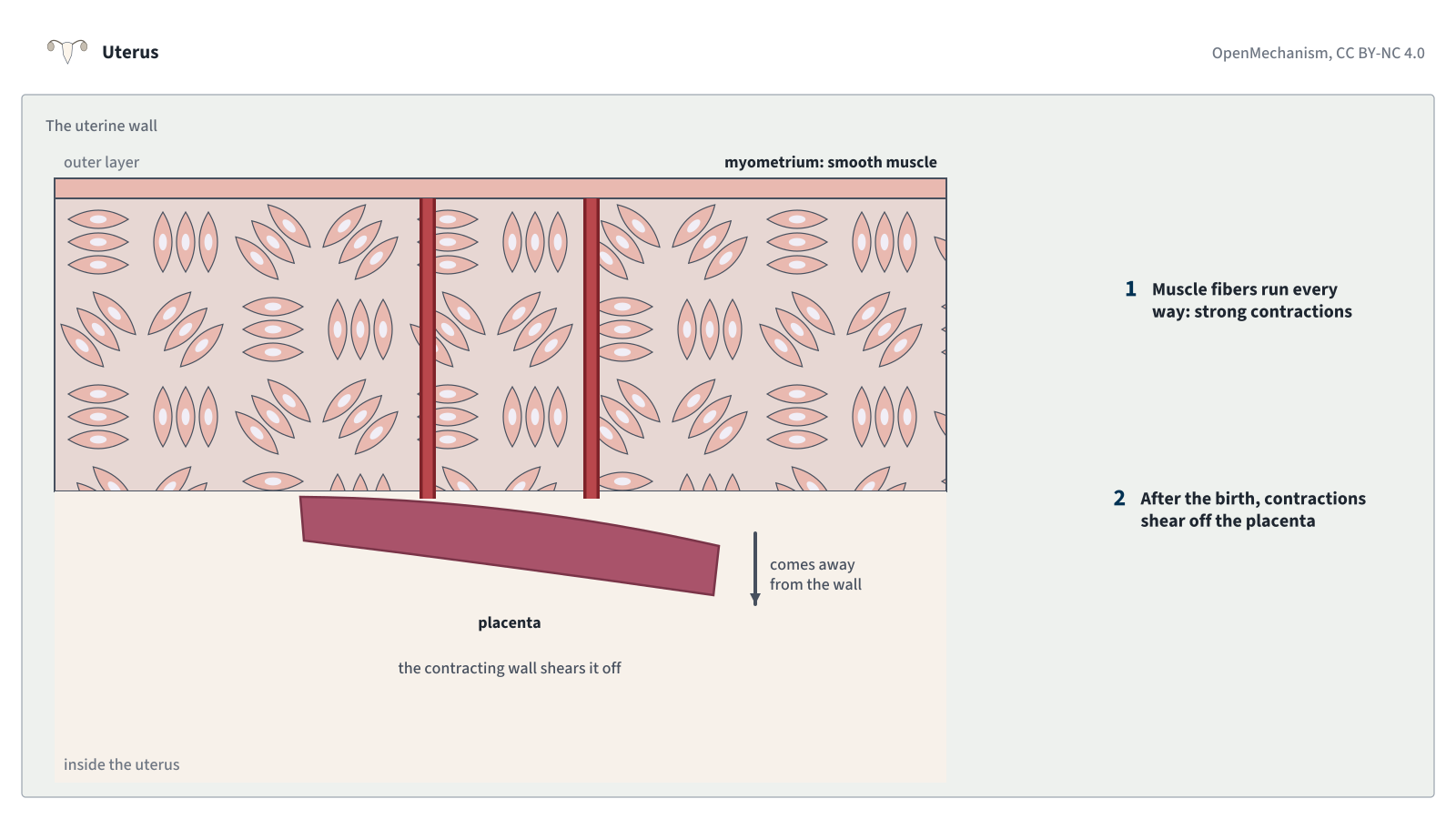
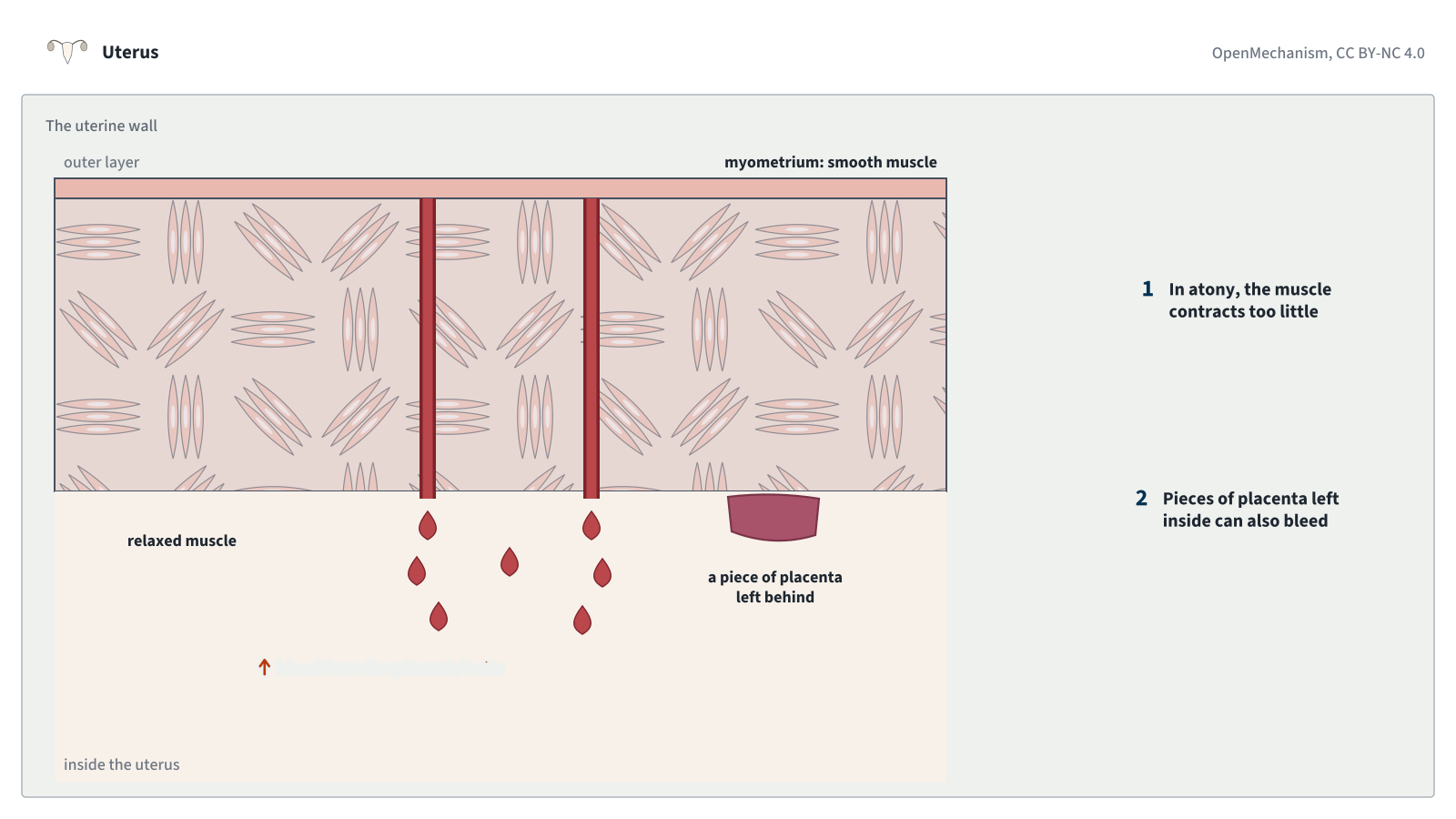
Muscle fibers run every way: strong contractions. Most of the uterine wall is the myometrium, a thick layer of smooth muscle whose fibers run horizontally, vertically and diagonally, which allows the powerful contractions of labor.5
What the source says
“The middle layer, or myometrium, is a thick layer of smooth muscle responsible for uterine contractions.”
“Most of the uterus is myometrial tissue, and the muscle fibers run horizontally, vertically, and diagonally, allowing the powerful contractions that occur during labor”
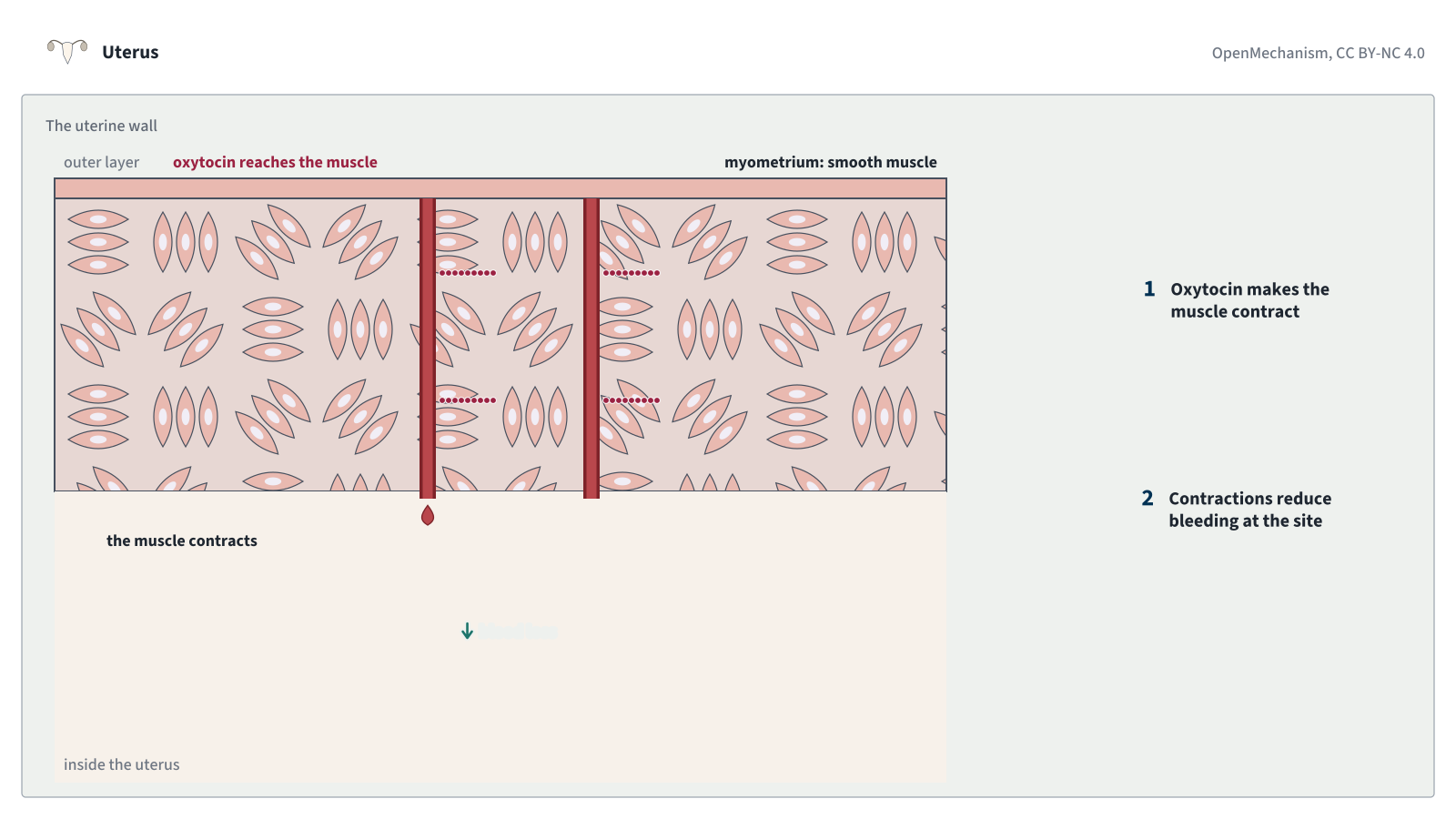
After the birth, contractions shear off the placenta. After the baby is born the muscle keeps contracting, and this shears the placenta off the uterine wall.1
What the source says
“After expulsion of the newborn, the myometrium continues to contract.”
Contractions reduce bleeding at the site. Contractions of the uterus after birth reduce the blood lost from the place where the placenta was attached.1
What the source says
“Continued uterine contractions then reduce blood loss from the site of the placenta.”
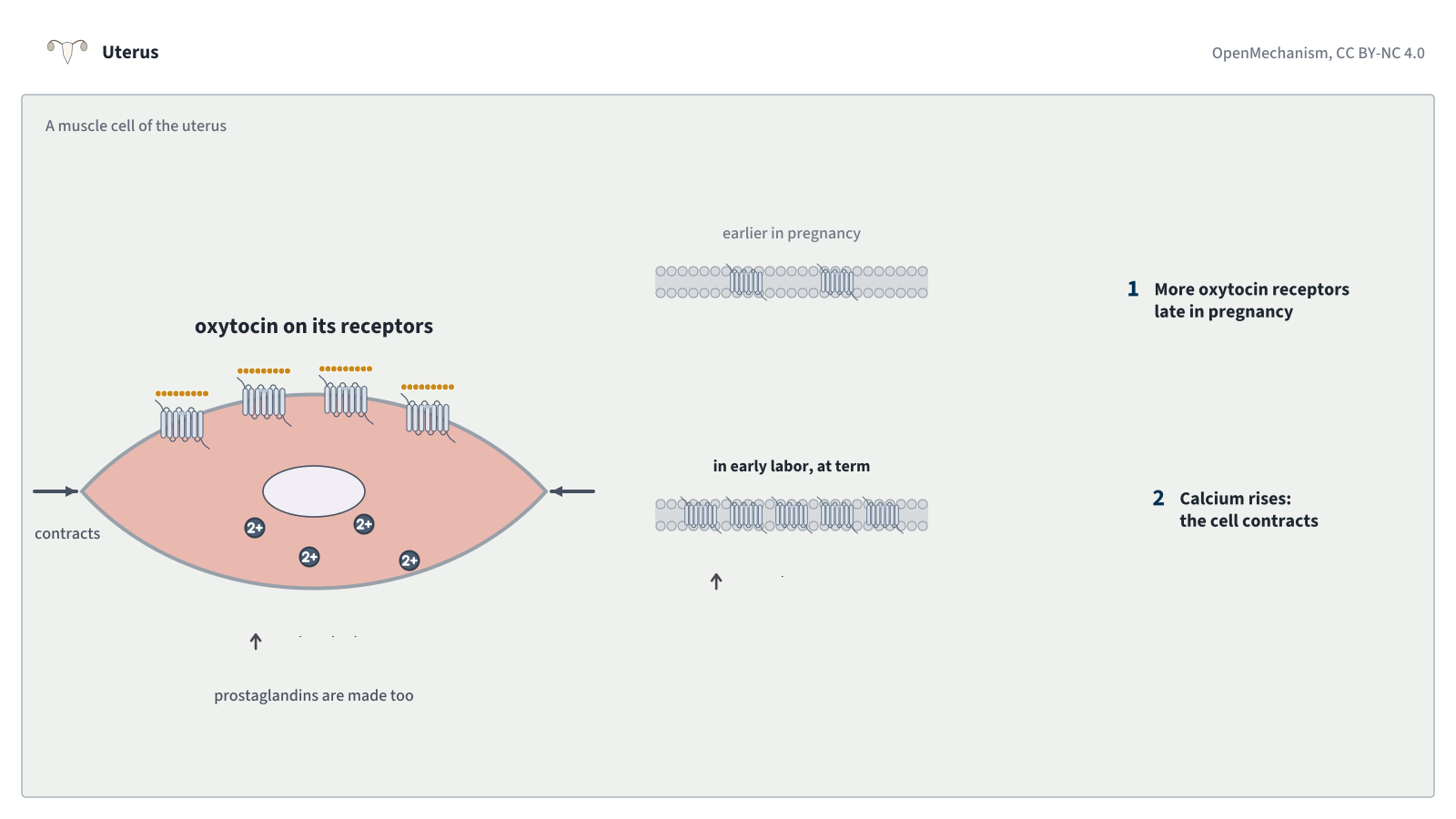
More oxytocin receptors late in pregnancy. The uterine muscle becomes more sensitive to oxytocin by making more receptors for it; their number rises greatly during pregnancy, to a peak in early labor at term.1,4
What the source says
“At the same time, the myometrium increases its sensitivity to oxytocin by expressing more receptors for this hormone.”
“Oxytocin has specific receptors in the myometrium and the receptor concentration increases greatly during pregnancy, reaching a maximum in early labor at term.”
Calcium rises: the cell contracts. Activating the oxytocin receptor makes the uterine muscle contract by raising the calcium inside its cells and the production of prostaglandins.7
What the source says
“Activation of oxytocin receptor causes myometrial contractions by increasing intracellular Ca(+2) and production of prostaglandins.”
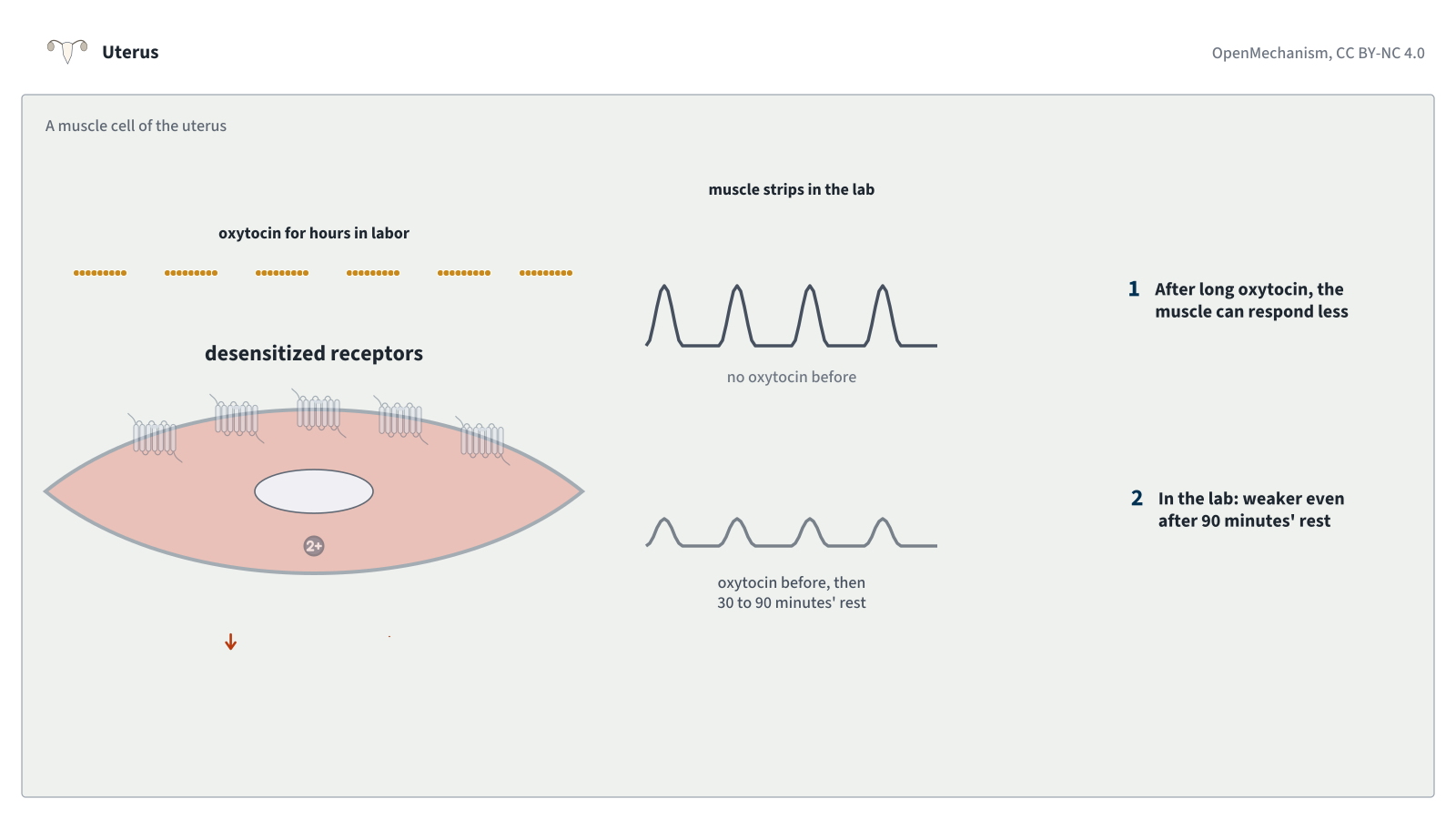
After long oxytocin, the muscle can respond less. Long exposure to oxytocin given to strengthen labor can desensitize the uterine muscle: it then responds less to more oxytocin.8
What the source says
“Prolonged exposure to oxytocin for labor augmentation can result in the desensitization phenomenon, a decrease in the responsiveness of myometrium to further oxytocin.”
In the lab: weaker even after 90 minutes' rest. In strips of uterine muscle from planned cesarean births, studied in the lab, oxytocin given beforehand weakened the contractions to more oxytocin, even after a rest of up to 90 minutes.8
What the source says
“Myometrial tissue was obtained from women undergoing elective cesarean deliveries.”
“Our study shows that oxytocin pretreatment attenuates oxytocin-induced contractility in human myometrium despite a rest period of up to 90 minutes after oxytocin administration.”
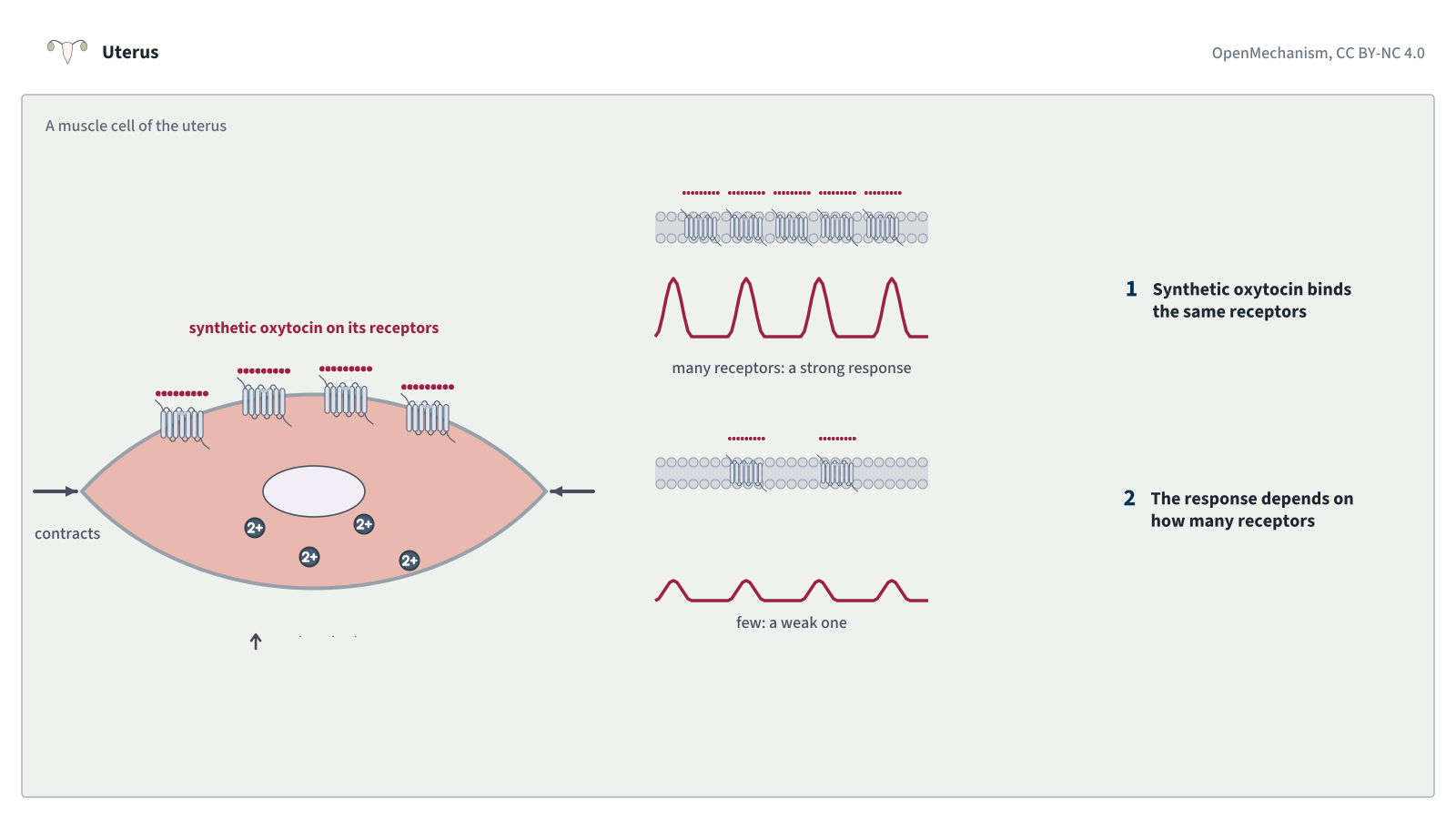
Synthetic oxytocin binds the same receptors. The medicine is synthetic oxytocin, and oxytocin acts through its own specific receptors in the uterine muscle.4
What the source says
“Pitocin (oxytocin injection, USP) is a sterile, clear, colorless aqueous solution of synthetic oxytocin, for intravenous infusion or intramuscular injection.”
The response depends on how many receptors. How strongly the uterus responds to a dose of oxytocin varies from person to person: it depends on the uterus's sensitivity, which is set by how many oxytocin receptors it has.4
What the source says
“The response to a given dose of oxytocin is very individualized and depends on the sensitivity of the uterus, which is determined by the oxytocin receptor concentration.”
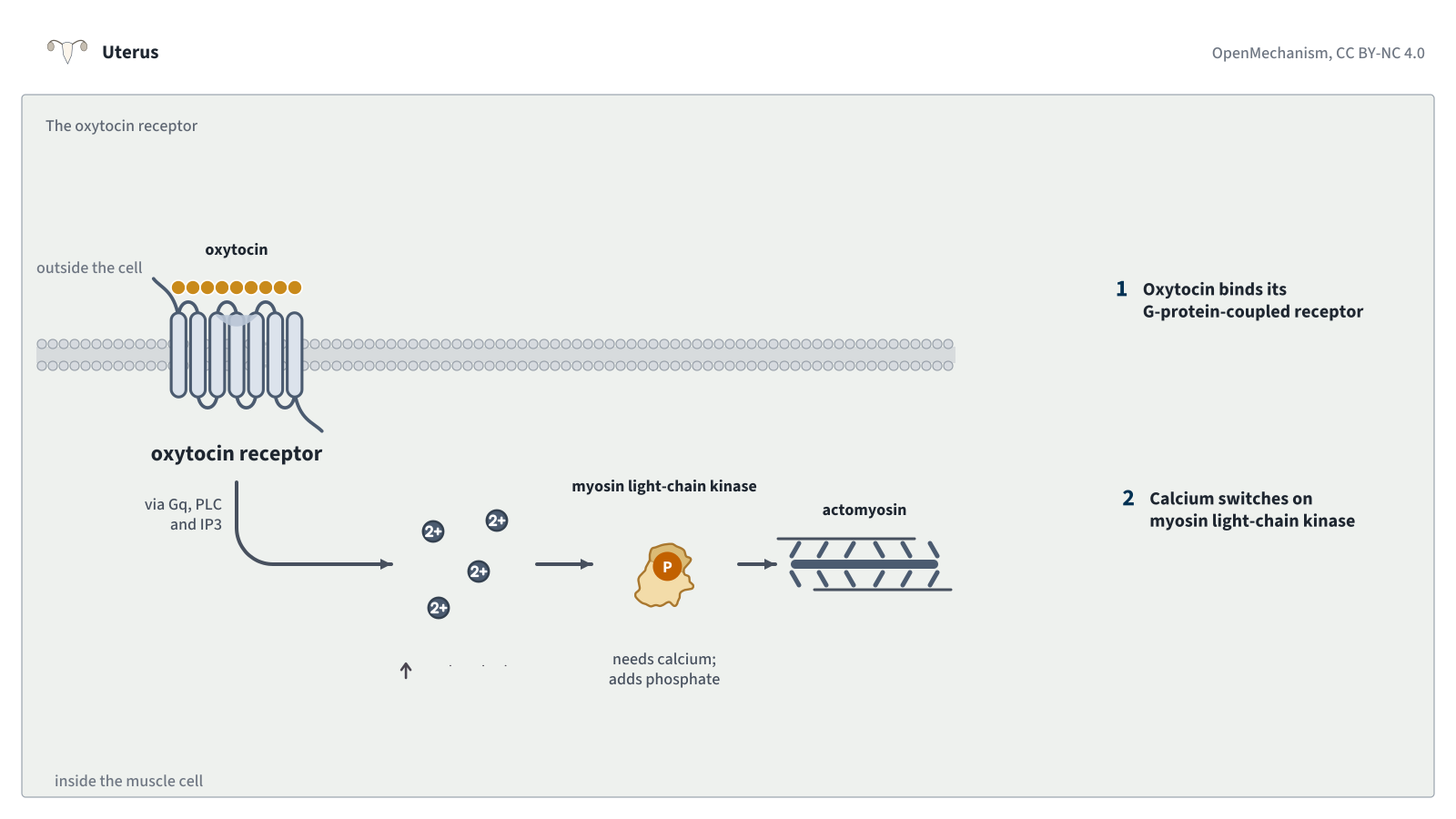
Oxytocin binds its G-protein-coupled receptor. Oxytocin acts through its own receptor, one of the ; in the uterine muscle it signals mainly through Gq, phospholipase C (PLC) and .7
What the source says
“It acts through its receptor, which belongs to the G-protein-coupled receptor superfamily, while Gq/phospholipase C (PLC)/inositol 1,4,5-triphosphate (InsP3) is the main pathway via which it exerts its action in the myometrium.”
Calcium switches on myosin light-chain kinase. The uterus contracts as actomyosin forms under myosin light-chain kinase, an enzyme that needs calcium and adds phosphate groups.4
What the source says
“Uterine motility depends on the formation of the contractile protein actomyosin under the influence of the Ca 2+- dependent phosphorylating enzyme myosin light-chain kinase.”
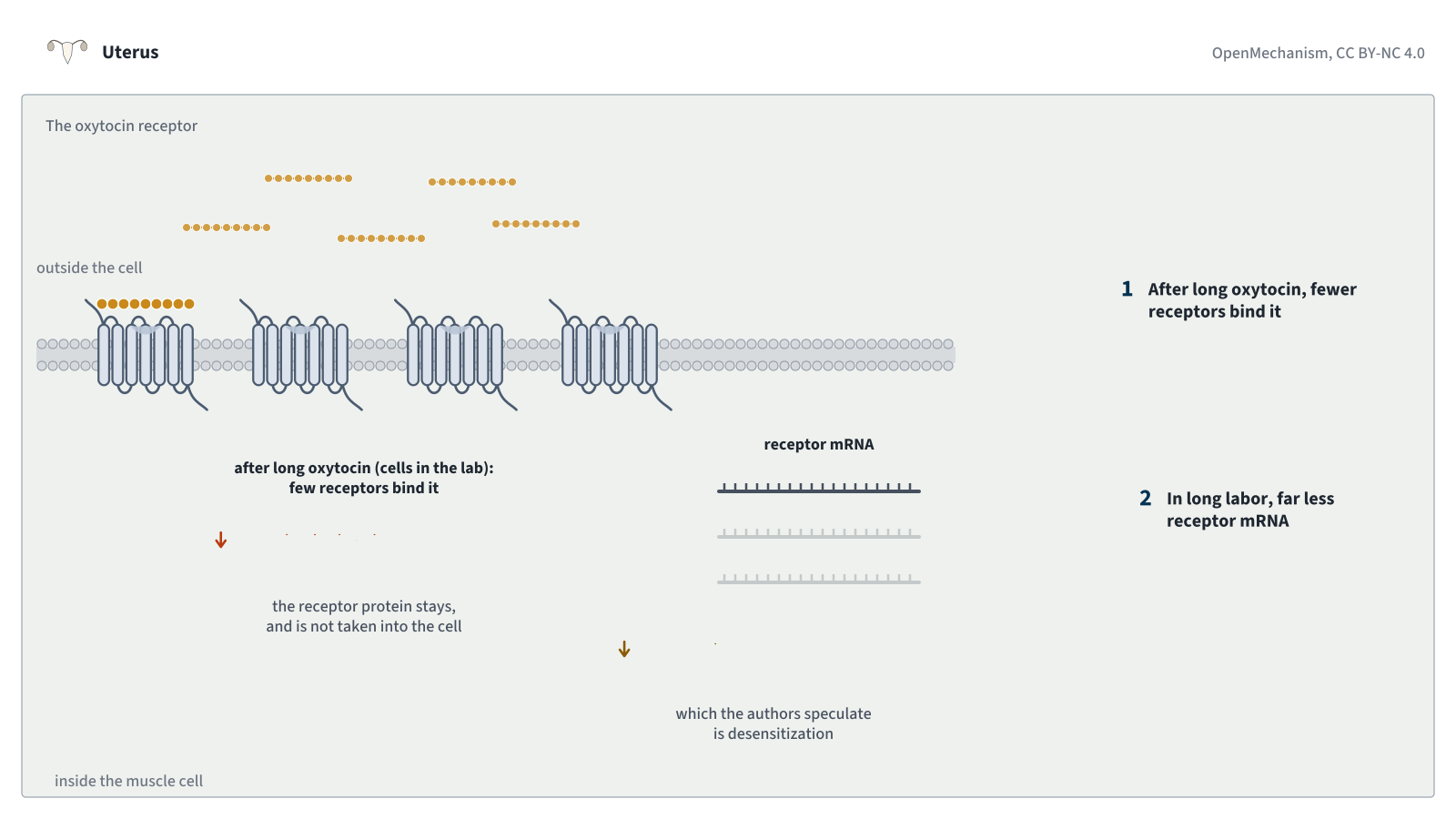
After long oxytocin, fewer receptors bind it. In uterine muscle cells grown in the lab, long exposure to oxytocin desensitized its receptors: the sites binding oxytocin fell from about 210,000 to 20,000 per cell within 20 hours, while the amount of receptor protein stayed the same and the receptors were not taken into the cell.9
What the source says
“Exposure of cultured myometrial cells to oxytocin for a prolonged period caused desensitization: the steady-state level of oxytocin binding was 210 x 10(3) binding sites/cell, but this was time-dependently reduced to 20.1 x 10(3) sites/cell by exposing the cells to oxytocin for up to 20 h.”
In long labor, far less receptor mRNA. In uterine muscle taken at emergency cesareans, the receptor's fell as labor went on: after 12 hours of labor it was about 50 times lower than in labors under 12 hours. The authors speculate that this is desensitization in the body.9
What the source says
“Analysis of this mRNA in myometrial biopsies from 17 patients undergoing emergency Caesarean section showed how it decreased with advancing labour.”
“Samples obtained after 12 h of labour contained approximately 50 times less OTR mRNA than samples obtained from patients in labour for less than 12 h.”
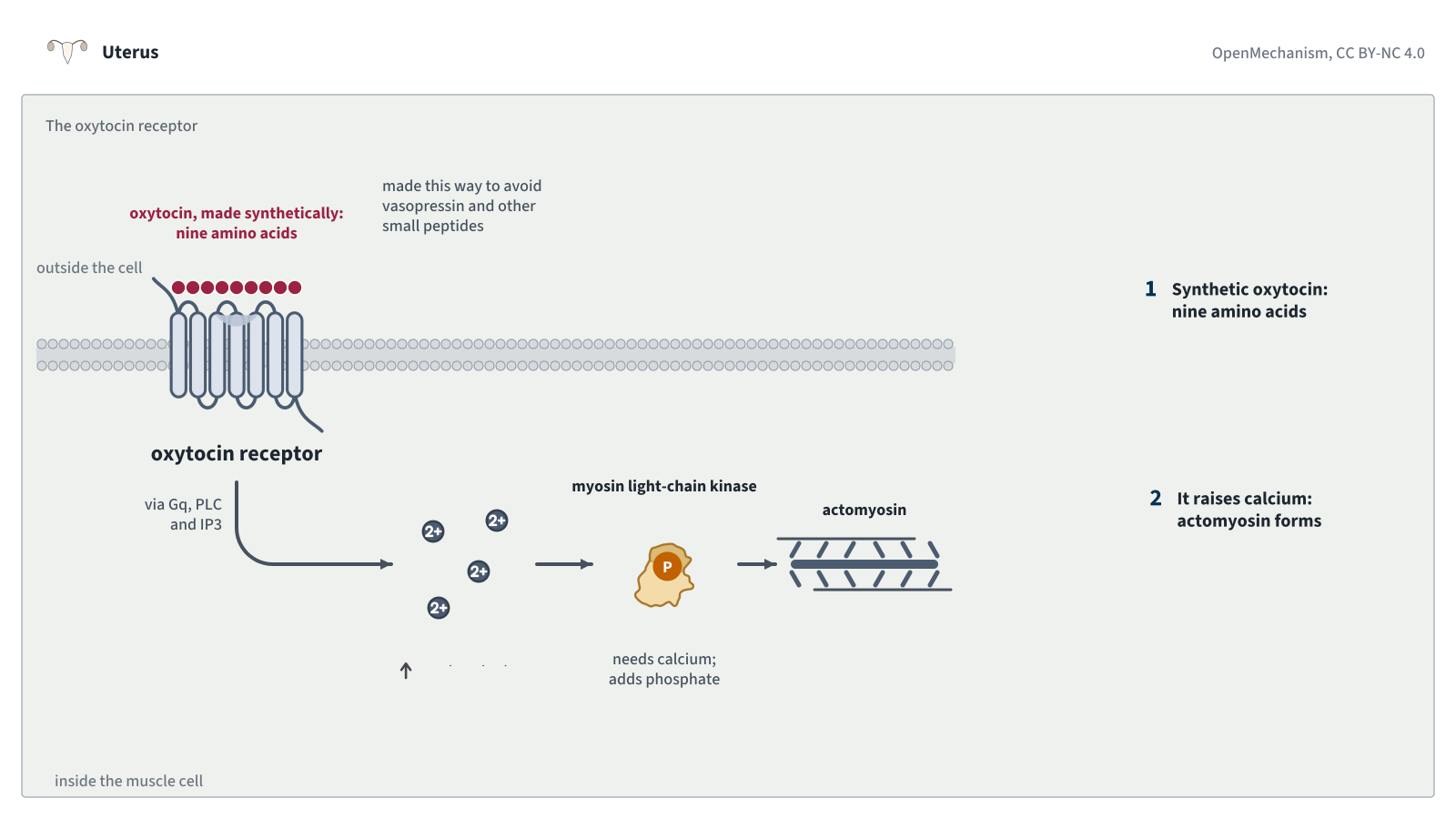
Synthetic oxytocin: nine amino acids. The medicine is oxytocin made synthetically: a peptide of nine amino acids, made this way to avoid contamination with vasopressin and other small peptides.4
What the source says
“Pitocin is a nonapeptide found in pituitary extracts from mammals.”
It raises calcium: actomyosin forms. Oxytocin promotes contractions by raising the calcium inside the muscle cells, where actomyosin forms under the calcium-dependent myosin light-chain kinase.4
What the source says
“Oxytocin promotes contractions by increasing the intracellular Ca 2+”
“Uterine motility depends on the formation of the contractile protein actomyosin under the influence of the Ca 2+- dependent phosphorylating enzyme myosin light-chain kinase.”
Heavy bleeding after birth has other causes besides atony, such as tears in the birth canal, clotting problems and an abnormally attached placenta; the drawings show atony and pieces of placenta left behind.2
The cell and molecule views of the bleeding show desensitization, measured in uterine muscle in the lab and in tissue taken at cesarean births; whether a rest after oxytocin restores the response is not yet known.8
Oxytocin is also used before birth, to start labor when there is a medical reason or to strengthen it; it is not for starting labor without one.4
The drawings are schematic and not to scale; each shows only what the statements under it say.
Tran D. Labor and after birth [Internet]. OpenMechanism; 2026 [updated 2026 Nov 13; cited 2026 Nov 13]. Available from: https://openmechanism.com/body/scales/uterus