Heavy bleeding after birth
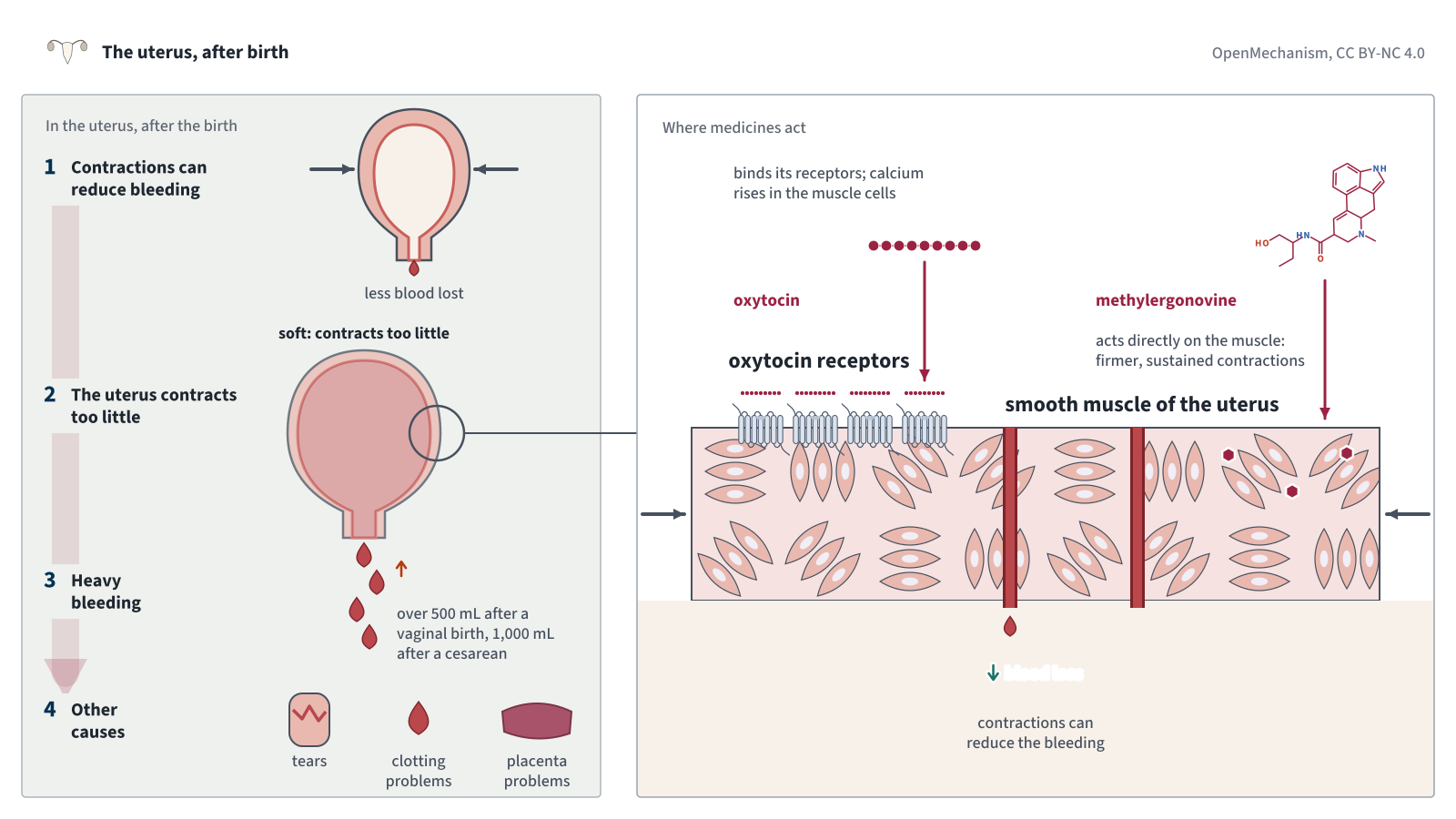
Postpartum hemorrhage, heavy bleeding after birth, is the leading cause of illness and death in mothers worldwide. After delivery the uterus keeps contracting, which can reduce bleeding; most often the bleeding comes from a uterus that contracts too little (uterine atony). Oxytocin and methylergonovine make the uterine muscle contract.
- Where
- The uterus, after birth
- Body system
- Bladder & reproductive organs
- Medicines
- 2 medicines
For teachers: download this drawing.
What goes wrong
Contractions can reduce bleeding. After the baby is born, the muscle of the uterus keeps contracting: it shears the placenta off the uterine wall, and in this third stage of labor the contractions can reduce bleeding.1,2
What the source says
“Normal placenta delivery requires adequate uterine contractions, with shearing of the placenta and decidua from the uterine wall and expulsion of the tissue.”
Source 1“Oxytocin and prostaglandin are hormones responsible for uterine contraction during the third stage of labour.”
Source 2“uterine contractions can reduce bleeding during the third stage of labour.”
Source 2The uterus contracts too little. In uterine atony the muscle of the uterus contracts too little. It is the most common cause of postpartum hemorrhage, estimated at 70 to 80% of cases.3,4
Heavy bleeding. Postpartum hemorrhage is heavy bleeding after birth, defined in one review as a loss of more than 500 mL of blood after a vaginal birth, or more than 1,000 mL after a cesarean.5
What the source says
“Defined as greater than 500 mL blood loss after vaginal delivery, and greater than 1,000 mL blood loss after cesarean delivery”
Source 5Other causes. It has other causes too: tears in the lower birth canal, problems with clotting, and problems with the placenta; pieces of placenta left in the uterus can lead to delayed bleeding.1,5
What the source says
“PPH has many causes, including uterine atony, lower genital tract lacerations, coagulopathy, and placental anomalies.”
Source 5“Complications can include major hemorrhage, endometritis, or retained portions of placental tissue, the latter of which can lead to delayed hemorrhage or infection.”
Source 1
Where medicines act
The muscle of the uterus
- A
Oxytocin targets Oxytocin receptors
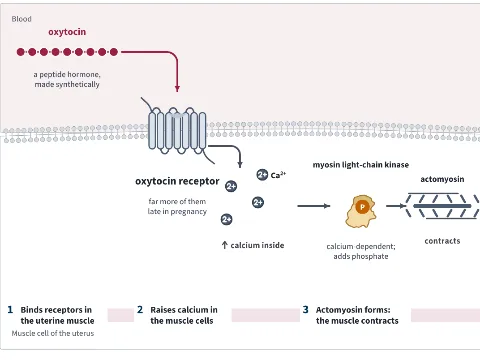
Binds its receptors in the uterine muscle and raises the calcium inside the muscle cells, so the uterus contracts.4,6
Used forBleeding after birth: to produce contractions in the third stage of labor and control the bleeding
What the label says
“Oxytocin has specific receptors in the myometrium”
Source 6“Oxytocin promotes contractions by increasing the intracellular Ca 2+”
Source 6“Postpartum: Pitocin is indicated to produce uterine contractions during the third stage of labor and to control postpartum bleeding or hemorrhage.”
Source 6“Evidence is strong for the use of oxytocin, the first-line uterotonic agent in the United States for prevention of postpartum hemorrhage.”
Source 4 - B
Methylergonovine targets Uterine smooth muscle
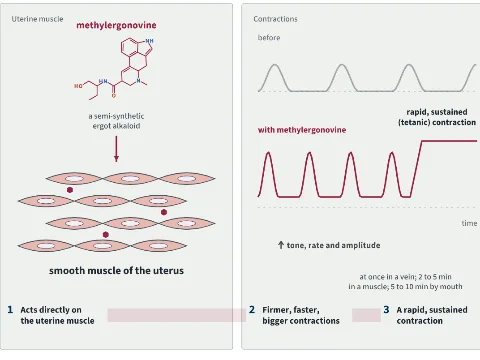
Acts directly on the uterine muscle: firmer, faster, stronger contractions, then a sustained one that reduces blood loss.7
Used forAtony and bleeding: after the placenta is deliveredBleeding in the second stage of labor: after the front shoulder is delivered
What the label says
“Methylergonovine maleate acts directly on the smooth muscle of the uterus and increases the tone, rate, and amplitude of rhythmic contractions.”
Source 7“Thus, it induces a rapid and sustained tetanic uterotonic effect which shortens the third stage of labor and reduces blood loss.”
Source 7“Following delivery of the placenta, for routine management of uterine atony, hemorrhage and subinvolution of the uterus.”
Source 7“For control of uterine hemorrhage in the second stage of labor following delivery of the anterior shoulder.”
Source 7
See also
Body system: bladder & reproductive organs.
Zoom in: labor and after birth.
Other conditions: heavy menstrual bleeding; and preeclampsia and eclampsia.
Sources
- 1Retained placenta after vaginal delivery: risk factors and managementPerlman NC, Carusi DA. Int J Womens Health 2019 (abstract). Saved copy
- 2Breastfeeding or nipple stimulation for reducing postpartum haemorrhage in the third stage of labourAbedi P et al. Cochrane Database Syst Rev 2016 (abstract). Saved copy
- 3Primary and secondary postpartum haemorrhage: a review for a rationale endovascular approachAlonso-Burgos A et al. CVIR Endovasc 2024 (abstract). Saved copy
- 4Preventing postpartum hemorrhage with combined therapy rather than oxytocin aloneJones AJ et al. Am J Obstet Gynecol MFM 2023 (abstract). Saved copy
- 5Pelvic artery embolization for treatment of postpartum hemorrhageLindquist JD, Vogelzang RL. Semin Intervent Radiol 2018 (abstract). Saved copy
- 6Pitocin (oxytocin injection): FDA labelIndications and Usage; Description; Clinical Pharmacology. Saved copy
- 7Methylergonovine maleate injection (Breckenridge): FDA labelIndications and Usage; Clinical Pharmacology. Saved copy
Notes and limits
- A 2023 review calls methylergonovine, misoprostol and carboprost second-line medicines: given with oxytocin, they lower the risk of this bleeding more than oxytocin alone. It also says tranexamic acid has been found to be effective and safe in lowering deaths in women with postpartum hemorrhage.4
- Medicines are not the only treatment: balloon tamponade, pelvic artery embolization and surgery that keeps the uterus are also used, and the uterus is removed when these fail.5
Notes that apply to every page are on How to read a page.
Spotted a mistake? Report an error (hello@openmechanism.com). Since launch, every published error we fix is listed on the corrections page.
Cite this page
Tran D. Heavy bleeding after birth [Internet]. OpenMechanism; 2026 [updated 2026 Nov 18; cited 2026 Nov 18]. Available from: https://openmechanism.com/conditions/postpartum-hemorrhage