Testosterone
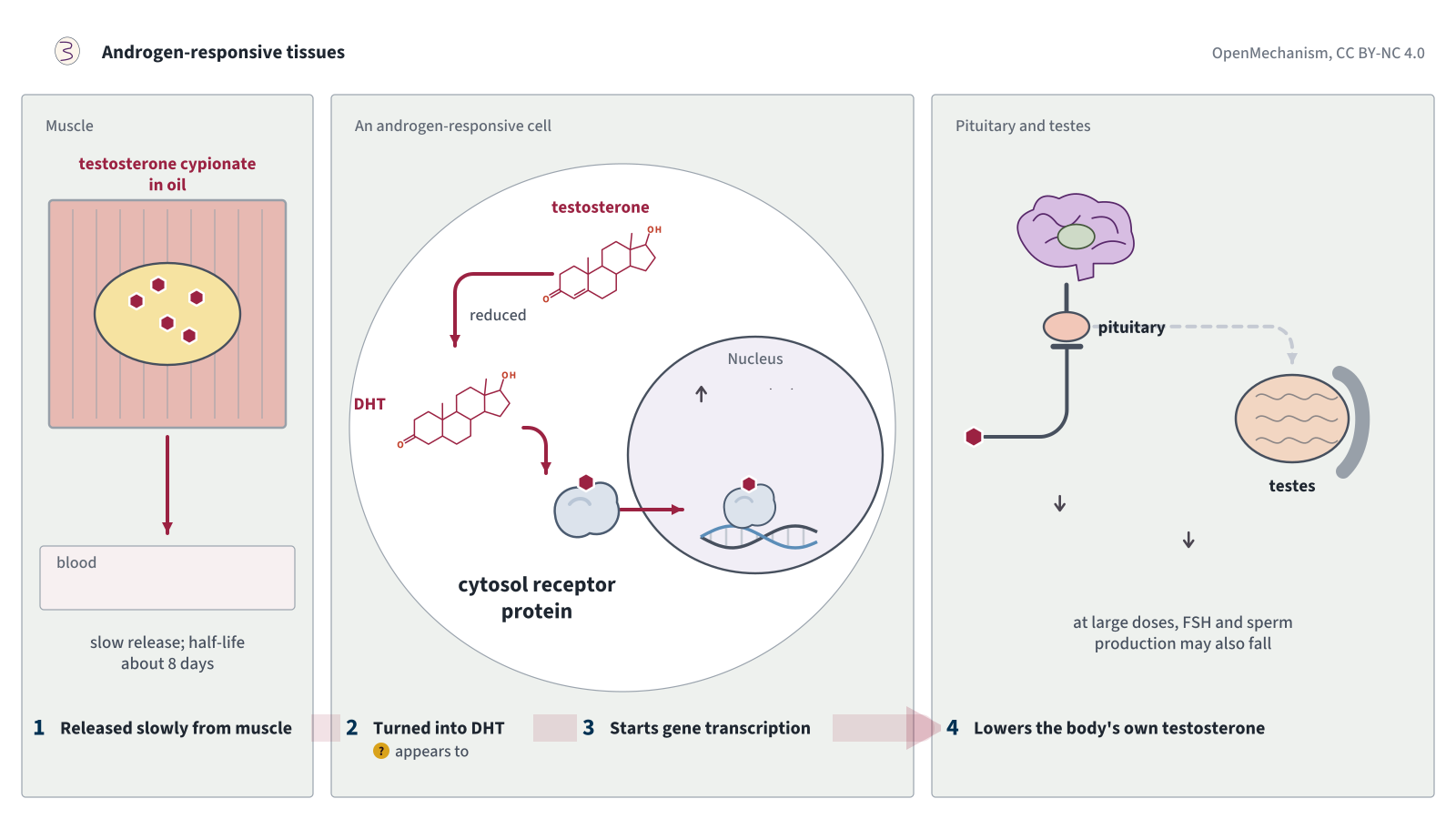
Testosterone cypionate, injected into muscle, is released slowly from its oil. In many tissues testosterone appears to act after being converted to (DHT), which binds its receptor; the complex moves into the nucleus and starts transcription and the cellular changes of androgen action. The added hormone also lowers pituitary , so the body's own testosterone falls. The Depo-Testosterone label lists it for replacement therapy in males with symptoms of too little or no testosterone of their own, from primary hypogonadism (testicular failure) or hypogonadotropic hypogonadism, and says its safety and efficacy in men with age-related (late-onset) hypogonadism have not been established.
- Acts on
- Androgen receptors (cytosol receptor proteins), in many tissues apparently via dihydrotestosterone
- Where
- Androgen-responsive tissues; the pituitary
- Medicine type
- Small molecule
- Used for
- Urinary & reproductive
Also called Depo-Testosterone (testosterone cypionate injection).
Step 2: appears to
The Depo-Testosterone label says: In many tissues the activity of testosterone appears to depend on reduction to dihydrotestosterone, which binds to cytosol receptor proteins.
Study: In a 2012 randomized controlled trial in 139 healthy men aged 18 to 50 whose own testosterone production was suppressed, given testosterone enanthate (not this page's cypionate) at 50, 125, 300 or 600 mg a week for 20 weeks, plus placebo or dutasteride 2.5 mg a day (which blocks conversion to DHT): Changes in fat-free mass in response to graded testosterone doses did not differ in men in whom DHT was suppressed by dutasteride from those treated with placebo, indicating that conversion of testosterone to DHT is not essential for mediating its anabolic effects on muscle.
Bhasin S et al., JAMA 2012 (PMID 22396515)
Key terms in this drawing
- DHT
- Dihydrotestosterone. An androgen that the enzyme 5α-reductase makes from testosterone; finasteride blocks its type II form.
- FSH
- Follicle-stimulating hormone. One of the gonadotropins, the pituitary hormones whose release estrogens hold back by negative feedback; large doses of added androgens may hold back FSH too. LH is the other.
- half-life
- Half-life. The time it takes for the amount in the blood to fall by half.
How it works
Released slowly from muscle. Testosterone cypionate, an ester in oil injected into muscle, is absorbed slowly from the oil; its is about eight days, and in the body the ester is split (hydrolyzed) to free testosterone.1,2
Turned into DHT. In many tissues, testosterone's activity appears to depend on its reduction to dihydrotestosterone (DHT), which binds to cytosol receptor proteins.1
Starts gene transcription. The steroid-receptor complex is transported to the nucleus, where it starts transcription and the cellular changes of androgen action.1
Lowers the body's own testosterone. During androgen treatment, the body's own testosterone release is inhibited through feedback on pituitary LH; at large doses, sperm production may also be suppressed through feedback on .1
For teachers: download this drawing.
See also
Condition pages: low testosterone (male hypogonadism).
Other sex hormones (estrogens, progestins, androgens): estradiol; norethindrone and ethinyl estradiol; and progesterone.
Body system: bladder & reproductive organs.
Sources
- 1Depo-Testosterone (testosterone cypionate): FDA labelIndications and Usage; Description; Clinical Pharmacology
- 2Testosterone enanthate injection: FDA labelDescription
- 3ChEMBL CHEMBL386630Target and action classification: Androgen Receptor agonist
- 4
Spotted a mistake? Report an error (hello@openmechanism.com). Since launch, every published error we fix is listed on the corrections page.
Notes and limits
- A schematic teaching drawing: not to scale, not exact structures, binding poses or a complete pathway, and not a guide to dosing, treatment or how a person will respond.
- The steps are in the order that explains them; one step is said to cause the next only where the source says so.
- The label says that in many tissues the activity of testosterone appears to depend on reduction to dihydrotestosterone.
All recorded limits are on the evidence page, and notes that apply to every page are on How to read a page. Version 1.0.1, medically reviewed by Daniel Tran, PharmD, on 14 November 2026.
Cite this page
Tran D. Testosterone [Internet]. OpenMechanism; 2026 [updated 2026 Nov 14; cited 2026 Nov 14]. Available from: https://openmechanism.com/medicines/testosterone