Tadalafil
During sexual stimulation, raises in smooth muscle, which relaxes it and lets blood flow into the penis. Tadalafil blocks , the enzyme that breaks cGMP down, so more cGMP builds up; without sexual stimulation it has no effect on erection. cGMP also rises in the prostate and bladder, but the label says the mechanism for reducing the symptoms of an enlarged prostate has not been established. The Cialis label lists it for erectile dysfunction (ED), for the signs and symptoms of an enlarged prostate (), and for both together; when it is used with finasteride to start BPH treatment, the label says its added benefit falls from 4 to 26 weeks and is unknown beyond 26 weeks.
- Acts on
- cGMP-specific phosphodiesterase type 5 (PDE5)
- Where
- Smooth muscle of the penis, prostate and bladder
- Medicine type
- Small molecule
- Used for
- Urinary & reproductive
- Drug class
- PDE5 inhibitors
Also called Cialis.
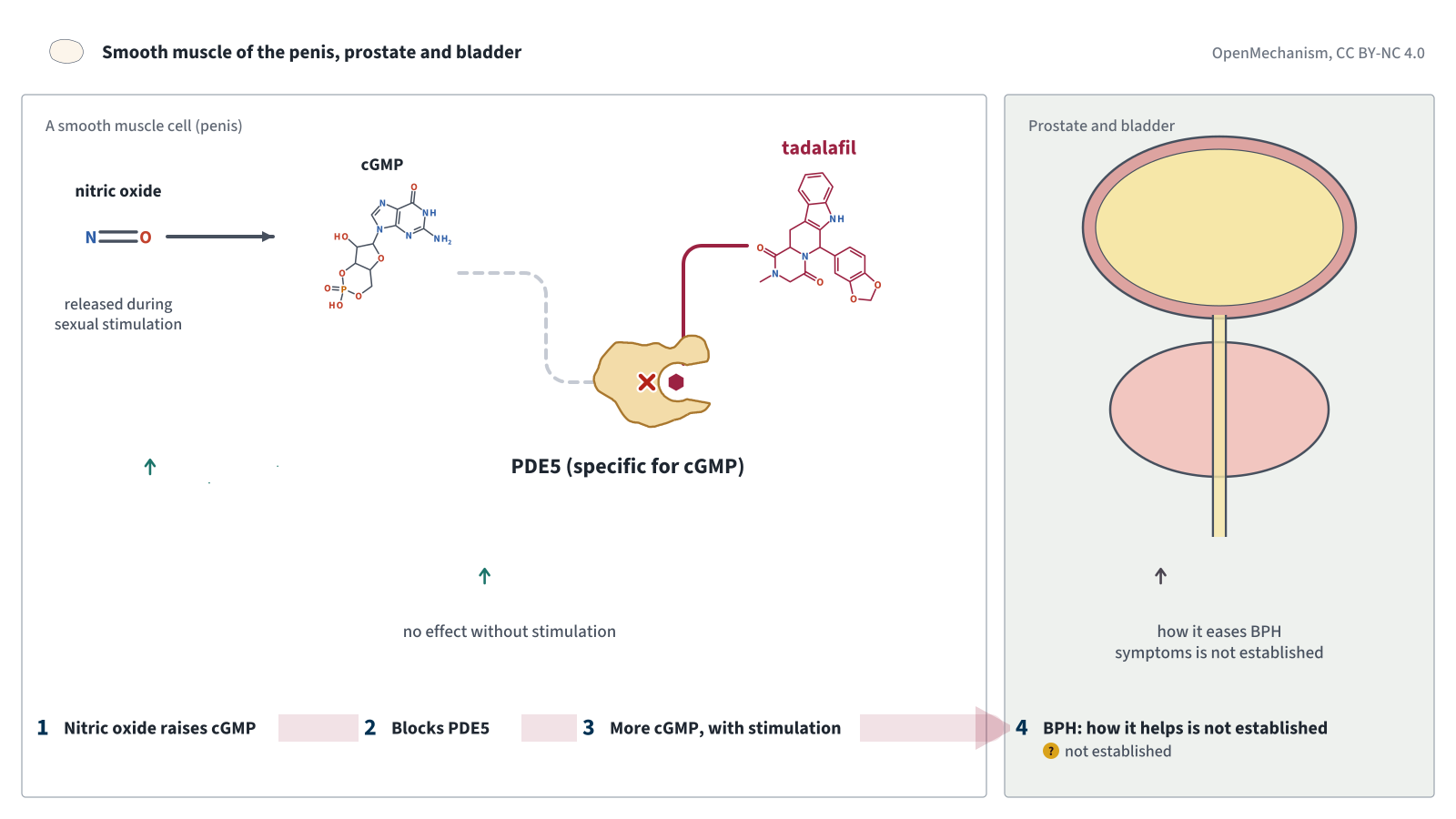
Step 4: not established
The Cialis label says: The mechanism for reducing BPH symptoms has not been established.
Source 1: Cialis (tadalafil): FDA label, 1 Indications and Usage; 11 Description; 12.1 Mechanism of Action
Clinical study: In a 2010 randomized, double-blind, placebo-controlled trial of tadalafil 20 mg once a day for 12 weeks in men with BPH symptoms, bladder pressure and flow did not differ significantly from placebo, yet symptoms improved: Urodynamic measures remained largely unchanged during the study with no statistically significant or clinically adverse difference between tadalafil and placebo in change in detrusor pressure at maximum urinary flow rate (mean difference between treatments -2.2 cm H(2)O, p = 0.33) or any other urodynamic parameter assessed including maximum urinary flow rate, maximum detrusor pressure, bladder outlet obstruction index or bladder capacity (all measures p > or = 0.13). Treatment with tadalafil resulted in significant improvements in International Prostate Symptom Score (mean difference between treatments -4.2, p < 0.001).
Dmochowski R et al., J Urol 2010 (PMID 20092847)
Key terms in this drawing
- BPH
- Benign prostatic hyperplasia. Enlargement of the prostate, as its stromal and epithelial cells multiply.
- cGMP
- Cyclic guanosine monophosphate. A molecule that rises in smooth muscle when nitric oxide activates guanylate cyclase; the rise leads the vessels to widen.
- NO
- Nitric oxide. A signal molecule released by nerve endings and the cells lining blood vessels; it makes smooth muscle cells produce cGMP.
- PDE5
- Phosphodiesterase type 5. An enzyme that breaks down cGMP in smooth muscle.
How it works
Nitric oxide raises cGMP. During sexual stimulation, nitric oxide released from nerve terminals and endothelial cells stimulates cGMP synthesis in smooth muscle cells; cGMP relaxes the muscle and increases blood flow into the corpus cavernosum.1
Blocks PDE5. Tadalafil is a selective inhibitor of the cGMP-specific phosphodiesterase type 5 (PDE5), the enzyme that breaks down cGMP in the corpus cavernosum.1,2
More cGMP, with stimulation. Inhibiting PDE5 enhances erectile function by increasing cGMP; because sexual stimulation is needed to release nitric oxide, it has no effect without stimulation.1
BPH: how it helps is not established. The same rise in cGMP occurs in the smooth muscle of the prostate, the bladder and their blood vessels; the label says the mechanism for reducing BPH symptoms has not been established.1
For teachers: download this drawing.
See also
Condition pages: enlarged prostate (BPH) and erectile dysfunction.
Other PDE5 inhibitors: sildenafil.
Explained: nitrates and PDE5 inhibitors such as sildenafil; and PDE5 inhibitors and alpha-blockers.
Body system: bladder & reproductive organs.
Sources
- 1Cialis (tadalafil): FDA label1 Indications and Usage; 11 Description; 12.1 Mechanism of Action
- 2Viagra (sildenafil citrate): FDA label12.1 Mechanism of Action
- 3ChEMBL CHEMBL779Target and action classification: Phosphodiesterase 5A inhibitor
- 4
Also used for the drawing
The PDE5 outline is traced from the crystal structure below.
- 5The catalytic domain of human phosphodiesterase 5 (PDE5) with tadalafilPDB 1UDU; Sung, B.-J. et al. Nature 2003; 425:98-102
Spotted a mistake? Report an error (hello@openmechanism.com). Since launch, every published error we fix is listed on the corrections page.
Notes and limits
- A schematic teaching drawing: not to scale, not exact structures, binding poses or a complete pathway, and not a guide to dosing, treatment or how a person will respond.
- The steps are in the order that explains them; one step is said to cause the next only where the source says so.
- The label says lab (in vitro) studies show tadalafil is selective for PDE5, but that in vitro it also inhibits PDE11A1, and to a lesser degree PDE11A4, at concentrations within the therapeutic range; it says the role and clinical consequence of PDE11 inhibition in people have not been defined.
- The label says the mechanism for reducing BPH symptoms has not been established.
All recorded limits are on the evidence page, and notes that apply to every page are on How to read a page. Version 1.0.1, medically reviewed by Daniel Tran, PharmD, on 14 November 2026.
Cite this page
Tran D. Tadalafil [Internet]. OpenMechanism; 2026 [updated 2026 Nov 14; cited 2026 Nov 14]. Available from: https://openmechanism.com/medicines/tadalafil