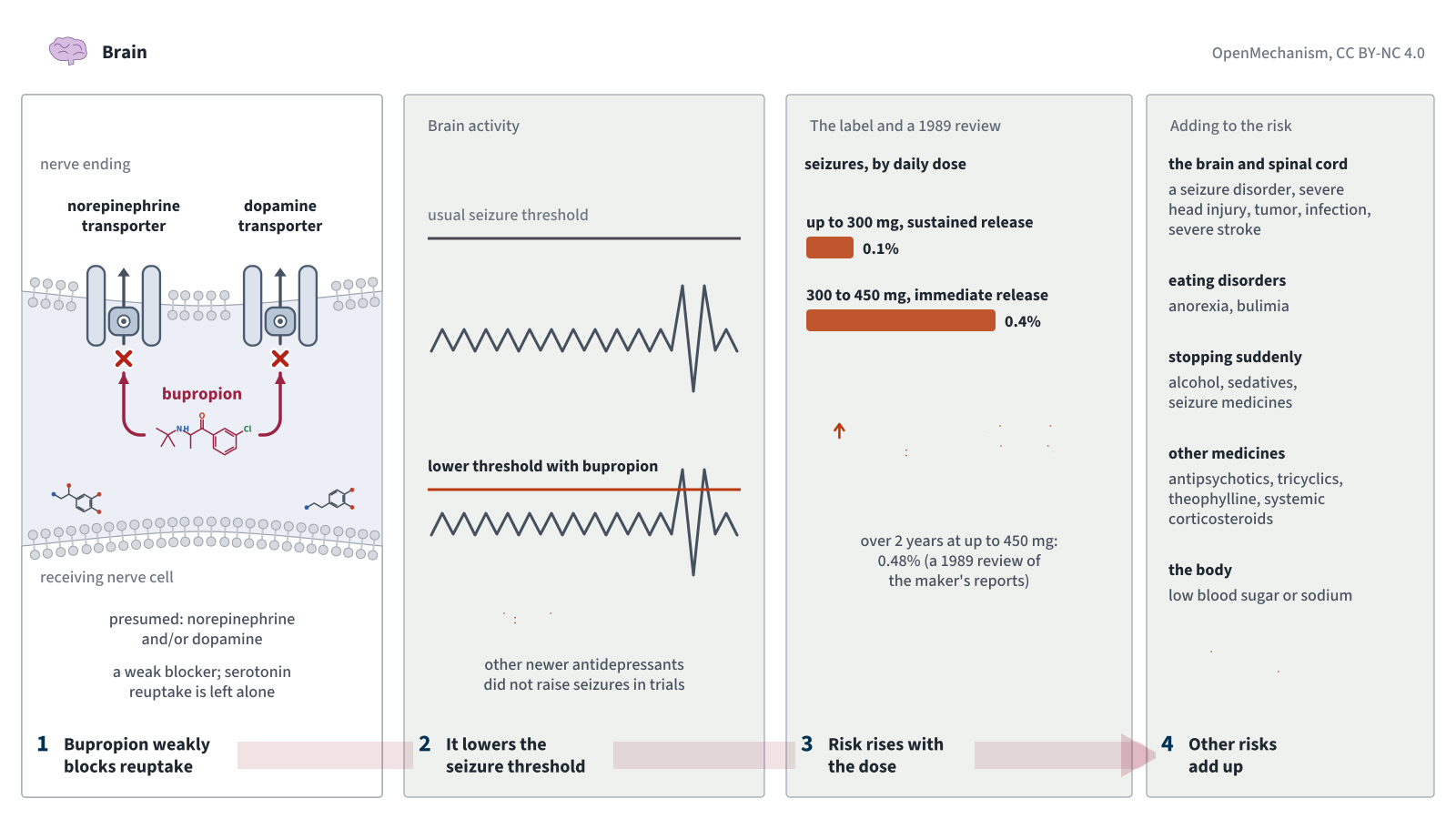
Bupropion, an antidepressant that weakly blocks the reuptake of norepinephrine and dopamine, can cause seizures: it lowers the seizure threshold, and in a 2007 analysis of FDA trial data its immediate-release form, unlike other newer antidepressants, was linked to more seizures. The risk rises with the dose, about 0.1% at up to 300 mg a day of the sustained-release form, and with conditions that add to it, from a severe head injury to anorexia or bulimia and alcohol withdrawal.
Bupropion weakly blocks reuptake. Bupropion, an antidepressant whose extended-release tablets are used for major depression and to prevent seasonal depression, weakly blocks the of norepinephrine and dopamine by nerve cells and leaves serotonin reuptake alone; its label says how bupropion works is unknown, as for other antidepressants, and presumes it works through norepinephrine and/or dopamine.1
What the source says
“Wellbutrin XL is an aminoketone antidepressant, indicated for: • treatment of major depressive disorder (MDD) ( 1.1 ) • prevention of seasonal affective disorder (SAD)”
“Bupropion is a relatively weak inhibitor of the neuronal uptake of norepinephrine and dopamine and does not inhibit monoamine oxidase or the reuptake of serotonin.”
It lowers the seizure threshold. Bupropion can also cause seizures, and its label counts other bupropion products among the medicines that lower the seizure threshold. In a 2007 analysis of FDA data from trials of psychiatric medicines approved from 1985 to 2004, with 75,873 patients in all, its immediate-release form was linked to more seizures, while other newer antidepressants seemed to protect against them.1,2
“The following conditions can also increase the risk of seizure: concomitant use of other medications that lower the seizure threshold (e.g., other bupropion products”
“We accessed public domain data from Food and Drug Administration (FDA) Phase II and III clinical trials as Summary Basis of Approval (SBA) reports that noted seizure incidence in trials of psychotropic drugs approved in the United States between 1985 and 2004, involving a total of 75,873 patients.”
Risk rises with the dose. The risk is dose related: about 0.1% with a sustained-release form at up to 300 mg a day, about 0.4% with the immediate-release form at 300 to 450 mg a day, and data for the immediate-release form suggest it rises almost tenfold from 450 to 600 mg a day. In a 1989 review of the maker's reports, the two-year risk at 450 mg a day or less was 0.48%.1,3
“In a large prospective, follow-up study, the seizure incidence was approximately 0.4% (13/3200) with bupropion HCl immediate-release in the range of 300 mg to 450 mg per day.”
“Additional data accumulated for bupropion immediate-release suggests that the estimated seizure incidence increases almost tenfold between 450 and 600 mg/day.”
Other risks add up. The person and other medicines add to the risk. The label rules bupropion out with a seizure disorder, a severe head injury, a tumor or infection of the brain or spinal cord, a severe stroke, anorexia or bulimia, or abrupt withdrawal from alcohol, benzodiazepine or barbiturate sedatives, or seizure medicines, and warns about other things that add to the risk, such as other threshold-lowering medicines, low blood sugar or sodium, severe liver impairment and illicit drugs such as cocaine. In a 1989 review of the maker's reports, over half of 37 cases had a predisposing factor.1,3
What the source says
“Wellbutrin XL is contraindicated in patients with a seizure disorder or conditions that increase the risk of seizure (e.g., severe head injury, arteriovenous malformation, CNS tumor or CNS infection, severe stroke, anorexia nervosa or bulimia, or abrupt discontinuation of alcohol, benzodiazepines, barbiturates, and antiepileptic drugs”
“The following conditions can also increase the risk of seizure: concomitant use of other medications that lower the seizure threshold (e.g., other bupropion products, antipsychotics, tricyclic antidepressants, theophylline, and systemic corticosteroids), metabolic disorders (e.g., hypoglycemia, hyponatremia, severe hepatic impairment, and hypoxia)”
“The risk of seizure appears to be higher with bupropion doses above the recommended maximum, and predisposing factors were noted in over half of the 37 reported cases.”
Depression itself is linked to a lower seizure threshold.2
Seizure rates for the once-daily extended-release form have not been formally evaluated in clinical trials; the figures come from the other forms.1
The sources don't say how bupropion lowers the seizure threshold, or link it to the reuptake block in step 1.
The label names other things that can add to the risk too: hypoxia, misuse of prescription stimulants, diabetes treated with insulin or medicines by mouth, appetite suppressants, and excessive use of alcohol, benzodiazepines, sedatives or opioids.1
The label's dose limits and its advice after a seizure are left out: this page explains the mechanism, not what to do.
Claude Opus 5.5 (AI source check), 7 November 2026: 23 statements compared with their sources, 4 flagged for the reviewer. An automated check, not a medical review.
Next review due
8 May 2028
Cite this page
Tran D. Why bupropion carries a risk of seizures [Internet]. OpenMechanism; 2026 [updated 2026 Nov 7; cited 2026 Nov 7]. Available from: https://openmechanism.com/explained/bupropion-and-seizures