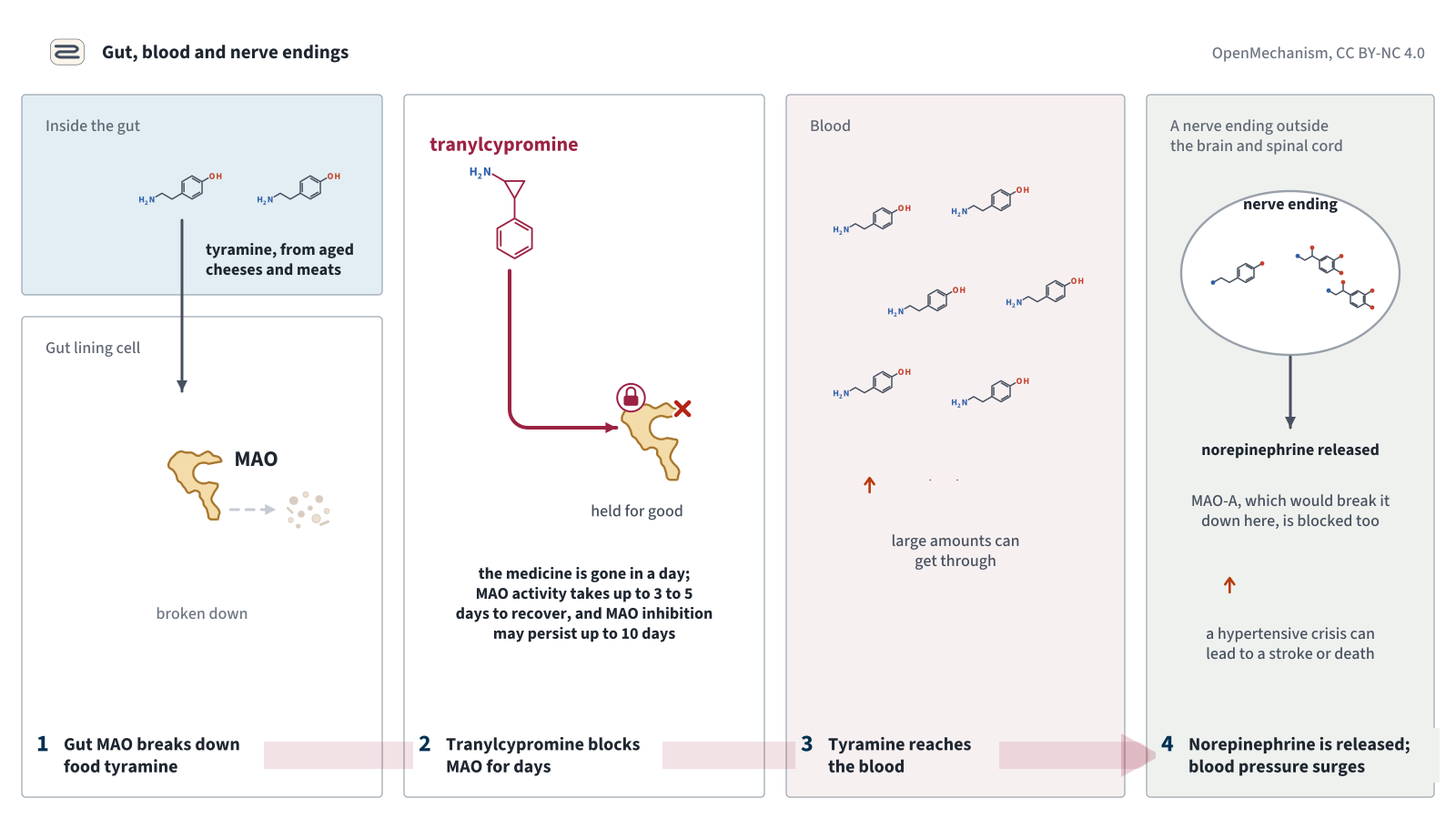
Tyramine, an amine in aged cheeses, air-dried or fermented meats and other aged or fermented foods, is broken down by the enzyme monoamine oxidase (MAO) in the gut. Tranylcypromine blocks MAO irreversibly, so large amounts of tyramine can reach the blood. There it makes nerve endings release norepinephrine, and blood pressure can rise suddenly into a hypertensive crisis, which can lead to a stroke or death. Blocking MAO-A is what matters: a 2012 paper found rasagiline, which is relatively selective for MAO-B at its recommended dose, was not linked with heightened sensitivity to tyramine, though its label notes a mild increase in sensitivity at recommended doses.
Gut MAO breaks down food tyramine. Tyramine is an amine in many aged, fermented or spoiled foods, such as aged cheeses, air-dried and fermented meats, tap beers and yeast extracts. The enzyme in the gut breaks it down.1,2
What the source says
“a hypertensive response to excess dietary tyramine, a biogenic sympathomimetic amine”
Tranylcypromine blocks MAO for days. Tranylcypromine blocks MAO irreversibly: the medicine itself is gone within 24 hours, but MAO activity takes up to 3 to 5 days to recover, and the label adds that MAO inhibition may persist up to 10 days after the medicine is stopped.2,3
What the source says
“resulting from its irreversible inhibition of the enzyme monoamine oxidase (MAO)”
Tyramine reaches the blood. With the gut's MAO blocked, large amounts of tyramine from food can enter the bloodstream.2
What the source says
“As a result of this inhibition, large amounts of tyramine may enter the systemic circulation and precipitate a sudden elevation in blood pressure or hypertensive crisis”
Norepinephrine is released; blood pressure surges. Tyramine makes nerve endings release norepinephrine, and with MAO-A, the enzyme that breaks norepinephrine down in those nerve endings, also blocked, the effect is stronger. Blood pressure can rise suddenly into a hypertensive crisis, which can lead to a stroke or death.2,4
What the source says
“Namely, potentiation of sympathomimetic activity of ingested tyramine present in cheese and other food stuff, resulting from its ability to release noradrenaline, when prevented from metabolism by MAO.”
“The cheese reaction is a consequence of inhibition of MAO-A, the enzyme responsible for metabolism of noradrenaline and serotonin, located in peripheral adrenergic neurons.”
Also part of this interaction: linezolid (“Tyramine: A significant pressor response has been observed in normal adult subjects receiving linezolid and tyramine doses of more than 100 mg.”7).
Tranylcypromine sulfate tablets (Actavis): FDA labelBoxed Warning and Medication Guide; 5.2 Hypertensive Crisis and Hypertension; 5.9 Risk of Clinically Significant Adverse Reactions due to Persistence of MAO Inhibition after Discontinuation; 7.2 Tyramine-Containing Foods and Beverages. Saved copy
The labels' full food lists and advice, including how long after stopping to keep avoiding tyramine, are left out: this page explains the mechanism, not what to do.
Blocking MAO-B, rather than MAO-A, is not described as bringing this risk: a 2012 paper found that, at recommended doses, rasagiline was not linked with heightened sensitivity to tyramine. Its label still notes a mild increase in sensitivity at recommended doses, says foods with very high amounts of tyramine could potentially cause severe hypertension in people taking it, and says its selectivity can be incomplete when healthy people eat large amounts of tyramine while taking recommended doses, and fades as the dose rises.1,5
Clinically significant rises in blood pressure have also been reported with MAO inhibitors, including tranylcypromine, in people not eating tyramine-rich foods or drinks.2
A 2018 review argues that most foods today hold much less tyramine than in past decades, but adds that because sensitivity to tyramine varies between people, some care is still required.6
Claude Opus 5.5 (AI source check), 7 November 2026: 30 statements compared with their sources, 2 flagged for the reviewer. An automated check, not a medical review.
Conflict of interest
Linezolid: Pfizer, the reviewer's former employer, makes or markets this medicine. Details
Next review due
8 May 2028
Cite this page
Tran D. MAO inhibitors and tyramine [Internet]. OpenMechanism; 2026 [updated 2026 Nov 7; cited 2026 Nov 7]. Available from: https://openmechanism.com/explained/mao-inhibitors-and-tyramine