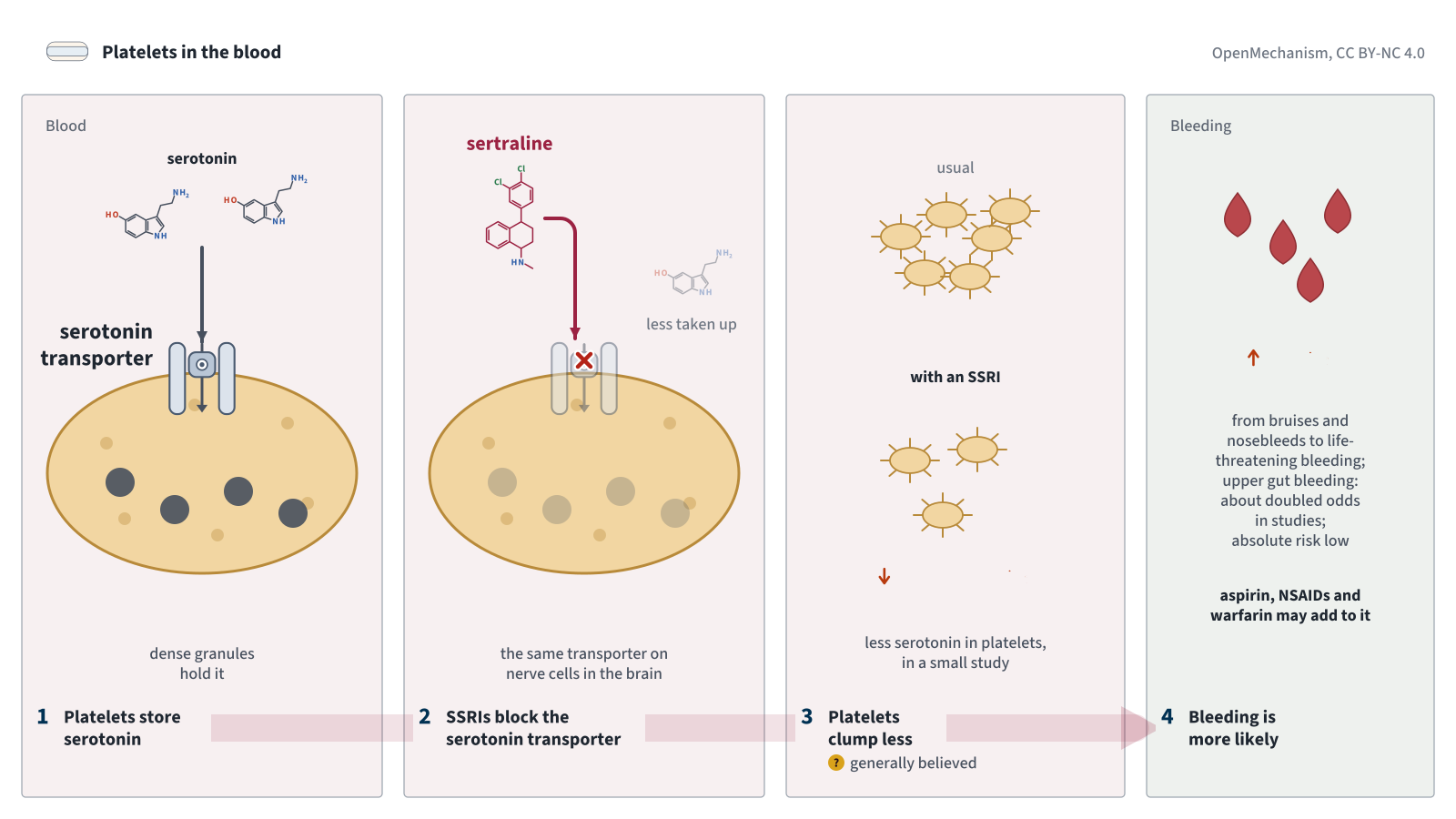
Platelets take up serotonin through the serotonin transporter and release it to strengthen clumping at an injury. SSRIs such as sertraline and escitalopram block that transporter, and in one small study, people who had taken SSRIs for months had platelets with less serotonin that clumped less; a 2010 review says this is generally believed to be how SSRIs raise the risk of bleeding, but suggests that more stomach acid may explain the bleeding in the gut. The labels say SSRIs raise the risk of bleeding, from bruises to life-threatening bleeding, and that aspirin, NSAIDs, other antiplatelet medicines, warfarin and other anticoagulants may add to it.
A 2010 review says it is generally believed that SSRIs increase the risk of abnormal bleeding … by blocking the uptake of serotonin into platelets, leading to an impairment in the platelet hemostatic response.
Clinical study: In Hergovich and colleagues' 2000 randomized, double-blind, placebo-controlled crossover trial, healthy men took the SSRI paroxetine, 20 mg a day for 2 weeks; the trial measured platelet serotonin and platelet function, not bleeding: Paroxetine substantially decreases intraplatelet serotonin content and thereby reduces platelet plug formation under shear stressHergovich N et al., Clin Pharmacol Ther 2000 (PMID 11061584)
Platelets store serotonin. Platelets take up serotonin through the serotonin transporter and store it in their dense granules. Released when platelets are triggered, it strengthens the clumping that injury signals start.1
What the source says
“SSRIs block the serotonin transporter, thereby inhibiting serotonin (5-HT) uptake into presynaptic neurons as well as into platelets where 5-HT is stored in dense granules.”
SSRIs block the serotonin transporter. Sertraline and escitalopram block the of serotonin by nerve cells in the brain, which is thought to be how they work against depression. Blocking the serotonin transporter also inhibits serotonin uptake into platelets.1,2,3
What the source says
“Sertraline potentiates serotonergic activity in the central nervous system through inhibition of neuronal reuptake of serotonin (5-HT).”
“The mechanism of antidepressant action of escitalopram, the S-enantiomer of racemic citalopram, is presumed to be linked to potentiation of serotonergic activity in the central nervous system (CNS) resulting from its inhibition of CNS neuronal reuptake of serotonin (5-HT).”
Platelets clump less. In a small 2012 study, the platelets of 14 people with major depression or obsessive-compulsive disorder who had taken various SSRIs for 6 to 108 months held less serotonin and clumped less to three of the four triggers tested than those of 14 healthy, untreated people of the same age and sex. A 2010 review says weaker platelets are generally believed to be how SSRIs raise the risk of bleeding, but suggests that more stomach acid may explain the bleeding in the gut.1,4
What the source says
“The study included ten DSM-IV-TR major depression (MDD) and four obsessive compulsive disorder (OCD) patients and fourteen healthy untreated age- and sex-matched controls. The patients were chronically medicated (6-108 months) with various SSRIs.”
“Patients chronically medicated with SSRIs exhibit lower platelet 5-HT content and reduced platelet aggregation induced by ADP, collagen and epinephrine, but not by arachidonic acid.”
Bleeding is more likely. The labels say SSRIs raise the risk of bleeding, from bruises and nosebleeds to life-threatening bleeding, and that aspirin, , other antiplatelet medicines, warfarin and other may add to the risk. A 2010 review says epidemiologic studies link SSRI use with roughly doubled odds of bleeding in the upper gut, though the absolute risk of these bleeds is low.2,3,4
What the source says
“Drugs that interfere with serotonin reuptake inhibition, including ZOLOFT, increase the risk of bleeding events. Concomitant use of aspirin, nonsteroidal anti-inflammatory drugs (NSAIDs), other antiplatelet drugs, warfarin, and other anticoagulants may add to this risk.”
“Bleeding events related to drugs that interfere with serotonin reuptake have ranged from ecchymosis, hematoma, epistaxis, and petechiae to life-threatening hemorrhages”
Can raise or cause it: warfarin (“Concomitant use of aspirin, nonsteroidal anti-inflammatory drugs (NSAIDs), other antiplatelet drugs, warfarin, and other anticoagulants may add to this risk.”2); and aspirin (“Concomitant use of aspirin, nonsteroidal anti-inflammatory drugs (NSAIDs), other antiplatelet drugs, warfarin, and other anticoagulants may add to the risk.”3).
The labels' monitoring and management advice are left out: this page explains the mechanism, not what to do.
The 2010 review suggests that more stomach acid may explain the bleeding in the gut.4
The platelet study was small, and its authors list the patients' other medicines, such as benzodiazepines, as a limitation.1
In the review, the risk of gut bleeding with SSRIs was lower when proton pump inhibitors were taken with them, and bleeding was more likely with liver cirrhosis or liver failure.4
The labels add that studies have linked these medicines with bleeding in the gut, and SSRI use, particularly in the month before delivery, with a less than 2-fold rise in the risk of heavy bleeding after childbirth (postpartum hemorrhage).2,3
text f75068577d08…; drawings df9e90e27af4…; notes 915b76f74bc7…
AI source check
Claude Opus 5.5 (AI source check), 3 November 2026: 28 statements compared with their sources, 7 flagged for the reviewer. An automated check, not a medical review.
Key terms
Definitions reworded since this review: NSAID. Definitions are shared across pages, so a later rewording does not take the review line off (what a review covers).
Next review due
4 May 2028
Cite this page
Tran D. Why SSRIs can raise the risk of bleeding [Internet]. OpenMechanism; 2026 [updated 2026 Nov 3; cited 2026 Nov 3]. Available from: https://openmechanism.com/explained/ssris-and-bleeding