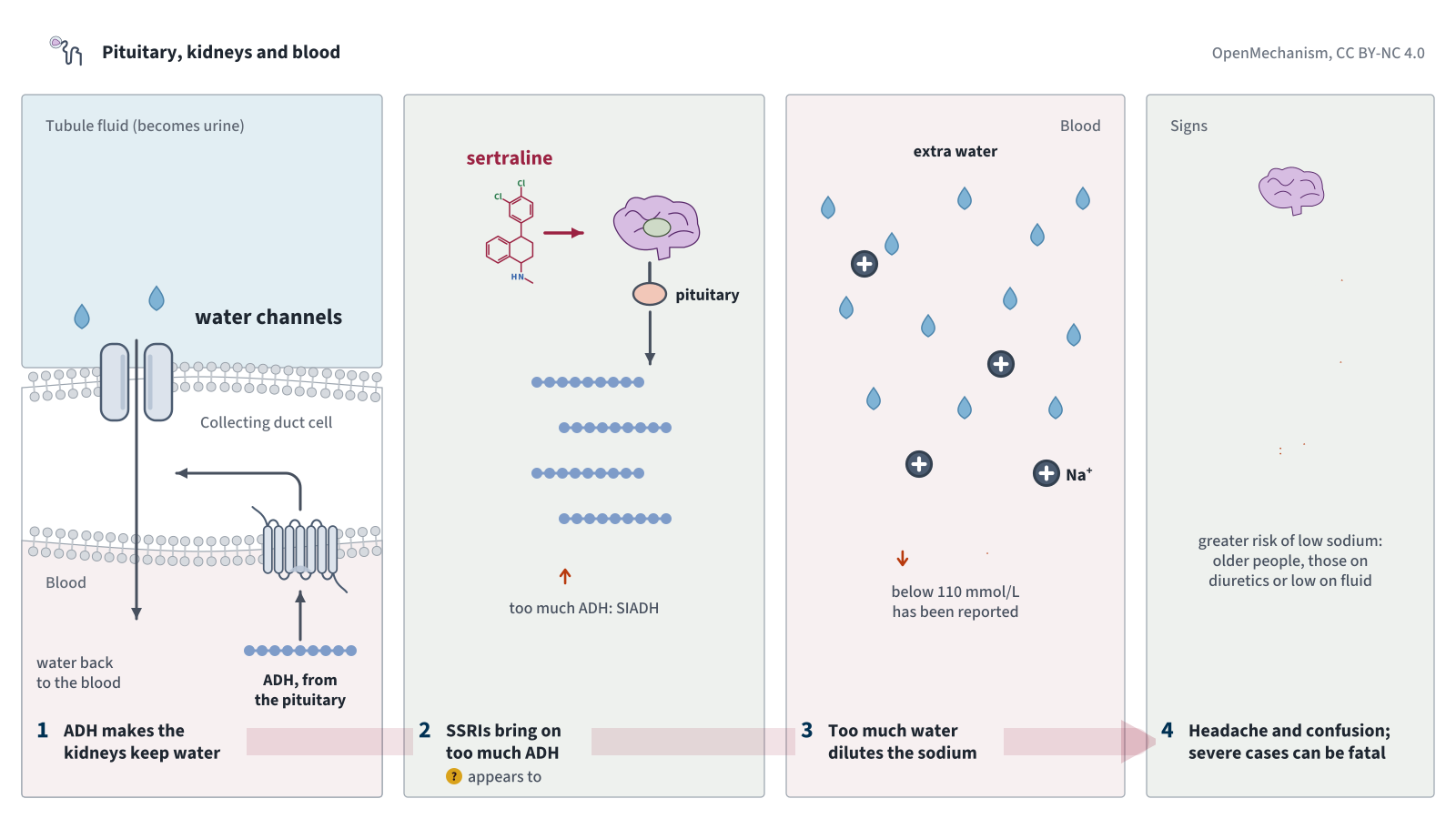
ADH, a hormone from the pituitary, makes the kidneys keep water. Selective serotonin inhibitors (SSRIs) such as sertraline can lower blood sodium, in many cases apparently through too much ADH (SIADH): the kidneys keep back too much water, and the sodium is diluted. Older people, people taking diuretics and those low on fluid may be at greater risk. Severe or sudden cases have included seizures, coma and death.
The Zoloft label says: In many cases, this hyponatremia appears to be the result of the syndrome of inappropriate antidiuretic hormone secretion (SIADH).
Clinical study: In Bouman and colleagues' 1998 retrospective case-note study of a year of admissions to an old-age psychiatry ward, the authors found among the 32 people taking SSRIs: Of 32 patients taking SSRIs, four developed symptomatic hyponatraemia due to SIADH (12.5%). A further four developed asymptomatic hyponatraemia following introduction of an SSRI (12.5%), although laboratory confirmation of SIADH was lacking.Bouman WP et al., Int J Geriatr Psychiatry 1998 (PMID 9489575)
ADH makes the kidneys keep water. The posterior pituitary releases (ADH). It makes the kidney's collecting ducts let more water through, so more water returns to the blood and less leaves in the urine; under the influence of ADH, the collecting ducts can recover most of the water passing through them in dehydration, or almost none after drinking water.1,2,3,4
What the source says
“Under physiological conditions, excessive loss of water through the urine is prevented by the release of the antidiuretic hormone arginine-vasopressin (AVP) from the posterior pituitary.”
“Vasopressin increases the water permeability of the renal collecting duct cells, allowing more water to be reabsorbed from collecting duct urine to blood.”
“During dehydration, arginine vasopressin (AVP) stimulates the expression and trafficking of aquaporin 2 (AQP2) to the apical membrane of CD principal cells, thereby allowing water reabsorption from the primary urine.”
“The antidiuretic hormone arginine-vasopressin increases the water permeability of the renal collecting ducts and induces the reabsorption of 11 liters of water: the final urinary osmolality is 1200 mmol/kg for a urinary flow rate of 1 litre per 24 hours.”
“Conversely, when the secretion of AVP is lowered, as for instance upon water ingestion or as a consequence of diabetes insipidus, the CD remains water impermeable leading to enhanced diuresis and urine dilution.”
SSRIs bring on too much ADH. SSRIs and SNRIs, including sertraline, can lower blood sodium; in many cases this appears to be the result of too much ADH, the syndrome of inappropriate antidiuretic hormone secretion (SIADH).5
What the source says
“Hyponatremia may occur as a result of treatment with SNRIs and SSRIs, including ZOLOFT.”
Too much water dilutes the sodium. Low blood sodium (hyponatremia) is usually linked with too much water in the body, which dilutes the sodium. With these medicines, levels below 110 mmol/L have been reported.5,6
What the source says
“Hyponatremia is generally defined as a serum sodium ion concentration <135 to 136 mmol/L and can be broadly categorized into 2 types, dilutional or depletional.”
Headache and confusion; severe cases can be fatal. Signs include headache, trouble concentrating, memory problems, confusion, weakness and unsteadiness that may lead to falls; severe or sudden cases have included hallucinations, fainting, seizures, coma, breathing stopping and death. Older people, people taking diuretics and those low on fluid may be at greater risk of low blood sodium with SSRIs and SNRIs.5
What the source says
“Signs and symptoms of hyponatremia include headache, difficulty concentrating, memory impairment, confusion, weakness, and unsteadiness, which may lead to falls. Signs and symptoms associated with more severe or acute cases have included hallucination, syncope, seizure, coma, respiratory arrest, and death.”
“Elderly patients, patients taking diuretics, and those who are volume-depleted may be at greater risk of developing hyponatremia with SSRIs and SNRIs”
text ff47a3fe4238…; drawings e7cb0d7ba40b…; notes 4874281f36df…
AI source check
Claude Opus 5.5 (AI source check), 4 November 2026: 37 statements compared with their sources, 9 flagged for the reviewer. An automated check, not a medical review.
text f4588e328b48…; drawings e7cb0d7ba40b…; notes 4874281f36df…
AI source check
The file of this review’s AI source check was later saved over by the check for the review of 12 November 2026, so its own date and counts are not shown. An automated check, not a medical review.
Next review due
4 May 2028
Cite this page
Tran D. Why SSRIs can lower sodium [Internet]. OpenMechanism; 2026 [updated 2026 Nov 12; cited 2026 Nov 12]. Available from: https://openmechanism.com/explained/ssris-and-low-sodium