Medically reviewed by Daniel Tran, PharmD, on 12 November 2026.
Why anticholinergic medicines cause dry mouth, constipation and confusion
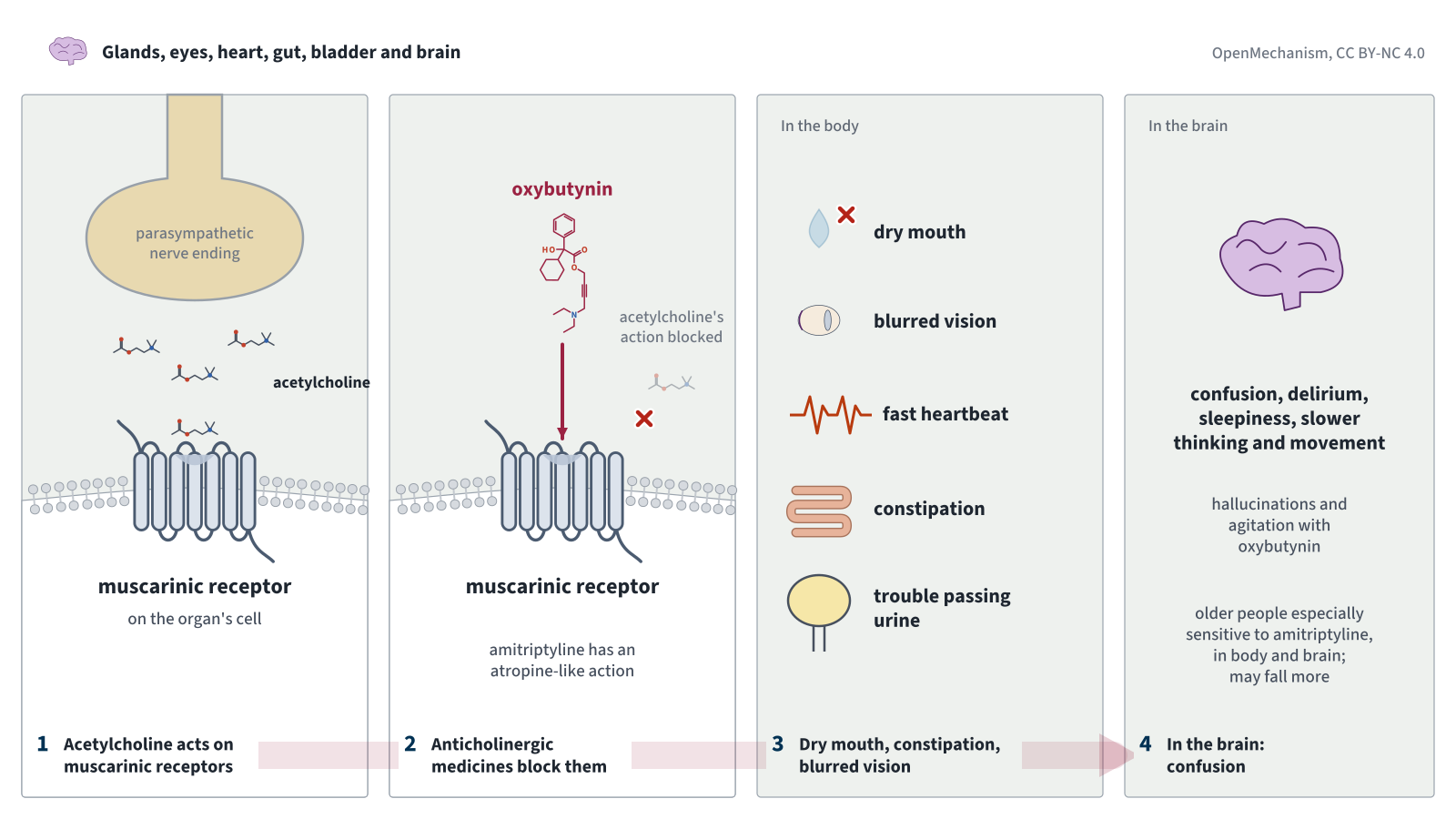
Parasympathetic nerves release acetylcholine onto muscarinic receptors in the eyes, salivary glands, heart, gut and other organs. Anticholinergic medicines such as oxybutynin block these receptors, and amitriptyline has an atropine-like action; these can bring a dry mouth, constipation, trouble passing urine, blurred vision and a fast heartbeat, and in the brain confusion; older people are especially sensitive to these effects of tricyclic antidepressants such as amitriptyline.
- Kind
- Side effect
- Medicines
- Oxybutynin, Amitriptyline
- Sources
- 5
For teachers: download this drawing.
Step by step
Acetylcholine acts on muscarinic receptors. Parasympathetic nerve fibers release acetylcholine (ACh) onto , on the organs they reach, among them the iris of the eye, the salivary glands, the heart and the gut.1,2
What the source says
“Muscarinic receptors are G-protein-coupled receptors that mediate the response to acetylcholine released from parasympathetic nerves.”
Source 1“M3 receptors are widely located in various tissues including salivary glands, gut smooth muscles, iris, and ciliary muscles”
Source 2“adverse events mediated by the blockade of cardiac M2 receptors (tachycardia)”
Source 2Anticholinergic medicines block them. Medicines that block acetylcholine's effects are called anticholinergic. Oxybutynin blocks acetylcholine's muscarinic action on smooth muscle and relaxes the bladder's muscle; amitriptyline has an atropine-like action.3,4,5
What the source says
“Any agent that binds to and blocks nicotinic and/or muscarinic receptors, thereby preventing the actions of the neurotransmitter acetylcholine (Ach) at these receptors.”
Source 3“Oxybutynin relaxes bladder smooth muscle.”
Source 4“Oxybutynin chloride exerts a direct antispasmodic effect on smooth muscle and inhibits the muscarinic action of acetylcholine on smooth muscle.”
Source 4“It should be used with caution in patients with a history of seizures and, because of its atropine-like action, in patients with a history of urinary retention or angle-closure glaucoma.”
Source 5Dry mouth, constipation, blurred vision. Blocking them in the body can bring a fast heartbeat, trouble passing urine, constipation, a dry mouth, blurred vision and worse narrow-angle glaucoma; dry mouth and constipation are among oxybutynin's most common side effects. The amitriptyline label lists anticholinergic reactions from most to least severe, starting with paralytic ileus and hyperpyrexia, and says its list includes a few reactions not reported with amitriptyline itself.4,5
What the source says
“Peripheral anticholinergic effects include tachycardia, urinary retention, constipation, drymouth, blurred vision, and exacerbation of narrow-angle glaucoma.”
Source 5“The most common (incidence ≥5%) adverse reactions were dry mouth, constipation, diarrhea, headache, somnolence, and dizziness.”
Source 4“Within each category the following adverse reactions are listed in order of decreasing severity. Included in the listing are a few adverse reactions which have not been reported with this specific drug.”
Source 5“Anticholinergic: Paralytic ileus, hyperpyrexia”
Source 5In the brain: confusion. In the brain they can cause poorer thinking, slowed movement, confusion, sleepiness and delirium; with oxybutynin, hallucinations and agitation have been reported. Older people are especially sensitive to the anticholinergic side effects of tricyclic antidepressants such as amitriptyline, in the body as well as the brain, and older people taking amitriptyline may fall more.4,5
What the source says
“Central nervous system anticholinergic effects include cognitive impairment, psychomotor slowing, confusion, sedation, and delirium.”
Source 5“A variety of CNS anticholinergic effects have been reported, including hallucinations, agitation, confusion and somnolence.”
Source 4“Geriatric patients are particularly sensitive to the anticholinergic side effects of tricyclic antidepressants including amitriptyline hydrochloride.”
Source 5“Elderly patients taking amitriptyline hydrochloride may be at increased risk for falls.”
Source 5
See also
Medicine pages: oxybutynin and amitriptyline.
Other side effects (urinary & reproductive): why sildenafil can change color vision, why the combined pill raises the risk of blood clots and all 65 side effects.
Conditions: overactive bladder and depression.
Sources
- 1Structure of the human M2 muscarinic acetylcholine receptor bound to an antagonistHaga K et al. Nature 2012 (abstract). Saved copy
- 2Medicinal chemistry and therapeutic potential of muscarinic M3 antagonistsPeretto I, Petrillo P, Imbimbo BP. Med Res Rev 2009 (abstract). Saved copy
- 3Anticholinergic agent: NCI Thesaurus definitionNCI definition, concept C66880. Saved copy
- 4Oxybutynin chloride extended-release tablets: FDA label5 Warnings and Precautions; 6 Adverse Reactions; 12.1 Mechanism of Action. Saved copy
- 5Amitriptyline hydrochloride tablets: FDA labelWarnings; Precautions (Geriatric Use); Adverse Reactions. Saved copy
Notes and limits
- The labels' dosing and management advice are left out: this page explains the mechanism, not what to do.
Notes that apply to every page are on How to read a page.
Spotted a mistake? Report an error (hello@openmechanism.com). Since launch, every published error we fix is listed on the corrections page.
Medical review
Earlier reviews (1)
Cite this page
Tran D. Why anticholinergic medicines cause dry mouth, constipation and confusion [Internet]. OpenMechanism; 2026 [updated 2026 Nov 12; cited 2026 Nov 12]. Available from: https://openmechanism.com/explained/anticholinergic-side-effects