Why montelukast carries a boxed warning about mood and behavior
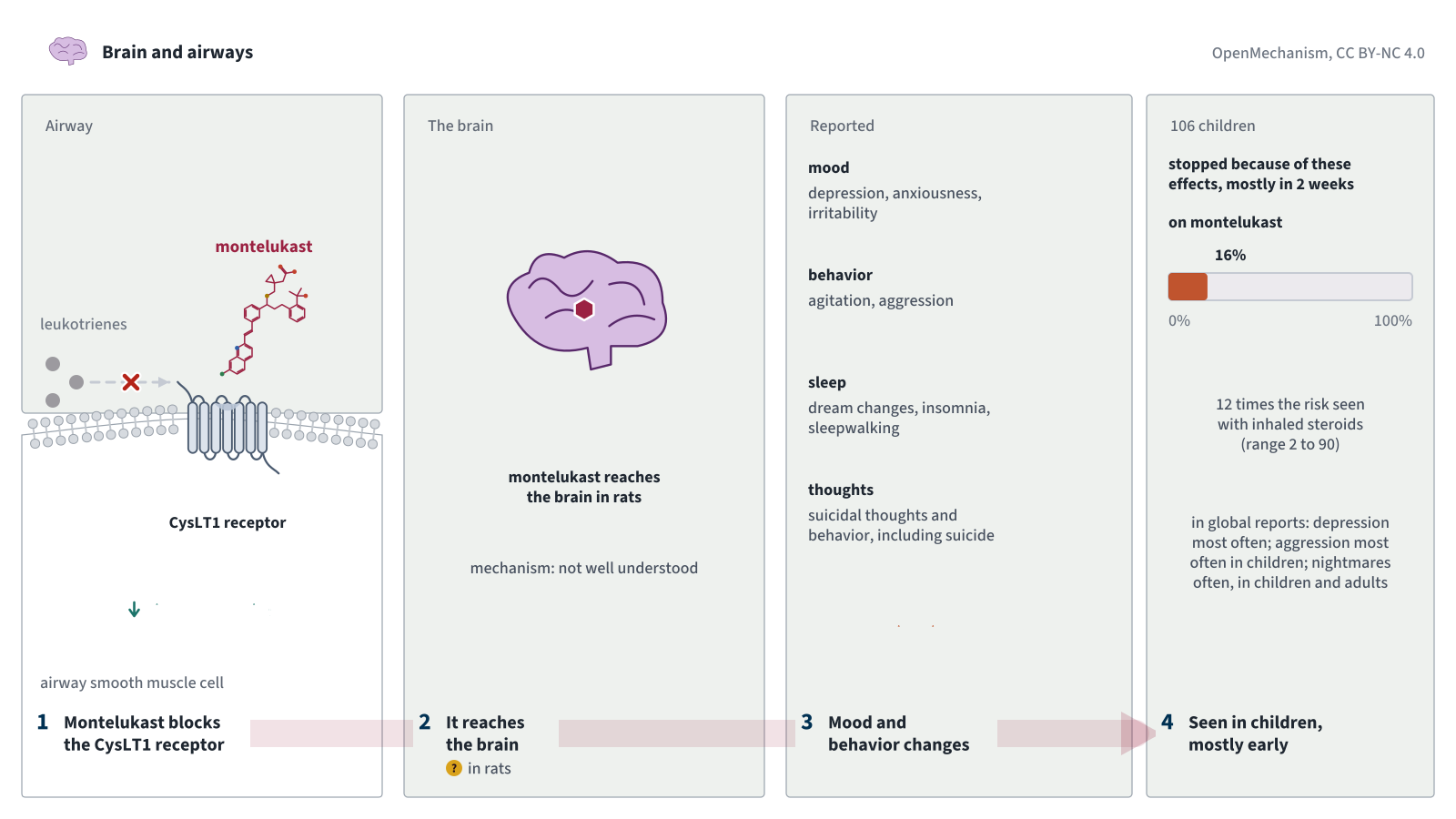
Montelukast blocks leukotriene receptors in the airways. Its label covers the prevention and long-term treatment of asthma and, only for people whom other treatments have not helped or did not suit, the relief of allergic rhinitis symptoms. The label has a boxed warning: serious neuropsychiatric events have been reported, among them agitation, aggression, depression, sleep disturbances and suicidal thoughts and behavior, including suicide. They have been reported in children, adolescents and adults. Montelukast reaches the brain in rats, but the label says the mechanisms behind these events are not well understood. Many cases resolved after it was stopped, but some persisted.
The Singulair (montelukast) label says: Animal studies showed that montelukast distributes into the brain in rats … however, the mechanisms underlying SINGULAIR-associated NP events are currently not well understood.
Clinical study: Benard and colleagues' 2017 retrospective study of 106 children started on montelukast for asthma, compared with matched children started on inhaled steroids, with side effects found by interviewing parents; it measured how many stopped because of these effects, not the mechanism behind them: The incidence (95% CI) of drug cessation due to neuropsychiatric ADRs was 16 (10-26)%, mostly occurring within 2 weeks. … The relative risk of neuropsychiatric ADRs associated with montelukast versus ICS was 12 (2-90).Benard B et al., Eur Respir J 2017 (PMID 28818882)
Montelukast blocks the CysLT1 receptor. Montelukast, whose label covers the prevention and long-term treatment of asthma in people 12 months and older, the prevention of exercise-induced airway narrowing in people 6 years and older and, for people whom other treatments have not helped or did not suit, the relief of allergic rhinitis symptoms (seasonal in people 2 years and older, perennial in people 6 months and older), binds selectively to the receptor , found on airway smooth muscle cells among others, and blocks it. In asthma, the cysteinyl leukotrienes swell the airway wall and tighten its smooth muscle, and they alter the activity of cells in the inflammatory process.1
What the source says
“SINGULAIR is a leukotriene receptor antagonist indicated for: Prophylaxis and chronic treatment of asthma in patients 12 months of age and older ( 1.1 ). Acute prevention of exercise-induced bronchoconstriction (EIB) in patients 6 years of age and older ( 1.2 ). Relief of symptoms of allergic rhinitis (AR): seasonal allergic rhinitis (SAR) in patients 2 years of age and older, and perennial allergic rhinitis (PAR) in patients 6 months of age and older”
“In asthma, leukotriene-mediated effects include airway edema, smooth muscle contraction, and altered cellular activity associated with the inflammatory process.”
It reaches the brain. In animal studies montelukast entered the brain in rats, but the label says the mechanisms behind the mood and behavior events linked to it are not well understood.1
What the source says
“Animal studies showed that montelukast distributes into the brain in rats”
Mood and behavior changes. Serious neuropsychiatric events have been reported, among them agitation and aggression, anxiousness, depression, disorientation, dream abnormalities, hallucinations, insomnia, irritability, sleepwalking and suicidal thoughts and behavior, including suicide. They have come in children, adolescents and adults, with or without past psychiatric illness, mostly during treatment but some after it ended.1
What the source says
“Serious neuropsychiatric (NP) events have been reported with use of SINGULAIR.”
“These postmarketing reports have been highly variable and included, but were not limited to, agitation, aggressive behavior or hostility, anxiousness, depression, disorientation, disturbance in attention, dream abnormalities, dysphemia (stuttering), hallucinations, insomnia, irritability, memory impairment, obsessive-compulsive symptoms, restlessness, somnambulism, suicidal thoughts and behavior (including suicide), tic, and tremor.”
Seen in children, mostly early. In a 2017 retrospective study of 106 children started on montelukast, 16% stopped it because of these effects, mostly within two weeks; the most frequent effects were irritability, aggressiveness and sleep problems, and the risk of such effects was 12 times that of matched children started on inhaled steroids, with a wide range of uncertainty (2 to 90 times). In reports to a global database, depression was reported most often overall and aggression most often in children; nightmares were often reported in both children and adults.2,3
What the source says
“We conducted a retrospective cohort study in children aged 1-17 years initiated on montelukast.”
“children initiated on montelukast as monotherapy or adjunct therapy to inhaled corticosteroids (ICS) were matched to those initiated on ICS monotherapy.”
“Out of the 106 participants who initiated montelukast, most were male (58%), Caucasian (62%) with a median (interquartile range) age of 5 (3-8) years.”
Many cases resolved after montelukast was stopped, but some persisted, and the available data make it hard to name risk factors or measure the risk.1
The global figures come from spontaneous reports to the WHO database; a 2016 analysis of such reports said studies were needed to measure the risk.3,4
The label says its benefits may not outweigh the risk of these events in some people, particularly when the symptoms may be mild and adequately treated with other therapies. Because its benefits may not outweigh this risk in allergic rhinitis, the label keeps it, for that use, for people whom other treatments have not helped or did not suit.1
text b254b07ee856…; drawings 3efebd8b3334…; notes c3c9e67720ab…
AI source check
Claude Opus 5.5 (AI source check), 13 November 2026: 25 statements compared with their sources, 5 flagged for the reviewer. An automated check, not a medical review.
Next review due
14 May 2028
Cite this page
Tran D. Why montelukast carries a boxed warning about mood and behavior [Internet]. OpenMechanism; 2026 [updated 2026 Nov 13; cited 2026 Nov 13]. Available from: https://openmechanism.com/explained/montelukast-and-mood