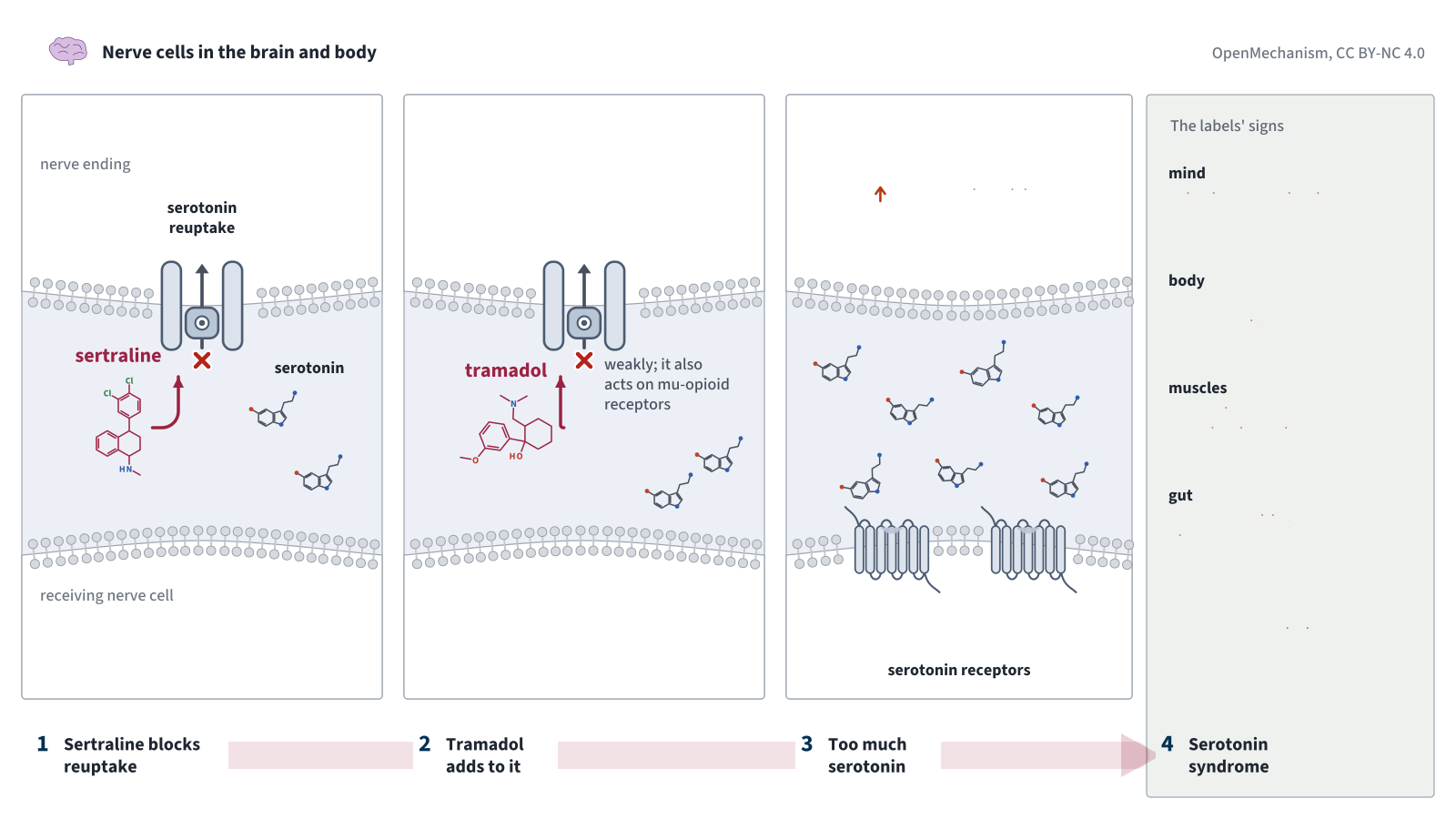
Sertraline, a selective serotonin reuptake inhibitor (SSRI), blocks the reuptake of serotonin by nerve cells. Tramadol, an opioid pain medicine, also weakly blocks serotonin reuptake. Together they can push serotonergic activity too high: serotonin syndrome, a potentially life-threatening reaction whose signs may include agitation, a racing heart, high body temperature, overactive reflexes and stiffness, usually within hours to days.
Sertraline blocks reuptake. Sertraline, a selective serotonin inhibitor (SSRI) used for major depressive disorder, obsessive-compulsive disorder, panic disorder and other disorders, strengthens serotonin's activity in the brain and spinal cord by blocking its reuptake into nerve cells.1
What the source says
“ZOLOFT is a selective serotonin reuptake inhibitor (SSRI) indicated for the treatment of ( 1 ): • Major depressive disorder (MDD) • Obsessive-compulsive disorder (OCD) • Panic disorder (PD) • Posttraumatic stress disorder (PTSD) • Social anxiety disorder (SAD) • Premenstrual dysphoric disorder (PMDD)”
Tramadol adds to it. Tramadol is an opioid that also blocks the reuptake of norepinephrine and serotonin, weakly; these reuptake effects give it a side-effect profile of its own, serotonin syndrome and seizures among them. Sertraline also blocks , the enzyme that makes M1, a metabolite of tramadol that binds mu-opioid receptors more strongly than tramadol does: the tramadol label says CYP2D6 inhibitors may raise tramadol levels, with more risk of seizures and serotonin syndrome, and lower M1, which could lessen tramadol's effect.1,2,3
What the source says
“Tramadol hydrochloride tablets contain tramadol, an opioid agonist and inhibitor of norepinephrine and serotonin re- uptake. Although the mode of action is not completely understood, the analgesic effect of tramadol is believed to be due to both binding to μ-opioid receptors and weak inhibition of re-uptake of norepinephrine and serotonin. Opioid activity is due to both low affinity binding of the parent compound and higher affinity binding of the O -demethylated metabolite M1 to μ-opioid receptors.”
“However, tramadol's serotonin and norepinephrine reuptake inhibitory effects result in a unique adverse effect profile. Two such adverse events are serotonin syndrome and seizures.”
“The concomitant use of tramadol hydrochloride tablets and CYP2D6 inhibitors may result in an increase in the plasma concentration of tramadol and a decrease in the plasma concentration of M1, particularly when an inhibitor is added after a stable dose of tramadol hydrochloride tablets is achieved. Since M1 is a more potent µ-opioid agonist, decreased M1 exposure could result in decreased therapeutic effects, and may result in signs and symptoms of opioid withdrawal in patients who had developed physical dependence to tramadol. Increased tramadol exposure can result in increased or prolonged therapeutic effects and increased risk for serious adverse events including seizures and serotonin syndrome.”
Too much serotonin. Serotonin syndrome is a potentially life-threatening reaction to medicines, linked to increased serotonergic activity in the brain and the rest of the body. Severe cases usually follow starting two or more serotonergic medicines at once, though the syndrome can also follow adding one to another taken for a long time; the Zoloft label names tramadol among the medicines that raise the risk, and the tramadol label says serotonin reuptake inhibitors, SSRIs among them, may raise it.1,2,4
What the source says
“Serotonin syndrome (SS) (also referred to as serotonin toxicity) is a potentially life-threatening drug-induced toxidrome associated with increased serotonergic activity in both the peripheral (PNS) and central nervous systems (CNS).”
“Severe SS is only usually precipitated by the simultaneous initiation of 2 or more serotonergic drugs, but the syndrome can also occur after the initiation of a single serotonergic drug in a susceptible individual, the addition of a second or third agent to long-standing doses of a maintenance serotonergic drug, or after an overdose.”
“The risk is increased with concomitant use of other serotonergic drugs (including triptans, tricyclic antidepressants, fentanyl, lithium, tramadol, meperidine, methadone, tryptophan, buspirone, amphetamines, and St. John’s Wort)”
“Cases of serotonin syndrome, a potentially life-threatening condition, have been reported with the use of tramadol, particularly during concomitant use with serotonergic drugs. Serotonergic drugs include selective serotonin reuptake inhibitors (SSRIs), serotonin and norepinephrine reuptake inhibitors (SNRIs), tricyclic antidepressants (TCAs), triptans, 5-HT3 receptor antagonists, drugs that affect the serotonergic neurotransmitter system (e.g., mirtazapine, trazodone, tramadol), certain muscle relaxants (i.e., cyclobenzaprine, metaxalone), and drugs that impair metabolism of serotonin (including MAO inhibitors, both those intended to treat psychiatric disorders and also others, such as linezolid and intravenous methylene blue) [see Drug Interactions (7)] .”
“Concomitant use of serotonin re-uptake inhibitors and MAO inhibitors may enhance the risk of adverse events, including seizure and serotonin syndrome”
Serotonin syndrome. Its signs may include agitation, hallucinations or coma; a fast heart rate, unstable blood pressure and high body temperature; overactive reflexes, poor coordination and stiffness; and nausea, vomiting or diarrhea. They usually start within hours to a few days of taking the two together, sometimes later, and can come at the usual doses.2
What the source says
“This may occur within the recommended dosage range. Serotonin syndrome symptoms may include mental status changes (e.g., agitation, hallucinations, coma), autonomic instability (e.g., tachycardia, labile blood pressure, hyperthermia), neuromuscular aberrations (e.g., hyperreflexia, incoordination, rigidity), and/or gastrointestinal symptoms (e.g., nausea, vomiting, diarrhea). The onset of symptoms generally occurs within several hours to a few days of concomitant use, but may occur later than that.”
Serotonin syndrome can also happen with one serotonergic medicine alone.1
The tramadol label also says taking it with SSRIs raises the risk of seizures.2
A monoamine oxidase inhibitor with a serotonergic medicine is especially dangerous and may lead to the most severe form, occasionally fatal; linezolid is one such inhibitor.2,4
A 2018 review says tramadol-related serotonin syndrome and seizures are of modest prevalence in the general population, but that if left untreated, their rates of illness and death can be high.3
Claude Opus 5.5 (AI source check), 3 November 2026: 25 statements compared with their sources, 5 flagged for the reviewer. An automated check, not a medical review.
Next review due
4 May 2028
Cite this page
Tran D. Tramadol and SSRIs such as sertraline [Internet]. OpenMechanism; 2026 [updated 2026 Nov 3; cited 2026 Nov 3]. Available from: https://openmechanism.com/explained/tramadol-and-ssris