Skin, hair & nails
How the skin keeps the world out and water in, and renews itself.
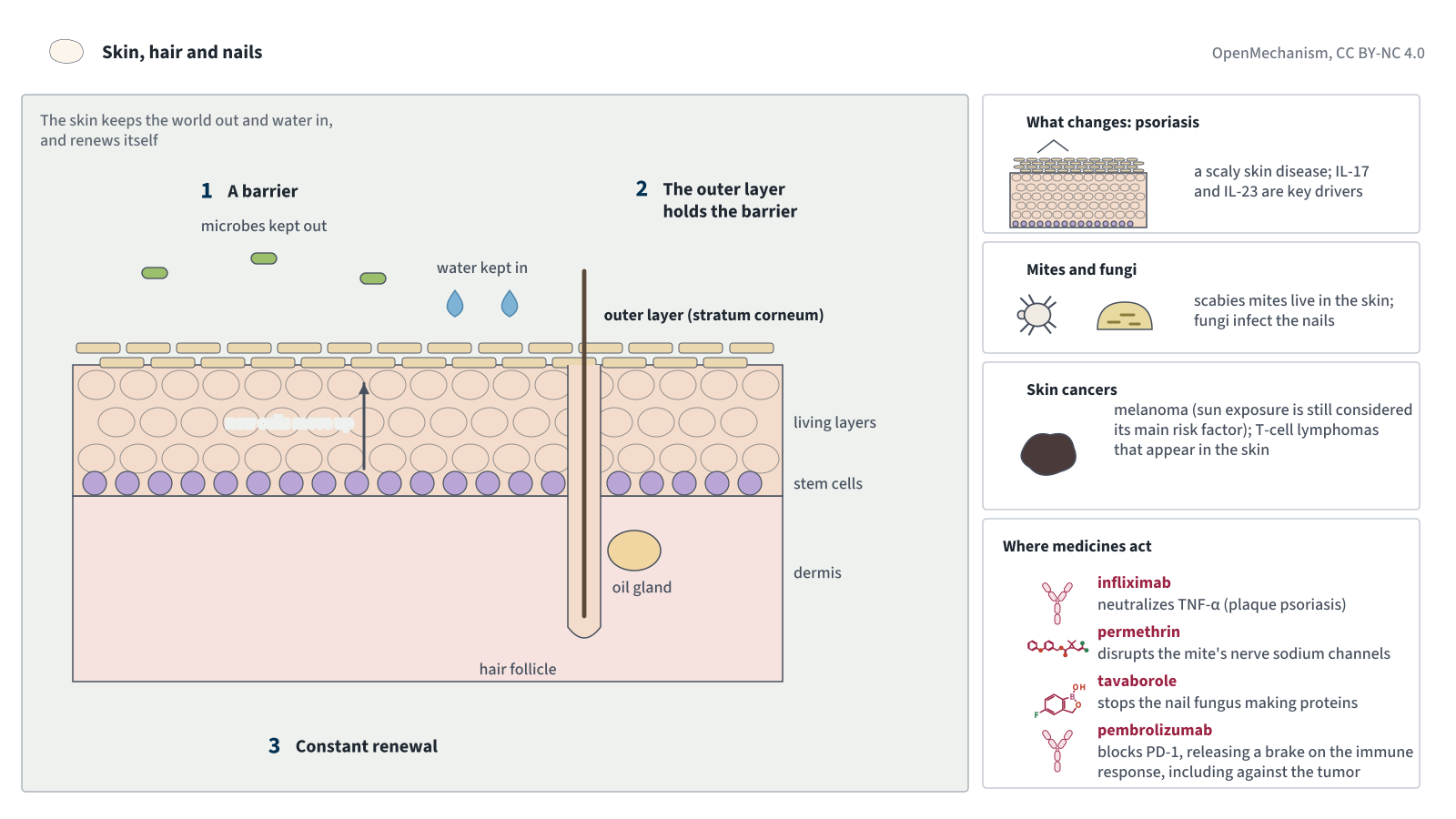
For teachers: download this drawing.
Key terms in this drawing
- IL-17
- Interleukin-17. A cytokine that, with IL-23, is a key driver of psoriasis.
- IL-23
- Interleukin-23. A cytokine that inflammatory dendritic cells release to switch on IL-17-making T cells, as in psoriasis.
- PD-1
- Programmed cell death protein 1. A receptor on T cells that acts as a brake when PD-L1 or PD-L2 binds it.
- TNF
- Tumor necrosis factor (TNF-α). A signaling molecule (cytokine) that drives inflammation.
How it works
A barrier. The skin is a barrier between the body and the world: it keeps out microbes, chemical and physical harm, and stops water from leaking out.1
What the source says
“The skin forms an effective barrier between the organism and the environment preventing invasion of pathogens and fending off chemical and physical assaults, as well as the unregulated loss of water and solutes.”
Source 1The outer layer holds the barrier. The barrier lies mostly in the outermost layer (the stratum corneum): flattened cells (corneocytes) with fats between them.1
What the source says
“The physical barrier is mainly localized in the stratum corneum (SC) and consists of protein-enriched cells (corneocytes with cornified envelope and cytoskeletal elements, as well as corneodesmosomes) and lipid-enriched intercellular domains.”
Source 1Constant renewal. The outer skin renews itself all the time: stem cells make new cells to replace those constantly lost, in the skin surface, hair follicles and oil glands.2
What the source says
“The skin epidermis and its array of appendages undergo ongoing renewal by a process called homeostasis.”
Source 2“Stem cells in the epidermis have a crucial role in maintaining tissue homeostasis by providing new cells to replace those that are constantly lost during tissue turnover or following injury.”
Source 2“including interfollicular epidermis, hair follicles and sebaceous glands.”
Source 2
What changes in disease
Psoriasis. Psoriasis is a common, long-term scaly skin disease; the immune signals and are key drivers.3
Mites and fungi. A mite that can only live on people causes scabies, and fungi infect nails (onychomycosis, the most common nail disorder seen in clinics).4,5
What the source says
“Scabies is an ectoparasite caused by the mite Sarcoptes scabiei var hominis, an obligate human parasite.”
Source 4“Onychomycosis is a fungal nail infection caused by dermatophytes, nondermatophytes, and yeast, and is the most common nail disorder seen in clinical practice.”
Source 5Skin cancers. Melanoma is a common cancer in the Western world, and sun exposure is still considered its main risk factor; some lymphomas of also appear first in the skin.6,7
What the source says
“Melanoma is a common cancer in the Western world with an increasing incidence.”
Source 6“Sun exposure is still considered to be the major risk factor for melanoma.”
Source 6“Primary cutaneous T cell lymphomas (CTCLs) are a heterogeneous group of lymphomas that present in the skin”
Source 7
Where medicines act
- d
Infliximab
Neutralizes TNF-α; used for severe plaque psoriasis.
- e
Permethrin
Disrupts the sodium channels of the mite's nerve cells.
- f
Tavaborole
Stops the nail fungus making proteins.
- g
Pembrolizumab
Blocks PD-1, releasing a brake on the immune response, including against the tumor.
See also
Zoom in: skin renewal.
Conditions
More medicines for this area
Sources
- 1The skin: an indispensable barrierProksch E et al. Exp Dermatol 2008 (abstract). Saved copy
- 2Epidermal homeostasis: a balancing act of stem cells in the skinBlanpain C, Fuchs E. Nat Rev Mol Cell Biol 2009 (abstract). Saved copy
- 3PsoriasisGriffiths CEM et al. Lancet 2021 (abstract). Saved copy
- 4ScabiesHicks MI, Elston DM. Dermatol Ther 2009 (abstract). Saved copy
- 5Onychomycosis: clinical overview and diagnosisLipner SR, Scher RK. J Am Acad Dermatol 2019 (abstract). Saved copy
- 6MelanomaSchadendorf D et al. Nat Rev Dis Primers 2015 (abstract). Saved copy
- 7Cutaneous T cell lymphomaDummer R et al. Nat Rev Dis Primers 2021 (abstract). Saved copy
- 8Remicade (infliximab): FDA label1 Indications and Usage; 12.1 Mechanism of Action. Saved copy
- 9Permethrin cream 5%: FDA labelIndications and Usage; Clinical Pharmacology. Saved copy
- 10Tavaborole topical solution 5%: FDA label1 Indications and Usage; 12.4 Microbiology. Saved copy
- 11Keytruda (pembrolizumab): FDA label1 Indications and Usage; 12.1 Mechanism of Action. Saved copy
Notes and limits
- Psoriasis cannot currently be cured.3
- The drawing is schematic and not to scale; it shows only what the statements above say.
Spotted a mistake? Report an error (hello@openmechanism.com). Since launch, every published error we fix is listed on the corrections page.
Cite this page
Tran D. Skin, hair & nails [Internet]. OpenMechanism; 2026 [updated 2026 Oct 13; cited 2026 Oct 13]. Available from: https://openmechanism.com/body/skin