Ketoconazole
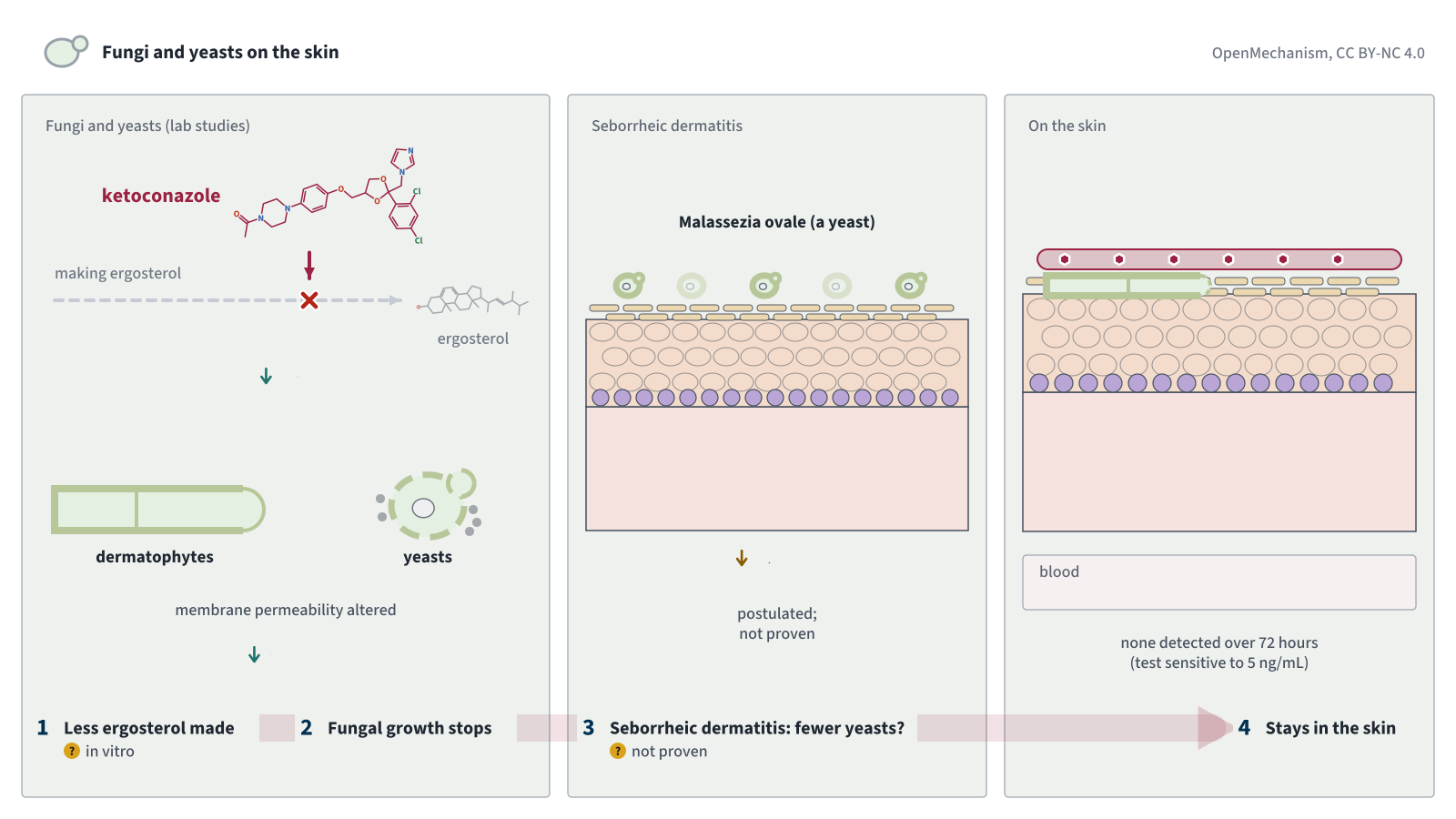
Ketoconazole cream acts on fungi and yeasts on the skin. Laboratory studies suggest it impairs the making of ergosterol, a vital part of the fungal cell membrane; it alters the membrane's permeability and stops the fungi growing. It is used for ringworm-type infections, tinea versicolor, skin candidiasis and seborrheic dermatitis, where how it helps is not proven. None was found in the blood after use on the skin.
- Acts on
- Ergosterol synthesis in the fungal cell membrane (in vitro)
- Where
- Fungi and yeasts on the skin
- Medicine type
- Small molecule
- Used for
- Skin
- Drug class
- Antifungals
Step 1: in vitro
The ketoconazole cream label says: In vitro studies suggest that ketoconazole impairs the synthesis of ergosterol, which is a vital component of fungal cell membranes.
Clinical study: In a double-blind trial in 101 people with tinea versicolor, ketoconazole 2% cream was compared with a placebo cream; the trial measured clinical response and fungal cure, not how ketoconazole works: There was an overall 84% mycologic cure rate (negative KOH at treatment end) for patients using ketoconazole 2% cream and 10% for those using placebo cream
Savin RC, Horwitz SN, J Am Acad Dermatol 1986 (PMID 3760275)
This study was picked with a literature search and is not yet checked by our reviewer.
Step 3: not proven
The ketoconazole cream label says: It is postulated that the therapeutic effect of ketoconazole in seborrheic dermatitis is due to the reduction of M. ovale, but this has not been proven.
Clinical study: A Cochrane review of topical antifungals for seborrheic dermatitis (low-quality evidence), which measured clearance of the rash, not whether the yeast was reduced, found, for ketoconazole compared with placebo: Topical ketoconazole 2% treatment showed a 31% lower risk of failed clearance of rashes compared with placebo
Okokon EO et al., Cochrane Database Syst Rev 2015 (PMID 25933684)
This study was picked with a literature search and is not yet checked by our reviewer.
How it works
Less ergosterol made. In vitro studies suggest that ketoconazole impairs the making of ergosterol, a vital component of fungal cell membranes.1
Fungal growth stops. Ketoconazole is a broad-spectrum antifungal that, in the laboratory, stops the growth of common dermatophytes (such as Trichophyton, Microsporum and Epidermophyton) and yeasts (Candida and Malassezia) by altering the permeability of their cell membrane. The cream is used for tinea (ringworm) infections of the body, groin and feet, tinea versicolor, skin candidiasis and seborrheic dermatitis.1
Seborrheic dermatitis: fewer yeasts? It is postulated that ketoconazole helps seborrheic dermatitis by reducing the yeast Malassezia ovale, but this has not been proven.1
Stays in the skin. After a single application of the cream to the chest, back and arms of healthy volunteers, no ketoconazole was detected in the blood over 72 hours, with a test sensitive to 5 ng/mL.1
For teachers: download this drawing.
See also
Condition pages: ringworm (tinea).
Other antifungals: amphotericin B, caspofungin and fluconazole.
Body system: skin, hair & nails.
Sources
- 1Ketoconazole cream 2% (Sun Pharmaceutical): FDA labelIndications and Usage; Clinical Pharmacology; Microbiology; Mode of Action
- 2ChEMBL CHEMBL157101Target and action classification: Cytochrome P450 51 inhibitor
- 3Double-blind comparison of 2% ketoconazole cream and placebo in the treatment of tinea versicolorSavin RC, Horwitz SN. J Am Acad Dermatol 1986 (abstract)
- 4Topical antifungals for seborrhoeic dermatitisOkokon EO et al. Cochrane Database Syst Rev 2015 (abstract)
Spotted a mistake? Report an error (hello@openmechanism.com). Since launch, every published error we fix is listed on the corrections page.
Notes and limits
- A schematic teaching drawing: not to scale, not exact structures, binding poses or a complete pathway, and not a guide to dosing, treatment or how a person will respond.
- The label says in vitro studies suggest that ketoconazole impairs the synthesis of ergosterol.
- The label says it is postulated that ketoconazole's effect in seborrheic dermatitis is due to the reduction of M. ovale, but this has not been proven.
All recorded limits are on the evidence page, and notes that apply to every page are on How to read a page. Version 1.0.0, not yet medically reviewed.
Cite this page
Tran D. Ketoconazole [Internet]. OpenMechanism; 2026 [updated 2026 Oct 11; cited 2026 Oct 11]. Available from: https://openmechanism.com/medicines/ketoconazole