Tretinoin
Tretinoin, a metabolite of vitamin A, activates retinoic acid receptors. How it works in acne is not known exactly: current evidence suggests the cells lining the hair follicle stick together less, so fewer small plugs form, and they divide and turn over faster, pushing plugs out. Very little reaches the blood.
- Acts on
- Retinoic acid receptors (, RARβ, RARγ)
- Where
- Hair follicles in the skin
- Medicine type
- Small molecule
- Used for
- Skin
Also called Retin-A Micro.
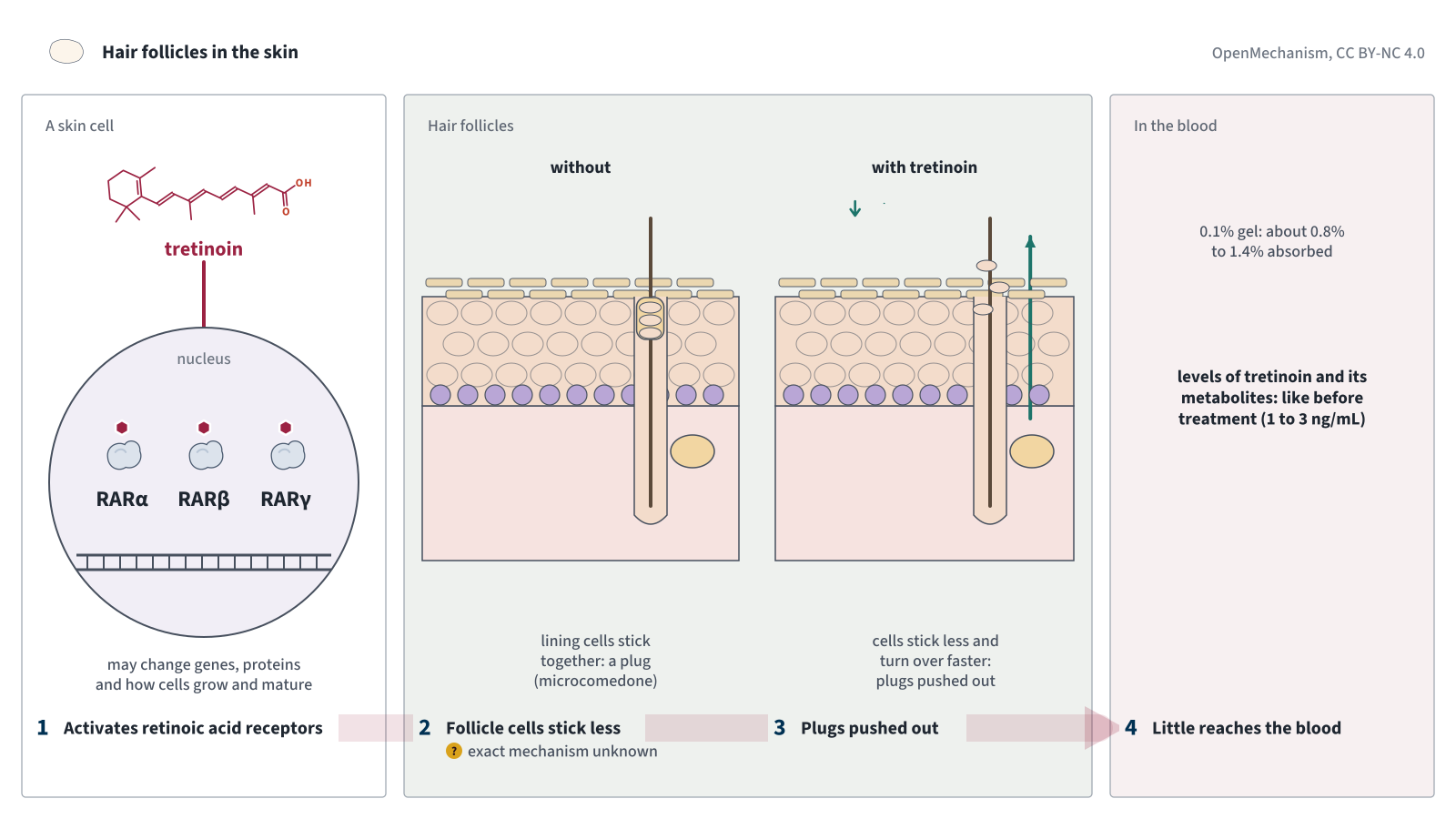
Step 2: exact mechanism unknown
The Retin-A Micro (tretinoin) label says: The exact mechanism of action of topical tretinoin for treatment of acne vulgaris is unknown. … it has not been established whether the clinical effects of tretinoin are mediated through activation of retinoic acid receptors and/or other mechanisms.
Clinical study: In a randomized, double-blind trial in 178 adults with mild to moderate acne, tretinoin gel microsphere 0.04% was compared with its vehicle for 12 weeks; the trial measured acne lesion counts, not how tretinoin works: at week 12, mean total, inflammatory, and noninflammatory lesion counts were statistically significantly lower in the tretinoin treatment group versus vehicle group
Berger R et al., Cutis 2007 (PMID 17944177)
This study was picked with a literature search and is not yet checked by our reviewer.
Key terms in this drawing
- RAR
- Retinoic acid receptors (RARα, RARβ, RARγ). Three nuclear receptors that tretinoin switches on; they may change gene activity and skin-cell growth, though it is not established that tretinoin works this way.
How it works
Activates retinoic acid receptors. Tretinoin, all-trans-retinoic acid, is a retinoid and a metabolite of naturally occurring vitamin A. It activates three retinoic acid receptors, nuclear receptors called RARα, RARβ and RARγ, which may change gene expression, the proteins then made, and the growth and maturing (differentiation) of epithelial cells.1
Follicle cells stick less. The exact mechanism in acne is unknown, and it has not been established whether tretinoin's effects come through these receptors and/or other mechanisms. Current evidence suggests that it makes the cells lining the hair follicle stick together less, so fewer microcomedones (the first small plugs) form.1
Plugs pushed out. Tretinoin also stimulates the follicle lining cells to divide and turn over faster, which pushes comedones out.1
Little reaches the blood. With a 0.1% tretinoin gel, about 0.8% to 1.4% of the dose was absorbed. With Retin-A Micro 0.1%, blood levels of tretinoin and its metabolites (generally 1 to 3 ng/mL) were essentially unchanged from levels before treatment.1
For teachers: download this drawing.
See also
Condition pages: acne.
Body system: skin, hair & nails.
Sources
- 1Retin-A Micro (tretinoin gel) microsphere: FDA label11 Description; 12.1 Mechanism of Action; 12.3 Pharmacokinetics
- 2ChEMBL CHEMBL38Target and action classification: Retinoic acid receptor agonist
- 3
Spotted a mistake? Report an error (hello@openmechanism.com). Since launch, every published error we fix is listed on the corrections page.
Notes and limits
- A schematic teaching drawing: not to scale, not exact structures, binding poses or a complete pathway, and not a guide to dosing, treatment or how a person will respond.
- The label says the exact mechanism of action of topical tretinoin in acne is unknown, and that it has not been established whether its clinical effects come through retinoic acid receptors and/or other mechanisms.
All recorded limits are on the evidence page, and notes that apply to every page are on How to read a page. Version 1.0.0, not yet medically reviewed.
Cite this page
Tran D. Tretinoin [Internet]. OpenMechanism; 2026 [updated 2026 Oct 11; cited 2026 Oct 11]. Available from: https://openmechanism.com/medicines/tretinoin