Acne
Acne is a long-lasting inflammatory disease of the hair follicle and its oil gland. It results from more oil (sebum) driven by androgens, abnormal keratinizing of the follicle's lining, inflammation and bacteria (Propionibacterium acnes) in the follicles. Tretinoin on the skin is thought to loosen the follicle plugs; doxycycline, an antibiotic, may help in severe acne.
- Where
- Hair follicles and oil glands
- Body system
- Skin, hair & nails
- Medicines
- 2 medicines
Mechanism unknown
The Retin-A Micro label says: The exact mechanism of action of topical tretinoin for treatment of acne vulgaris is unknown.
Clinical study: In a randomized, double-blind trial in 178 adults with mild to moderate acne, tretinoin gel microsphere 0.04% was compared with its vehicle for 12 weeks; the trial measured acne lesion counts, not how tretinoin works: at week 12, mean total, inflammatory, and noninflammatory lesion counts were statistically significantly lower in the tretinoin treatment group versus vehicle group
Berger R et al., Cutis 2007 (PMID 17944177)
This study was picked with a literature search and is not yet checked by our reviewer.
May be useful
The doxycycline label says: In severe acne, doxycycline may be useful adjunctive therapy.
Source 5: Doxycycline hyclate tablets: FDA label, Indications and Usage; Description; Mechanism of Action
Clinical study: In a randomized, double-blind, placebo-controlled trial of a low, subantimicrobial dose of doxycycline for 6 months in 51 adults with moderate facial acne; the trial counted lesions and the skin's bacteria: At 6 months, the SD doxycycline group had a significantly greater percent reduction in the number of comedones (P<.01), inflammatory and noninflammatory lesions combined (P<.01), and total inflammatory lesions (P<.05) than did the placebo group. … There were no significant differences in microbial counts between groups and no evidence of change in antibiotic susceptibility or colonization by potential pathogens.
Skidmore R et al., Arch Dermatol 2003 (PMID 12707093)
This study was picked with a literature search and is not yet checked by our reviewer.
For teachers: download this drawing.
What goes wrong
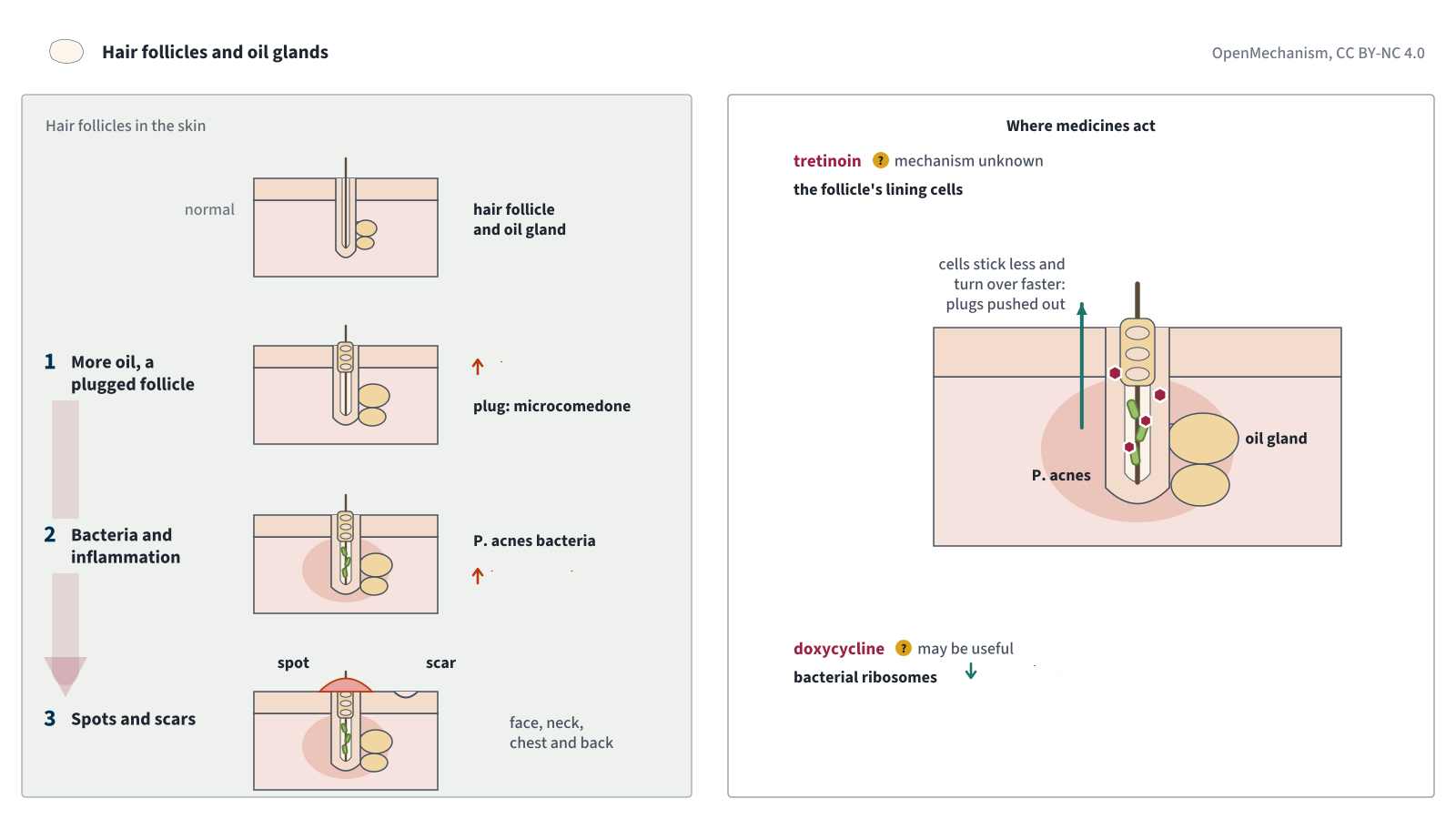
More oil, a plugged follicle. Acne is a long-lasting inflammatory disease of the pilosebaceous unit: the hair follicle, its hair and its oil (sebaceous) gland. Androgens raise the gland's oil (sebum) production, and the follicle's lining keratinizes abnormally; tiny plugs (microcomedones) can form in the follicle.1,2,3
What the source says
“Acne vulgaris is a chronic inflammatory disease - rather than a natural part of the life cycle as colloquially viewed - of the pilosebaceous unit (comprising the hair follicle, hair shaft and sebaceous gland)”
Source 1“Acne is a chronic inflammatory disease of the pilosebaceous unit resulting from androgen-induced increased sebum production, altered keratinisation, inflammation, and bacterial colonisation of hair follicles on the face, neck, chest, and back by Propionibacterium acnes.”
Source 2“Some of the key mechanisms involved in the development of acne include disturbed sebaceous gland activity associated with hyperseborrhoea (that is, increased sebum production) and alterations in sebum fatty acid composition, dysregulation of the hormone microenvironment, interaction with neuropeptides, follicular hyperkeratinization, induction of inflammation and dysfunction of the innate and adaptive immunity.”
Source 1“Current evidence suggests that topical tretinoin decreases cohesiveness of follicular epithelial cells with decreased microcomedone formation.”
Source 3Bacteria and inflammation. Bacteria colonize the follicles; Propionibacterium acnes, among the follicle's microbes, has been linked to acne through its effects on oil, plugs (comedones) and inflammation. Exactly what triggers acne remains unclear.2,4
What the source says
“Acne is a chronic inflammatory disease of the pilosebaceous unit resulting from androgen-induced increased sebum production, altered keratinisation, inflammation, and bacterial colonisation of hair follicles on the face, neck, chest, and back by Propionibacterium acnes.”
Source 2“Among them, Propionibacterium acnes and Malassezia spp. have been linked to acne development through their influence on sebum secretion, comedone formation, and inflammatory response.”
Source 4“Although early colonisation with P acnes and family history might have important roles in the disease, exactly what triggers acne and how treatment affects the course of the disease remain unclear.”
Source 2Spots and scars. Acne affects follicles on the face, neck, chest and back. It commonly causes scarring and lowers quality of life; facial scarring affects up to 20% of teenagers, and acne can last into adulthood.1,2
What the source says
“Acne is a chronic inflammatory disease of the pilosebaceous unit resulting from androgen-induced increased sebum production, altered keratinisation, inflammation, and bacterial colonisation of hair follicles on the face, neck, chest, and back by Propionibacterium acnes.”
Source 2“Acne commonly causes scarring and reduces the quality of life of patients.”
Source 1“Facial scarring due to acne affects up to 20% of teenagers.”
Source 2“Acne can persist into adulthood, with detrimental effects on self-esteem.”
Source 2
Where medicines act
The lining of the hair follicle
- A
Tretinoin targets The follicle's lining cells
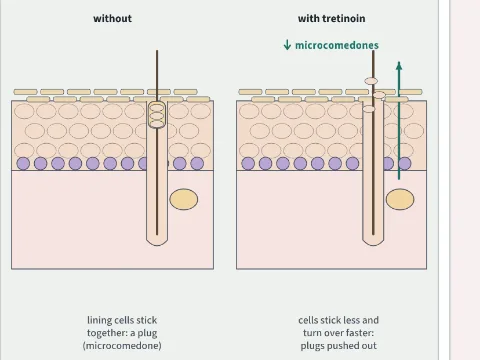
Thought to make the follicle's lining cells stick together less and turn over faster, so plugs are pushed out; exactly how is unknown.3
Used forAcne: on the skin, from age 12
What the label says
“RETIN-A MICRO ® is indicated for the topical treatment of acne vulgaris in adults and pediatric patients 12 years of age and older.”
Source 3“Although tretinoin activates three members of the retinoic acid (RAR) nuclear receptors (RARα, RARβ, and RARγ) which may act to modify gene expression, subsequent protein synthesis, and epithelial cell growth and differentiation, it has not been established whether the clinical effects of tretinoin are mediated through activation of retinoic acid receptors and/or other mechanisms.”
Source 3“The exact mechanism of action of topical tretinoin for treatment of acne vulgaris is unknown.”
Source 3“Current evidence suggests that topical tretinoin decreases cohesiveness of follicular epithelial cells with decreased microcomedone formation.”
Source 3“Additionally, tretinoin stimulates mitotic activity and increased turnover of follicular epithelial cells causing extrusion of the comedones.”
Source 3
Bacteria in the follicle
- B
Doxycycline targets Bacterial ribosomes
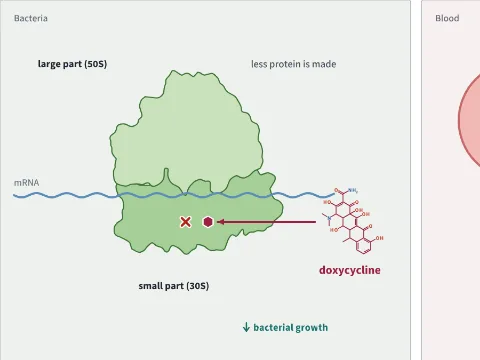
Holds back bacteria by blocking their ribosomes; may help as added treatment in severe acne.4,5
Used forSevere acne: as added (adjunctive) treatment
What the label says
“In severe acne, doxycycline may be useful adjunctive therapy.”
Source 5“Doxycycline hyclate is an antibacterial drug synthetically derived from oxytetracycline, and is available as doxycycline hyclate (doxycycline hydrochloride hemiethanolate hemihydrate) capsules and tablets for oral administration.”
Source 5“Doxycycline inhibits bacterial protein synthesis by binding to the 30S ribosomal subunit.”
Source 5“Doxycycline has bacteriostatic activity against a broad range of Gram-positive and Gram-negative bacteria.”
Source 5“Antibiotics targeting P. acnes have been the mainstay in acne treatment for the past four decades.”
Source 4“Among them, macrolides, clindamycin, and tetracyclines are the most widely prescribed.”
Source 4
See also
Body system: skin, hair & nails.
Other conditions: eczema (atopic dermatitis), psoriasis, malaria, syphilis and urinary tract infections.
Side effects: why tetracyclines can stain developing teeth.
Interactions: antibiotics and antacids, calcium or iron.
Sources
- 1Acne vulgarisMoradi Tuchayi S et al. Nat Rev Dis Primers 2015 (abstract). Saved copy
- 2Acne vulgarisWilliams HC et al. Lancet 2012 (abstract). Saved copy
- 3Retin-A Micro (tretinoin gel) microsphere: FDA label1 Indications and Usage; 12.1 Mechanism of Action. Saved copy
- 4Acne, the skin microbiome, and antibiotic treatmentXu H, Li H. Am J Clin Dermatol 2019 (abstract). Saved copy
- 5Doxycycline hyclate tablets: FDA labelIndications and Usage; Description; Mechanism of Action. Saved copy
- 6
- 7Effects of subantimicrobial-dose doxycycline in the treatment of moderate acneSkidmore R et al. Arch Dermatol 2003 (abstract). Saved copy
Notes and limits
- There is no ideal treatment for acne, though one that reduces spots can be found for most people, and good-quality evidence comparing the common treatments is scarce.2
- A 2012 review says severe inflammatory acne usually needs oral antibiotics combined with benzoyl peroxide on the skin, to reduce antibiotic-resistant bacteria; a 2019 review notes that antibiotic resistance is an increasing concern.2,4
- A 2012 review calls oral isotretinoin the most effective treatment, used early in severe acne, though harm to unborn babies and other side effects limit its use, and says combined oral contraceptives can help women with acne.2
- Diet has been suspected in acne but not proven.2
Notes that apply to every page are on How to read a page.
Spotted a mistake? Report an error (hello@openmechanism.com). Since launch, every published error we fix is listed on the corrections page.
Cite this page
Tran D. Acne [Internet]. OpenMechanism; 2026 [updated 2026 Nov 18; cited 2026 Nov 18]. Available from: https://openmechanism.com/conditions/acne