Griseofulvin
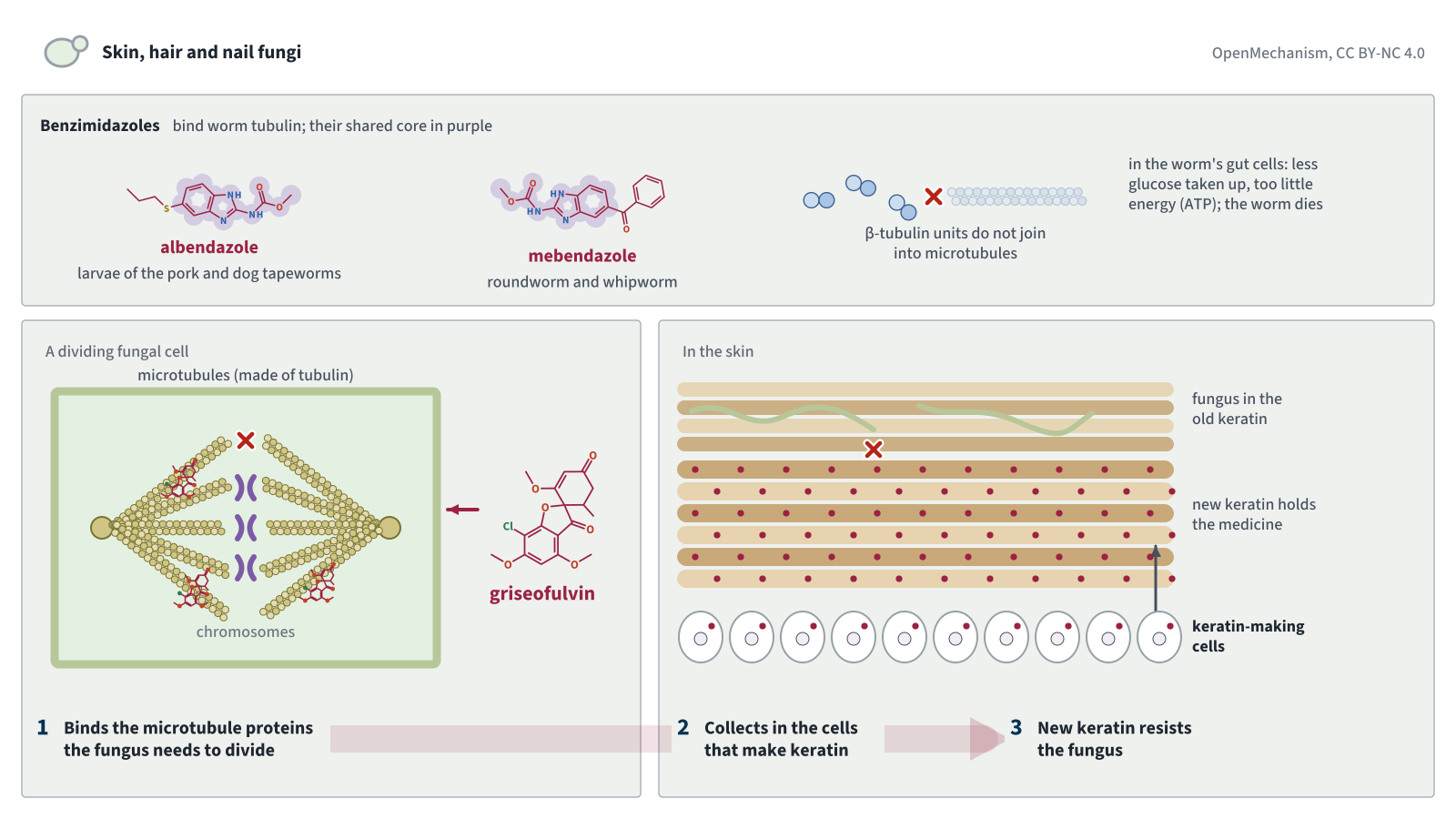
Griseofulvin binds proteins, which fungi need for cell division (mitosis); the label calls it fungistatic. Taken by mouth, it collects in the cells that make keratin and is tightly bound to the new keratin, which becomes highly resistant to fungal invasion.
- Acts on
- Microtubule proteins required for mitosis
- Where
- Dermatophyte fungi of the skin, hair and nails
- Medicine type
- Small molecule
- Used for
- Skin
Key terms in this drawing
- ATP
- Adenosine triphosphate. The molecule cells use to carry energy.
- microtubule
- Microtubule. A structure inside the cell, built from the protein tubulin, that the cell needs for dividing and for other vital work.
How it works
Binds the microtubule proteins the fungus needs to divide. The mechanism of griseofulvin consists of binding microtubular proteins, which are required for mitosis.1
Collects in the cells that make keratin. Following oral administration, griseofulvin is deposited in the keratin precursor cells and has a greater for diseased tissue.1
New keratin resists the fungus. The medicine is tightly bound to the new keratin, which becomes highly resistant to fungal invasions.1
For teachers: download this drawing.
See also
Condition pages: nail fungus and ringworm (tinea).
Related drawings: albendazole (binds the beta-tubulin of worms).
Body system: skin, hair & nails.
Sources
- 1Griseofulvin tablets (microsize): FDA labelMechanism of Action; Clinical Pharmacology; Description
- 2ChEMBL CHEMBL562Target and action classification: Tubulin inhibitor
Also used for the drawing
The drawing also shows the benzimidazoles (albendazole and mebendazole), which bind the tubulin of worms. These sources support that part; the steps above come from the sources listed above.
- 3Albendazole tablets: FDA label1 Indications and Usage; 12.4 Microbiology: Mechanism of Action, Mechanism of Resistance
- 4Vermox (mebendazole): FDA label1 Indications and Usage; 12.4 Microbiology
- 5Structures: ChEMBL (albendazole CHEMBL1483, mebendazole CHEMBL685)canonical structures from the Atlas catalog snapshot
Spotted a mistake? Report an error (hello@openmechanism.com). Since launch, every published error we fix is listed on the corrections page.
Notes and limits
- A schematic teaching drawing: not to scale, not exact structures, binding poses or a complete pathway, and not a guide to dosing, treatment or how a person will respond.
- The label says griseofulvin has no effect on bacteria or on other genera of fungi.
- The label calls griseofulvin a fungistatic antibiotic.
All recorded limits are on the evidence page, and notes that apply to every page are on How to read a page. Version 1.0.0, not yet medically reviewed.
Cite this page
Tran D. Griseofulvin [Internet]. OpenMechanism; 2026 [updated 2026 Oct 15; cited 2026 Oct 15]. Available from: https://openmechanism.com/medicines/griseofulvin