Dupilumab
Dupilumab is a human antibody that binds , a receptor part shared by the signals and , and so blocks both. These signals drive inflammation in atopic dermatitis, asthma, nasal polyps and other conditions; in asthma, dupilumab lowered , exhaled and other markers compared with placebo, though the label says the mechanism has not been definitively established. Its label lists it for moderate-to-severe atopic dermatitis not adequately controlled with prescription treatments put on the skin, or when those treatments are not advisable (from 6 months of age); as an add-on maintenance treatment for moderate-to-severe asthma with an eosinophilic phenotype, or asthma that depends on corticosteroids taken by mouth (from 6 years), but not for the relief of sudden airway narrowing (acute bronchospasm) or status asthmaticus; as an add-on maintenance treatment for inadequately controlled chronic rhinosinusitis with nasal polyps (from 12 years); for eosinophilic esophagitis (from 1 year, weighing at least 15 kg); for prurigo nodularis (adults); as an add-on maintenance treatment for inadequately controlled chronic obstructive pulmonary disease () with an eosinophilic phenotype (adults), but not for the relief of acute bronchospasm; for chronic spontaneous urticaria that stays symptomatic despite H1 antihistamine treatment (from 2 years), but not other forms of urticaria; for bullous pemphigoid (adults); and for allergic fungal rhinosinusitis in people who have had sino-nasal surgery (from 6 years).
- Acts on
- IL-4Rα, the receptor subunit shared by IL-4 and IL-13
- Where
- Cells that carry IL-4Rα, such as mast cells, eosinophils, lymphocytes and lining (epithelial) cells
- Used for
- Skin
- Drug class
- Antibody medicines
Also called Dupixent.
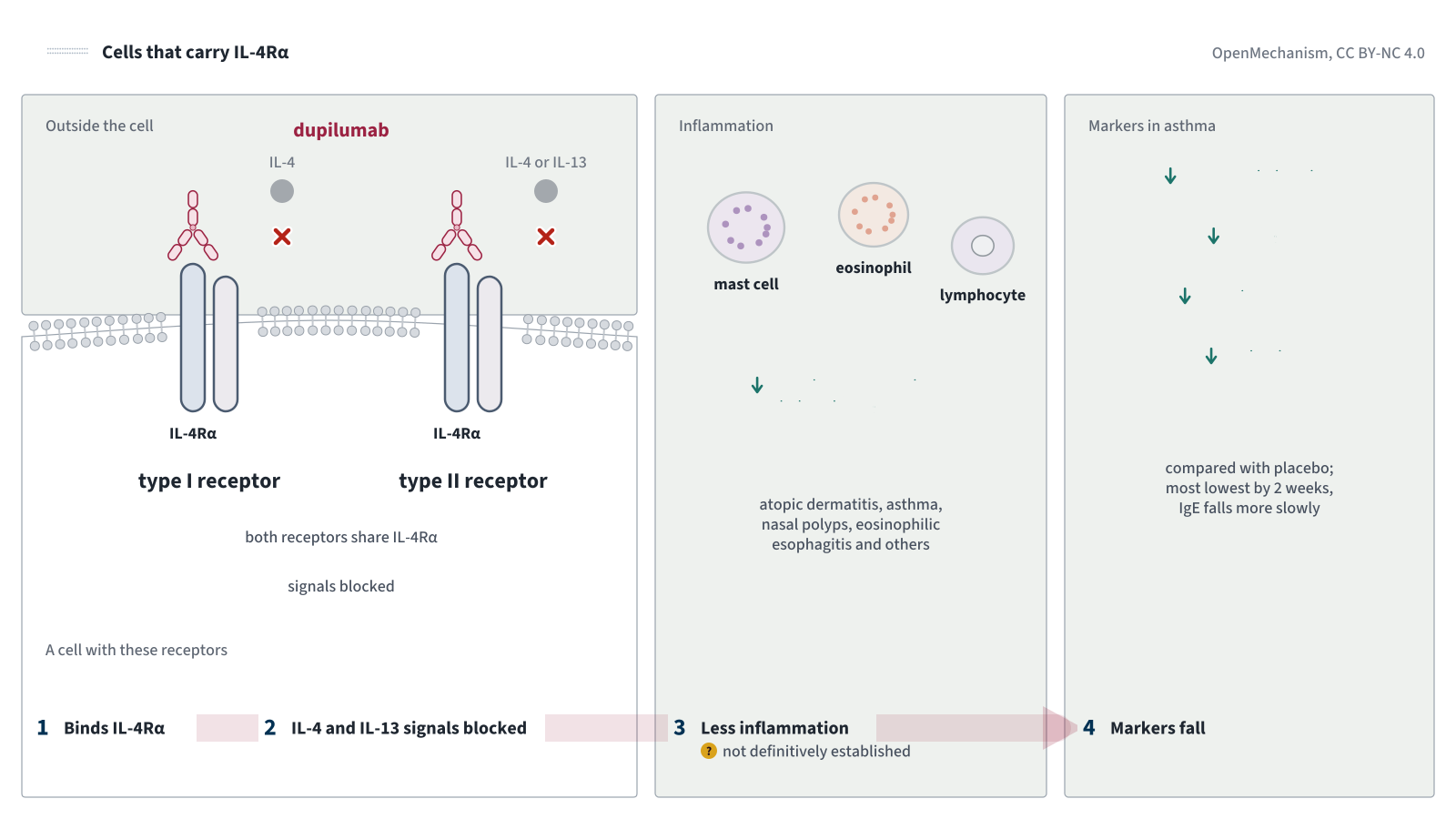
Step 3: not definitively established
The Dupixent (dupilumab) label says: The mechanism of dupilumab action has not been definitively established.
Clinical study: In two randomized, placebo-controlled phase 3 trials published in 2016 (SOLO 1 and SOLO 2), 671 and 708 adults with moderate-to-severe atopic dermatitis inadequately controlled by treatment put on the skin got dupilumab 300 mg under the skin weekly or every other week, or placebo, for 16 weeks; the trials measured how many people had clear or almost clear skin on the Investigator's Global Assessment, with a fall of 2 points or more in that score, at week 16, not how dupilumab works: In SOLO 1, the primary outcome occurred in 85 patients (38%) who received dupilumab every other week and in 83 (37%) who received dupilumab weekly, as compared with 23 (10%) who received placebo (P<0.001 for both comparisons with placebo). The results were similar in SOLO 2, with the primary outcome occurring in 84 patients (36%) who received dupilumab every other week and in 87 (36%) who received dupilumab weekly, as compared with 20 (8%) who received placebo (P<0.001 for both comparisons).
Simpson EL et al., N Engl J Med 2016 (PMID 27690741)
Key terms in this drawing (7)
- cytokines
- Cytokines. Signal molecules involved in inflammation, such as interleukin-2, interferon-γ, interleukin-4 and TNF-α, which T cells make.
- IgE
- Immunoglobulin E. A type of antibody involved in allergic reactions.
- IL-13
- Interleukin-13. A cytokine made by Th2 cells; with IL-4 it signals the switch from IgM to IgE antibodies.
- IL-4
- Interleukin-4. A cytokine made by Th2 cells; with IL-13 it signals the switch from IgM to IgE antibodies.
- IL-4Rα
- Interleukin-4 receptor alpha subunit. The receptor part shared by the IL-4 and IL-13 receptors; dupilumab binds it and blocks both signals.
- mast cell
- Mast cell. An immune cell in tissues such as the skin and the airways that releases histamine and other signals.
- NO
- Nitric oxide. A signal molecule released by nerve endings and the cells lining blood vessels; it makes smooth muscle cells produce cGMP.
How it works
Binds IL-4Rα. Dupilumab, a human monoclonal antibody, binds specifically to IL-4Rα, the receptor subunit shared by the interleukin-4 (IL-4) and interleukin-13 (IL-13) receptor complexes.1
IL-4 and IL-13 signals blocked. It inhibits IL-4 signaling through the type I receptor, and both IL-4 and IL-13 signaling through the type II receptor.1
Less inflammation. Inflammation driven by IL-4 and IL-13 is important in asthma, atopic dermatitis, chronic rhinosinusitis with nasal polyps, eosinophilic esophagitis and other conditions; many cells carry IL-4Rα, among them , eosinophils, lymphocytes and lining (epithelial) cells. Blocking IL-4Rα holds back IL-4- and IL-13-induced inflammatory responses, including the release of pro-inflammatory , chemokines, nitric oxide and IgE. The label says the mechanism of dupilumab's action has not been definitively established.1
Markers fall. In asthma, some markers of inflammation fell compared with placebo: exhaled nitric oxide (FeNO) and the blood levels of eotaxin-3, total and allergen-specific IgE, TARC and periostin; most were near their lowest after 2 weeks, while IgE fell more slowly.1
For teachers: download this drawing.
See also
Condition pages: asthma, chronic hives (urticaria), chronic obstructive pulmonary disease (COPD), eczema (atopic dermatitis) and chronic sinusitis with nasal polyps.
Other antibody medicines: adalimumab, bevacizumab, bezlotoxumab, blinatumomab, burosumab, denosumab, eculizumab, emicizumab and 14 more.
Body system: skin, hair & nails.
Sources
- 1Dupixent (dupilumab) injection: FDA label1 Indications and Usage; 11 Description; 12.1 Mechanism of Action; 12.2 Pharmacodynamics
- 2ChEMBL CHEMBL2108675Target and action classification: Interleukin-4 receptor subunit alpha antagonist
- 3Two Phase 3 Trials of Dupilumab versus Placebo in Atopic DermatitisSimpson EL et al. N Engl J Med 2016 (abstract)
Spotted a mistake? Report an error (hello@openmechanism.com). Since launch, every published error we fix is listed on the corrections page.
Notes and limits
- A schematic teaching drawing: not to scale, not exact structures, binding poses or a complete pathway, and not a guide to dosing, treatment or how a person will respond.
- The label says the mechanism of dupilumab action has not been definitively established.
All recorded limits are on the evidence page, and notes that apply to every page are on How to read a page. Version 1.0.1, medically reviewed by Daniel Tran, PharmD, on 14 November 2026.
Cite this page
Tran D. Dupilumab [Internet]. OpenMechanism; 2026 [updated 2026 Nov 14; cited 2026 Nov 14]. Available from: https://openmechanism.com/medicines/dupilumab