Mupirocin
Mupirocin ointment blocks the bacteria's , the enzyme that loads isoleucine for protein making, so the bacteria stop making proteins and are killed. It is used for caused by Staphylococcus aureus and Streptococcus pyogenes. Resistance comes from a changed or new enzyme, and none was measured in the blood after use on the skin.
- Acts on
- Bacterial isoleucyl-tRNA synthetase
- Where
- Bacteria on the skin
- Medicine type
- Small molecule
- Used for
- Skin
- Drug class
- Antibiotics
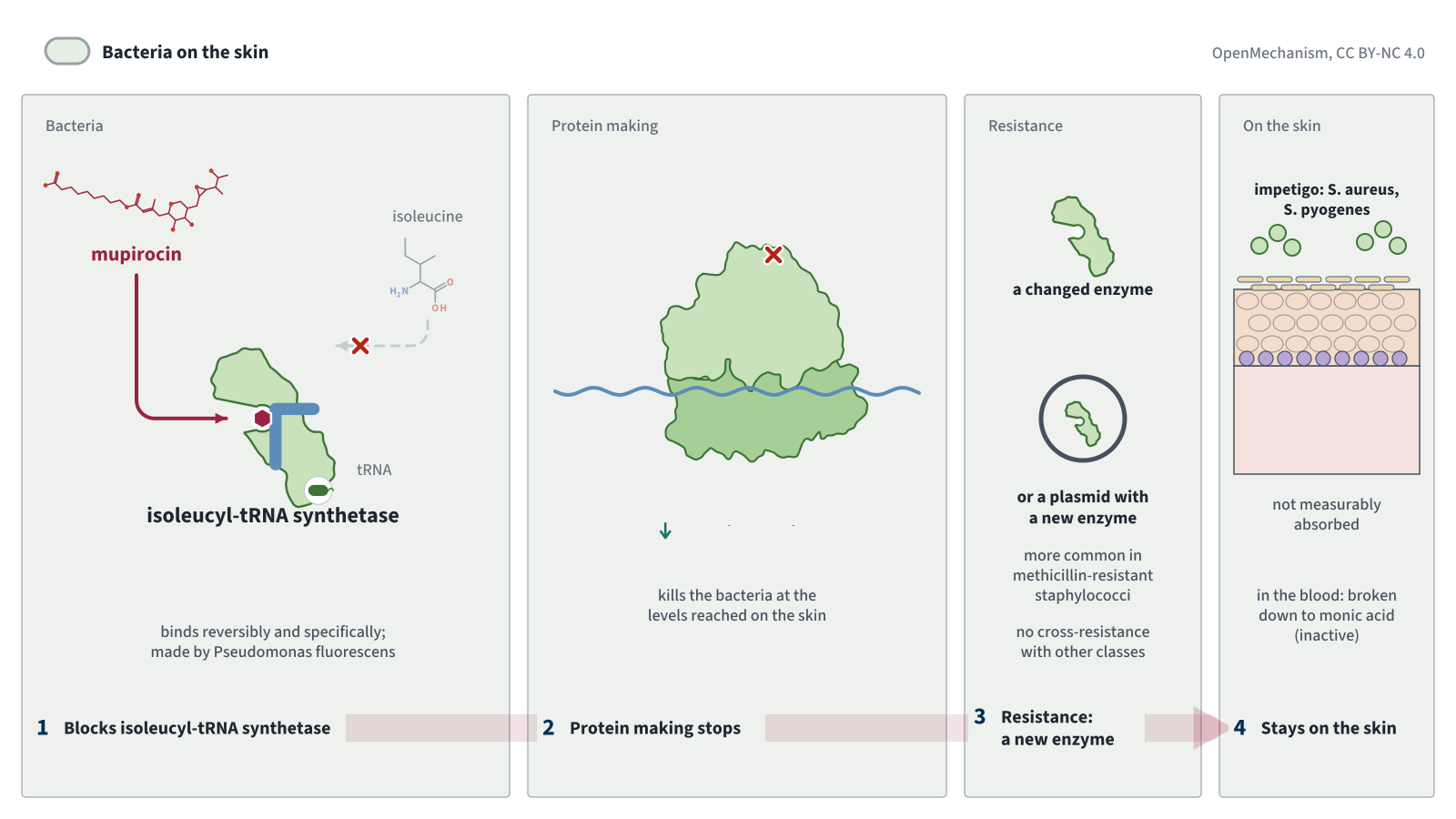
Key terms in this drawing
- impetigo
- Impetigo. A bacterial skin infection with red sores or blisters that turn into a honey-colored crust.
- tRNA
- Transfer RNA. An RNA that carries an amino acid into the ribosome.
- tRNA synthetase
- Aminoacyl-tRNA synthetase. An enzyme the cell needs to make proteins; mupirocin binds and blocks the bacterial isoleucyl-tRNA synthetase.
How it works
Blocks isoleucyl-tRNA synthetase. Mupirocin, an antibacterial made by the bacterium Pseudomonas fluorescens, binds reversibly and specifically to the bacteria's isoleucyl-transfer () synthetase, the enzyme that loads the amino acid isoleucine onto its tRNA.1
Protein making stops. This stops the bacteria making proteins. At the levels reached on the skin mupirocin kills bacteria (it is bactericidal); it is used for impetigo caused by Staphylococcus aureus and Streptococcus pyogenes.1
Resistance: a new enzyme. Resistance comes from a changed isoleucyl-tRNA synthetase, or from a plasmid that brings in a new one; it is more common in methicillin-resistant than in methicillin-susceptible staphylococci. Because of its mode of action, mupirocin shows no cross-resistance with other classes of antibacterials.1
Stays on the skin. Applied to the arm under a dressing for 24 hours, mupirocin was not measurably absorbed into the blood. Given into a vein or by mouth, it is quickly broken down to monic acid, which has no antibacterial activity.1
For teachers: download this drawing.
See also
Condition pages: skin and soft-tissue infections.
Other antibiotics: amoxicillin; amoxicillin and clavulanate; azithromycin; bedaquiline; ceftazidime and avibactam; ceftriaxone; cephalexin; ciprofloxacin; and 14 more.
Body system: skin, hair & nails.
Sources
- 1Mupirocin ointment 2% (Sun Pharmaceutical): FDA label1 Indications and Usage; 12.3 Pharmacokinetics; 12.4 Microbiology
- 2ChEMBL CHEMBL719Target and action classification: Isoleucyl-tRNA synthetase inhibitor
Also used for the drawing
The isoleucyl-tRNA synthetase and ribosome outlines are traced from the crystal and electron microscopy structures below.
- 3Isoleucyl-tRNA synthetase with its tRNA and mupirocinPDB 1QU2; Silvian, L.F. et al. Science 1999; 285:1074-1077
- 4Escherichia coli stalled ribosome with linezolidPDB 7S1G; Tsai, K. et al. Nat.Struct.Mol.Biol. 2022; 29:162-171
Spotted a mistake? Report an error (hello@openmechanism.com). Since launch, every published error we fix is listed on the corrections page.
Notes and limits
- A schematic teaching drawing: not to scale, not exact structures, binding poses or a complete pathway, and not a guide to dosing, treatment or how a person will respond.
All recorded limits are on the evidence page, and notes that apply to every page are on How to read a page. Version 1.0.0, not yet medically reviewed.
Cite this page
Tran D. Mupirocin [Internet]. OpenMechanism; 2026 [updated 2026 Oct 11; cited 2026 Oct 11]. Available from: https://openmechanism.com/medicines/mupirocin