Lungs & airways
How airway muscle and inflammation control the flow of air.
For teachers: download this drawing.
Key terms in this drawing
- IgE
- Immunoglobulin E. A type of antibody involved in allergic reactions.
- mast cell
- Mast cell. An immune cell in tissues such as the skin and the airways that releases histamine and other signals.
How it works
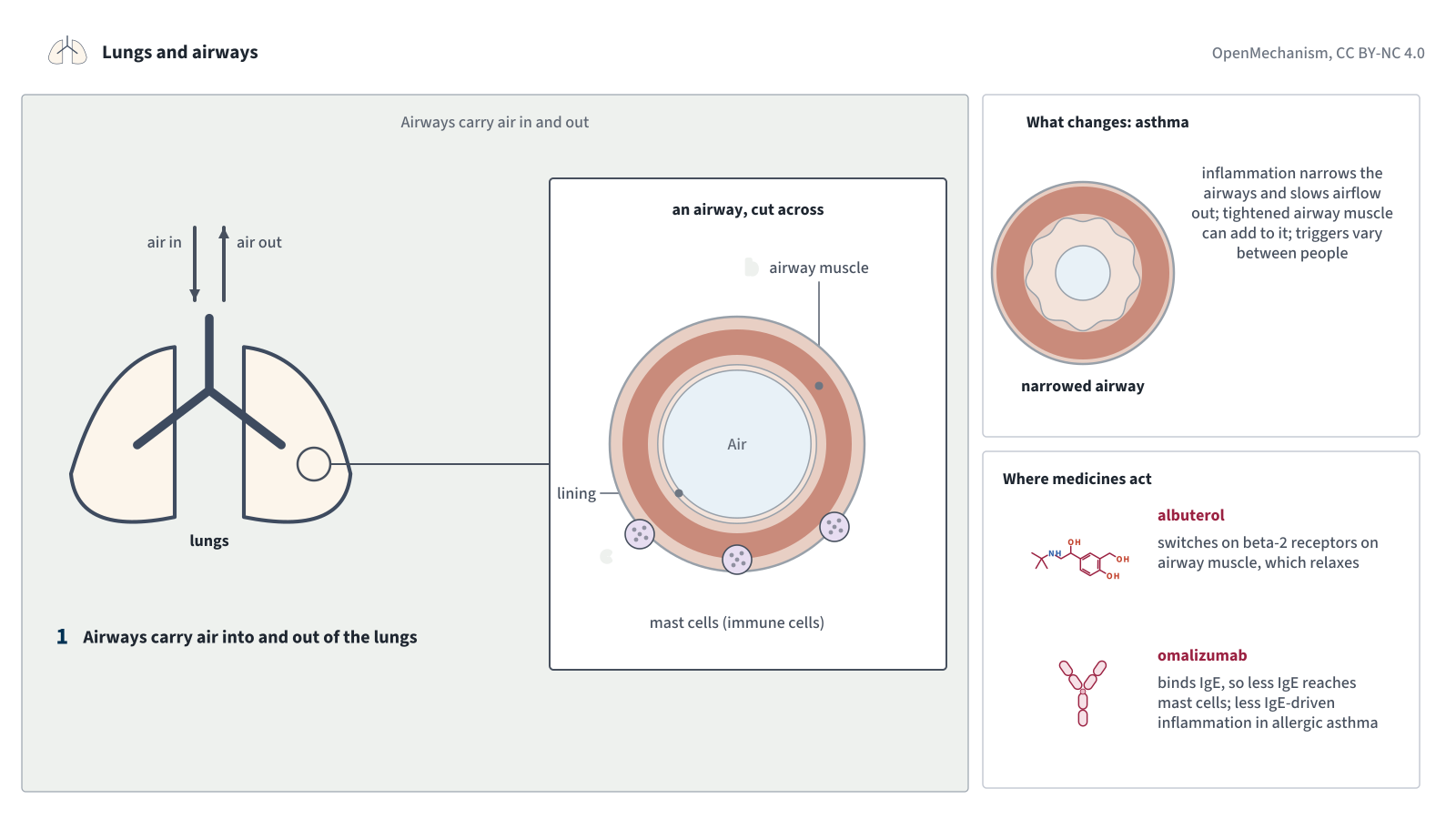
Airways carry air into and out of the lungs. The lungs are a system of highly branched tubes that bring air to the alveoli, where gas exchange takes place. The airways' main jobs are to give incoming and outgoing air its route, clean it of debris and germs, and warm and moisten it.1,2
What the source says
“Lungs are composed of a system of highly branched tubes that bring air into the alveoli, where gas exchange takes place.”
Source 1“The major functions of the conducting zone are to provide a route for incoming and outgoing air, remove debris and pathogens from the incoming air, and warm and humidify the incoming air.”
Source 2
What changes in disease
Asthma. Asthma is a long-term disease of inflamed, swollen airways that overreact. Their narrowing usually reverses; after a trigger, the air a person can breathe out hard in one second falls.2,3
What the source says
“Asthma is a chronic disease characterized by inflammation and edema of the airway, and bronchospasms (that is, constriction of the bronchioles), which can inhibit air from entering the lungs.”
Source 2“Asthma is best described as a chronic disease that involves inflammation of the pulmonary airways and bronchial hyperresponsiveness that results in the clinical expression of a lower airway obstruction that usually is reversible.”
Source 3“Bronchial provocation with allergen induces a prompt early phase immunoglobulin E (IgE)-mediated decrease in bronchial airflow (forced expiratory volume in 1 second)”
Source 3Tightened airway muscle can add to the narrowing, and mucus can block the airways further. Triggers vary: dust, pollen, pet hair, mold, smoke, infections, cold air or exercise.2,3,4
What the source says
“(that is, constriction of the bronchioles)”
Source 2“Therefore, β(2)ARs and cAMP are key players in combating the pathophysiology of airway narrowing and remodeling.”
Source 4“In addition, excessive mucus secretion can occur, which further contributes to airway occlusion”
Source 2“An attack may be triggered by environmental factors such as dust, pollen, pet hair, or dander, changes in the weather, mold, tobacco smoke, and respiratory infections, or by exercise and stress.”
Source 2“Other triggers that provoke airway obstruction include cold air, exercise, viral upper respiratory infection, cigarette smoke, and respiratory allergens.”
Source 3
Where medicines act
- b
Albuterol
Switches on beta-2 receptors on airway muscle, which relaxes.
- c
Omalizumab
Binds IgE, so less IgE reaches mast cells; less IgE-driven inflammation in allergic asthma.
See also
Zoom in: inside the airways.
Conditions
- ANCA vasculitis
- Asthma
- Chronic clots in the lung arteries (CTEPH)
- Chronic obstructive pulmonary disease (COPD)
- Chronic sinusitis with nasal polyps
- Cough
- COVID-19
- Cystic fibrosis
- Head and neck cancer
- Influenza
- Non-small cell lung cancer
- Opioid overdose
- Pneumocystis pneumonia (PCP)
- Pneumonia
- Respiratory distress syndrome in preterm babies
- RSV infection
- Small cell lung cancer
- Tuberculosis
More medicines for this area
Sources
- 1Lung organoids: current uses and future promiseBarkauskas CE et al. Development 2017 (abstract). Saved copy
- 2Organs and structures of the respiratory systemOpenStax Anatomy and Physiology 2e, section 22.1 (CC BY-NC-SA 4.0). Saved copy
- 3Understanding asthma pathophysiologyFireman P. Allergy Asthma Proc 2003 (abstract). Saved copy
- 4cAMP regulation of airway smooth muscle functionBillington CK et al. Pulm Pharmacol Ther 2013 (abstract). Saved copy
- 5Ventolin HFA (albuterol): FDA label12.1 Mechanism of Action. Saved copy
- 6Xolair (omalizumab): FDA label12.1 Mechanism of Action. Saved copy
Notes and limits
- Immune cells such as eosinophils may also take part, moving into the walls of the bronchi and bronchioles.2
- The drawing is schematic and not to scale; it shows only what the statements above say.
Spotted a mistake? Report an error (hello@openmechanism.com). Since launch, every published error we fix is listed on the corrections page.
Cite this page
Tran D. Lungs & airways [Internet]. OpenMechanism; 2026 [updated 2026 Nov 13; cited 2026 Nov 13]. Available from: https://openmechanism.com/body/airways