Cystic fibrosis
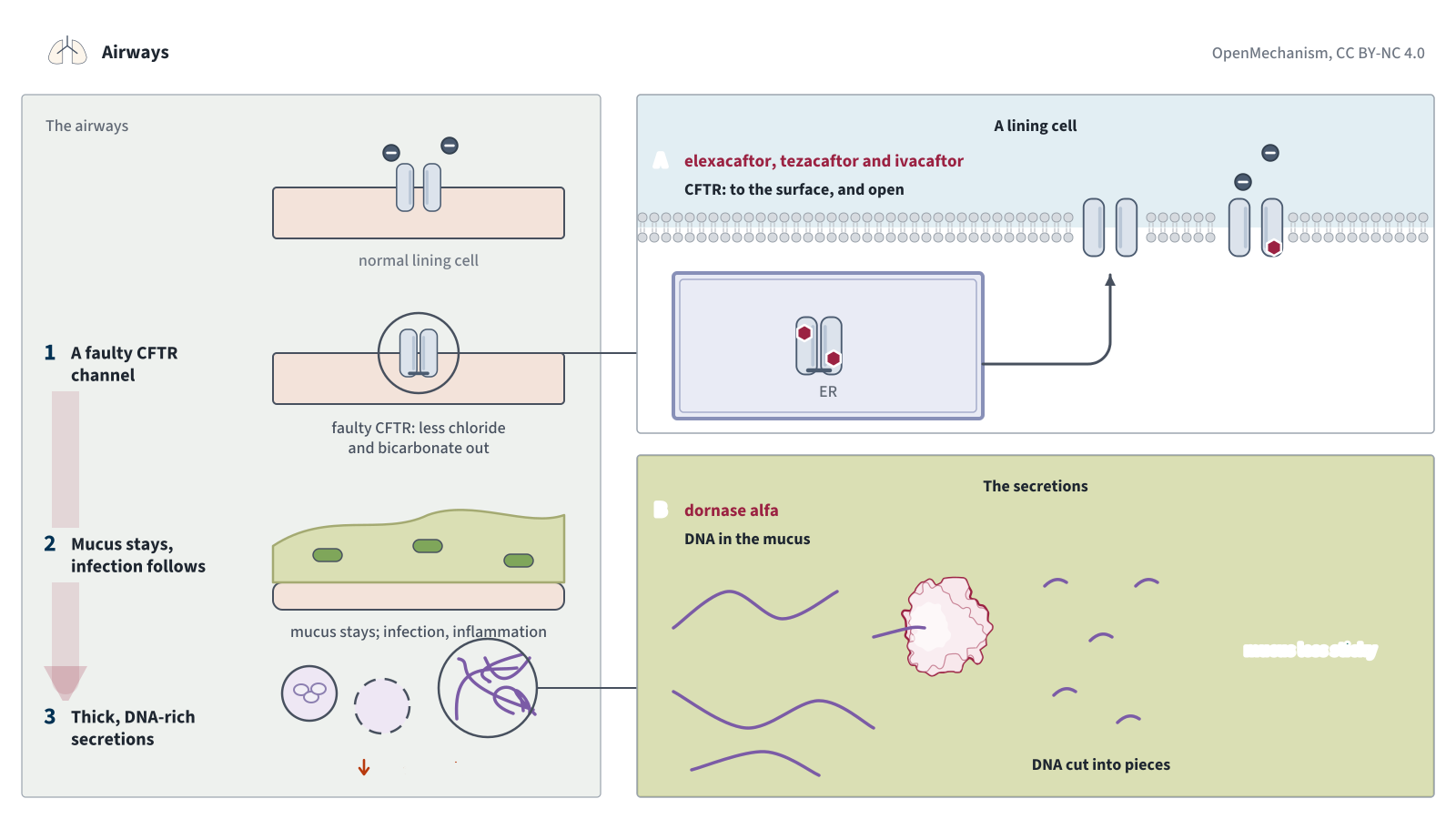
Cystic fibrosis is an inherited disease of CFTR, a chloride and bicarbonate channel in the airway lining; when it fails, mucus is poorly hydrated and cleared. Chronic infection and inflammation follow, and DNA from dying white cells thickens the secretions. Elexacaftor, tezacaftor and ivacaftor bring more CFTR to the cell surface and help it open; dornase alfa cuts that DNA.
- Where
- Airways
- Body system
- Lungs & airways
- Medicines
- 2 medicines
For teachers: download this drawing.
Key terms in this drawing
- CFTR
- Cystic fibrosis transmembrane conductance regulator. A chloride channel; faulty in cystic fibrosis.
- DNA
- Deoxyribonucleic acid. The molecule that stores genes.
What goes wrong
A faulty CFTR channel. comes from changes in the gene, which makes a channel in the lining cells that normally carries chloride and bicarbonate; without it, mucus is poorly hydrated and cleared.1,2
What the source says
“The disease is caused by mutation of a gene that encodes a chloride-conducting transmembrane channel called the cystic fibrosis transmembrane conductance regulator (CFTR), which regulates anion transport and mucociliary clearance in the airways.”
Source 1“Mutations in CFTR, the gene encoding the epithelial ion channel that normally transports chloride and bicarbonate, lead to impaired mucus hydration and clearance.”
Source 2Mucus stays, infection follows. When CFTR fails, mucus stays in the airways, followed by chronic infection and airway inflammation that harms the lungs.1
What the source says
“Functional failure of CFTR results in mucus retention and chronic infection and subsequently in local airway inflammation that is harmful to the lungs.”
Source 1Thick, DNA-rich secretions. White cells gathered against the infection break down and release into the secretions; these thick secretions lower lung function and bring more infections.3
What the source says
“Purulent pulmonary secretions contain very high concentrations of extracellular DNA released by degenerating leukocytes that accumulate in response to infection.”
Source 3“In CF patients, retention of viscous purulent secretions in the airways contributes both to reduced pulmonary function and to exacerbations of infection.”
Source 3
Where medicines act
- A
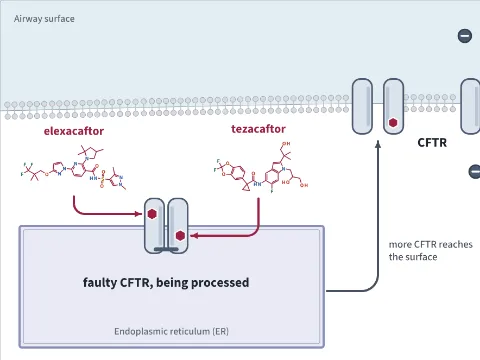
Elexacaftor, tezacaftor and ivacaftor: more CFTR, more open
Elexacaftor and tezacaftor help faulty CFTR (including F508del) reach the cell surface, and ivacaftor helps it open; it treats cystic fibrosis in people with at least one CFTR variant that responds.4
What the source says
“Elexacaftor and tezacaftor bind to different sites on the CFTR protein and have an additive effect in facilitating the cellular processing and trafficking of select mutant forms of CFTR (including F508del-CFTR) to increase the amount of CFTR protein delivered to the cell surface compared to either molecule alone.”
Source 4“Ivacaftor potentiates the channel open probability (or gating) of the CFTR protein at the cell surface.”
Source 4“TRIKAFTA is indicated for the treatment of cystic fibrosis (CF) in adult and pediatric patients aged 2 years and older who have a clinical diagnosis of CF and who have at least one variant in the cystic fibrosis transmembrane conductance regulator ( CFTR ) gene that is either responsive based on clinical and/or in vitro data”
Source 4 - B
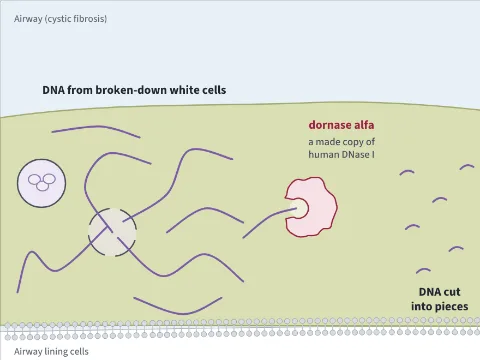
Dornase alfa: the DNA in mucus cut
Dornase alfa is an enzyme that cuts DNA; it breaks down the DNA in cystic fibrosis sputum and makes it less sticky, and is used with standard treatment to improve lung function.3
What the source says
“PULMOZYME is recombinant human deoxyribonuclease I (rhDNase), an enzyme which selectively cleaves DNA.”
Source 3“In preclinical in vitro studies, PULMOZYME hydrolyzes the DNA in sputum of CF patients and reduces sputum viscoelasticity.”
Source 3“for the management of pediatric and adult patients with cystic fibrosis (CF) to improve pulmonary function.”
Source 3
See also
Body system: lungs & airways.
Also used for it: pancrelipase (for exocrine pancreatic insufficiency: “ZENPEP ® is indicated for the treatment of exocrine pancreatic insufficiency in adult and pediatric patients.”5).
Sources
- 1Cystic fibrosisElborn JS. Lancet 2016 (abstract). Saved copy
- 2Cystic fibrosisShteinberg M et al. Lancet 2021 (abstract). Saved copy
- 3Pulmozyme (dornase alfa): FDA label1 Indications and Usage; 12.1 Mechanism of Action. Saved copy
- 4Trikafta (elexacaftor, tezacaftor and ivacaftor): FDA label1 Indications and Usage; 12.1 Mechanism of Action. Saved copy
- 5Zenpep (pancrelipase): FDA label1 Indications and Usage. Saved copy
- 6Recombinant human DNase IPDB 4AWN; Parsiegla, G. et al. Biochemistry 2012;51:10250. The DNase I outline in the drawing is traced from this structure. Saved copy
Notes and limits
- Cystic fibrosis also affects the pancreas, liver, sweat glands and vas deferens; this page shows the lungs.1
- CFTR's failure mainly affects lining cells, but there is evidence of a role in immune cells too.1
- Dornase alfa's effect on sputum was shown in laboratory studies.3
Notes that apply to every page are on How to read a page.
Spotted a mistake? Report an error (hello@openmechanism.com). Since launch, every published error we fix is listed on the corrections page.
Cite this page
Tran D. Cystic fibrosis [Internet]. OpenMechanism; 2026 [updated 2026 Oct 18; cited 2026 Oct 18]. Available from: https://openmechanism.com/conditions/cystic-fibrosis