Chronic clots in the lung arteries (CTEPH)
Chronic thromboembolic pulmonary hypertension (CTEPH) usually follows a clot in the lungs (pulmonary embolism) that does not fully clear: organized clots keep blocking large and middle-sized lung arteries, and the small vessels become diseased too. Pressure rises, leading to right heart failure. Riociguat stimulates sGC, raising cGMP, for people who cannot have surgery or still have high pressure after it.
- Where
- Lung arteries
- Body systems
- Heart, vessels & cholesterol; Lungs & airways
- Medicines
- 1 medicine
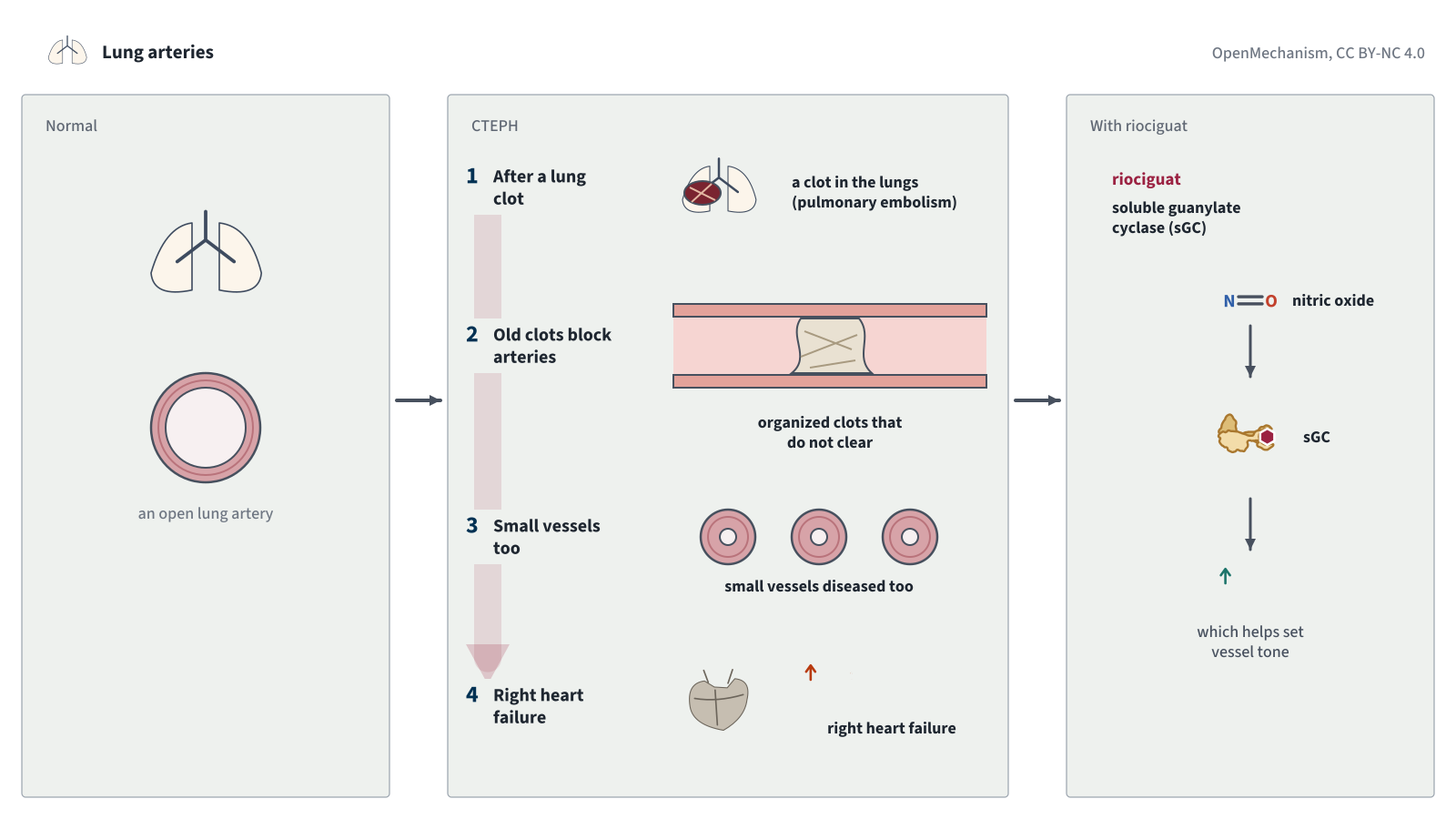
For teachers: download this drawing.
Key terms in this drawing
- cGMP
- Cyclic guanosine monophosphate. A molecule that rises in smooth muscle when nitric oxide activates guanylate cyclase; the rise leads the vessels to widen.
- CTEPH
- Chronic thromboembolic pulmonary hypertension. High blood pressure in the lung arteries that develops after a clot in the lungs (pulmonary embolism).
- NO
- Nitric oxide. A signal molecule released by nerve endings and the cells lining blood vessels; it makes smooth muscle cells produce cGMP.
- sGC
- Soluble guanylate cyclase. An enzyme that makes cGMP when nitric oxide binds it.
What goes wrong
After a lung clot. is a rare, worsening disease of the lung arteries that usually follows a clot in the lungs (pulmonary embolism).1
What the source says
“Chronic thromboembolic pulmonary hypertension (CTEPH) is a rare, progressive pulmonary vascular disease that is usually a consequence of prior acute pulmonary embolism.”
Source 1Old clots block arteries. Organized clots keep blocking large and middle-sized lung arteries. They may fail to clear because clot breakdown is abnormal or because of blood or autoimmune disorders.1
Small vessels too. Disease in the small vessels also adds to the problem and its worsening.1
What the source says
“It is now known that small-vessel abnormalities also contribute to haemodynamic compromise, functional impairment and disease progression in CTEPH.”
Source 1Right heart failure. Pressure in the lung arteries stays high, leading to right heart failure and death.2
What the source says
“Chronic thromboembolic pulmonary hypertension (CTEPH) is a complication of pulmonary embolism and a major cause of chronic PH leading to right heart failure and death.”
Source 2
Where medicines act
- A
Riociguat: sGC stimulated
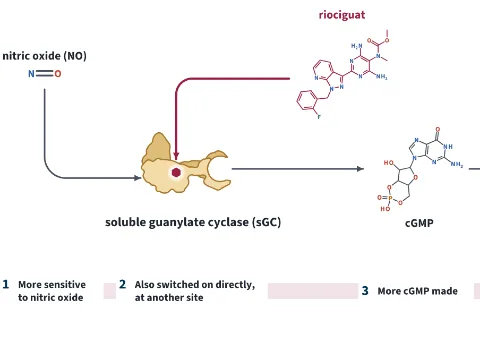
Riociguat stimulates soluble guanylate cyclase (), the receptor for , which makes ; cGMP helps set vessel tone. It treats CTEPH that cannot be operated on or persists after surgery, improving exercise capacity.3
What the source says
“Riociguat is a stimulator of soluble guanylate cyclase (sGC), an enzyme in the cardiopulmonary system and the receptor for nitric oxide (NO).”
Source 3“Intracellular cGMP plays an important role in regulating processes that influence vascular tone, proliferation, fibrosis and inflammation.”
Source 3“Persistent/recurrent Chronic Thromboembolic Pulmonary Hypertension (CTEPH) (WHO Group 4) after surgical treatment or inoperable CTEPH to improve exercise capacity and WHO functional class.”
Source 3
See also
Body systems: heart, vessels & cholesterol; and lungs & airways.
Other conditions: pulmonary arterial hypertension.
Sources
- 1The pathophysiology of chronic thromboembolic pulmonary hypertensionSimonneau G et al. Eur Respir Rev 2017 (abstract). Saved copy
- 2Chronic thromboembolic pulmonary hypertensionKim NH et al. Eur Respir J 2019 (abstract). Saved copy
- 3Adempas (riociguat): FDA label1 Indications and Usage; 12.1 Mechanism of Action. Saved copy
- 4Human soluble guanylate cyclase activated by nitric oxidePDB 6JT2; Kang, Y. et al. Nature 2019;574:206-210. The soluble guanylate cyclase outline in the drawing is traced from this structure. Saved copy
Notes and limits
- A 2019 paper says that, besides long-term blood thinners, every patient should be assessed first for surgery to remove the clots (pulmonary endarterectomy), the treatment guidelines recommend. When surgery is not technically possible, it recommends medicine, currently riociguat, and says balloon pulmonary angioplasty should be considered at an experienced center.2
- What drives the small-vessel disease is not fully understood.1
Notes that apply to every page are on How to read a page.
Spotted a mistake? Report an error (hello@openmechanism.com). Since launch, every published error we fix is listed on the corrections page.
Cite this page
Tran D. Chronic clots in the lung arteries (CTEPH) [Internet]. OpenMechanism; 2026 [updated 2026 Nov 18; cited 2026 Nov 18]. Available from: https://openmechanism.com/conditions/cteph