Tiotropium
Tiotropium blocks , with similar for all five subtypes, M1 to M5. In the airways, blocking on the smooth muscle widens the airways. Inhaled, its airway widening is mainly a local effect, and in preclinical (laboratory and animal) studies its protection against airway narrowing caused by methacholine lasted more than 24 hours. Its label lists it for long-term, once-daily maintenance treatment of airway narrowing (bronchospasm) in and of asthma in people 6 years and older, and to reduce COPD flare-ups (exacerbations); it is not for relieving sudden airway narrowing (acute bronchospasm).
- Acts on
- Muscarinic receptors (M3 on airway smooth muscle)
- Where
- Airway smooth muscle
- Medicine type
- Small molecule
- Used for
- Lungs & airways
Also called Spiriva Respimat (tiotropium inhalation spray).
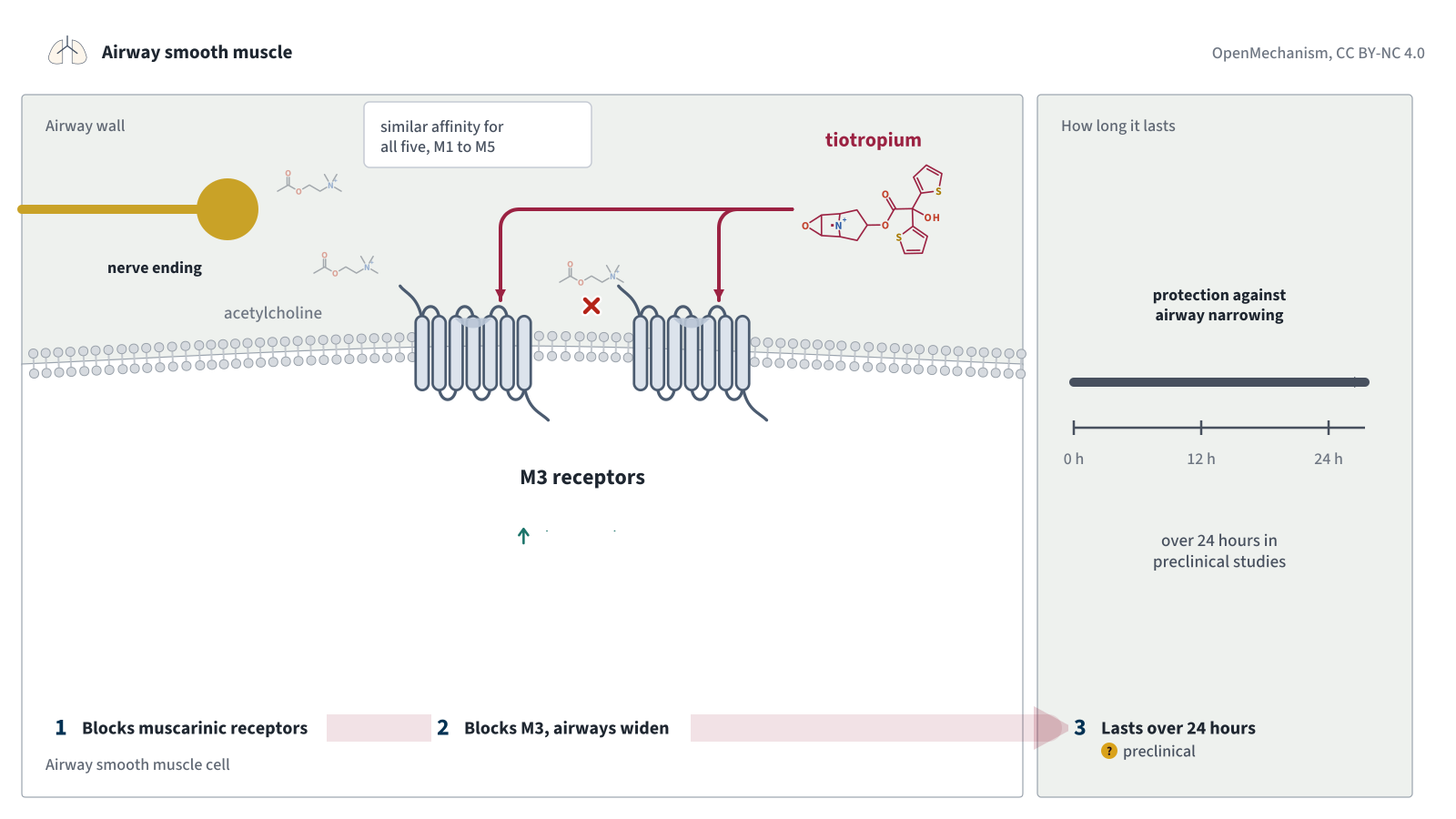
Step 3: preclinical
The Spiriva Respimat (tiotropium) label says: In preclinical in vitro as well as in vivo studies, prevention of methacholine-induced bronchoconstriction effects was dose-dependent and lasted longer than 24 hours.
Clinical study: In Casaburi and colleagues' 2002 report of two identical 1-year randomized, double-blind trials in 921 people with stable COPD, who inhaled tiotropium 18 micrograms as a dry powder (not the Spiriva Respimat spray) or placebo once daily, measuring trough FEV1 (lung function just before the next daily dose): Tiotropium provided significantly superior bronchodilation relative to placebo for trough FEV1 response (approximately 12% over baseline) (p<0.01)
Casaburi R et al., Eur Respir J 2002 (PMID 11866001)
Key terms in this drawing
- affinity
- Binding affinity. How strongly a molecule binds its target.
- M3 receptor
- Muscarinic M3 receptor. A muscarinic receptor on airway smooth muscle; blocking it opens up (dilates) the airways.
- muscarinic receptors
- Muscarinic receptors (M1 to M5). The receptors that antimuscarinic (anticholinergic) medicines block; they come in five subtypes, M1 to M5.
How it works
Blocks muscarinic receptors. Tiotropium is a long-acting antimuscarinic medicine, often called an anticholinergic, with similar affinity for all the muscarinic receptor subtypes, M1 to M5.1
Blocks M3, airways widen. Muscarinic receptors respond to acetylcholine released from parasympathetic nerves; outside the brain and spinal cord, M3 receptors make smooth muscle contract, and in the bronchi and bronchioles, unopposed parasympathetic activity raises airway resistance. In the airways, tiotropium blocks M3 receptors on the smooth muscle, which widens the airways (bronchodilation). In studies of human and animal receptors and of isolated organs, the block was competitive and reversible.1,2,3,4
Lasts over 24 hours. In preclinical (laboratory and animal) studies, its protection against airway narrowing caused by methacholine depended on the dose and lasted longer than 24 hours. After inhalation, the airway widening is mainly a local effect.1
For teachers: download this drawing.
See also
Condition pages: asthma and chronic obstructive pulmonary disease (COPD).
Other antimuscarinics (anticholinergics): atropine and oxybutynin.
Body system: lungs & airways.
Sources
- 1Spiriva Respimat (tiotropium bromide) inhalation spray: FDA label1 Indications and Usage; 12.1 Mechanism of Action
- 2Structure of the human M2 muscarinic acetylcholine receptor bound to an antagonistHaga K et al., Nature 2012 (abstract)
- 3Medicinal chemistry and therapeutic potential of muscarinic M3 antagonistsPeretto I et al., Med Res Rev 2009 (abstract)
- 4Timoptic (timolol maleate ophthalmic solution): FDA labelClinical Pharmacology
- 5ChEMBL CHEMBL1900528Target and action classification: Muscarinic acetylcholine receptor M3 antagonist
- 6A long-term evaluation of once-daily inhaled tiotropium in chronic obstructive pulmonary diseaseCasaburi R et al. Eur Respir J 2002 (abstract)
Spotted a mistake? Report an error (hello@openmechanism.com). Since launch, every published error we fix is listed on the corrections page.
Notes and limits
- A schematic teaching drawing: not to scale, not exact structures, binding poses or a complete pathway, and not a guide to dosing, treatment or how a person will respond.
- The steps are in the order that explains them; one step is said to cause the next only where the source says so.
- The label's evidence that the effect lasts longer than 24 hours comes from preclinical (laboratory and animal) studies.
All recorded limits are on the evidence page, and notes that apply to every page are on How to read a page. Version 1.0.1, medically reviewed by Daniel Tran, PharmD, on 13 November 2026.
Cite this page
Tran D. Tiotropium [Internet]. OpenMechanism; 2026 [updated 2026 Nov 13; cited 2026 Nov 13]. Available from: https://openmechanism.com/medicines/tiotropium