Cough
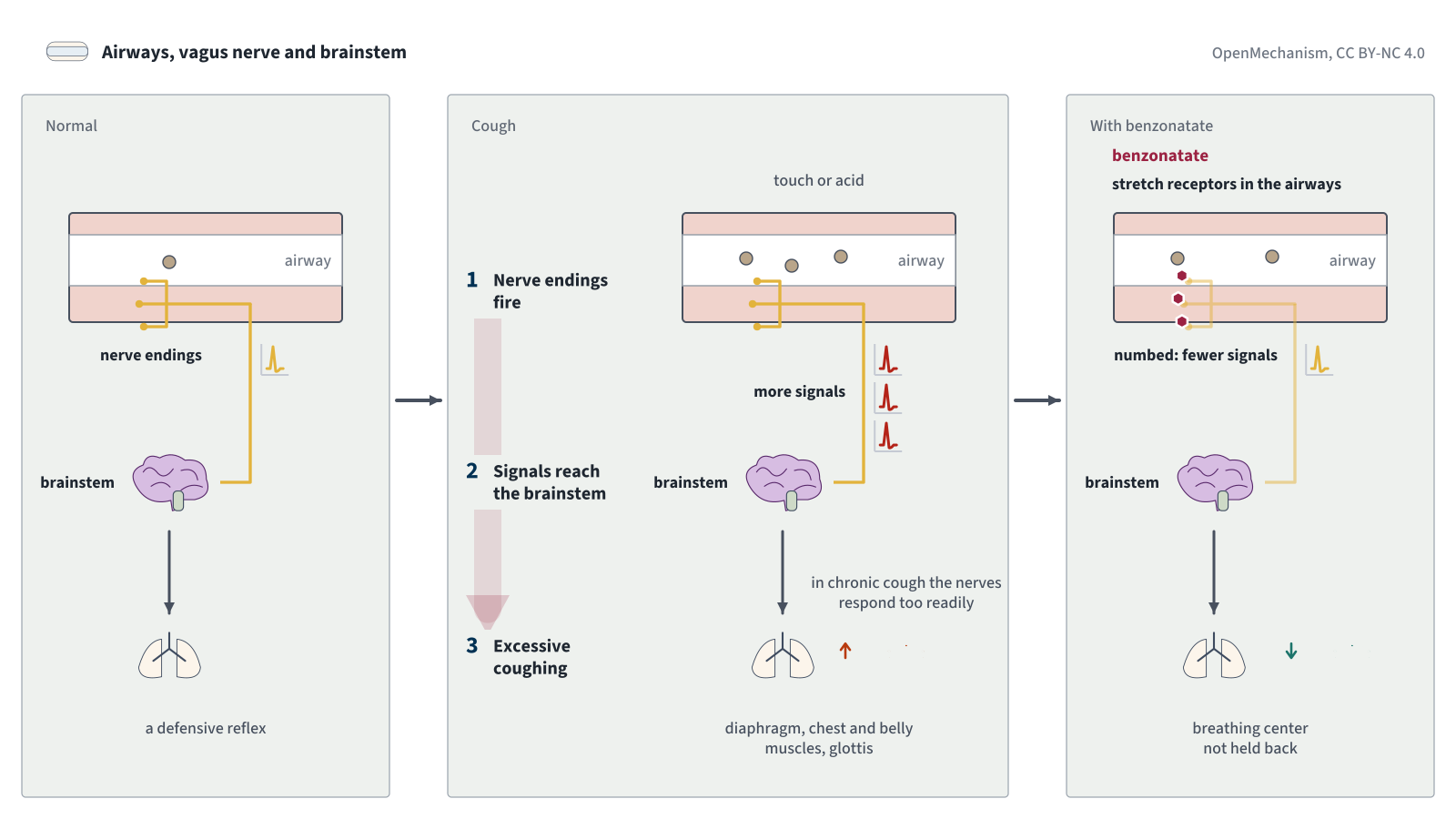
Coughing is a defensive reflex: sensory nerves in the airways signal the brainstem, which drives the breathing muscles and the glottis to cough. Cough is a symptom of conditions such as asthma, COPD and acid reflux, or a problem in its own right; in most chronic cough the nerves respond too readily. Benzonatate numbs the airways' stretch receptors.
- Where
- Airways, vagus nerve and brainstem
- Body system
- Lungs & airways
- Medicines
- 1 medicine
For teachers: download this drawing.
What goes wrong
Nerve endings fire. Coughing is an important defensive reflex. It starts from vagal sensory nerves in the airways: C-fibers and a subset of myelinated nerves that sense touch and acid, ending mainly in the larynx, trachea and large bronchi. In most people with chronic cough these nerves respond more than normal (cough hypersensitivity), often to harmless triggers.1,2,3
What the source says
“Coughing is an important defensive reflex that occurs through the stimulation of a complex reflex arc.”
Source 1“Bronchopulmonary C-fibers and a subset of mechanically sensitive, acid-sensitive myelinated sensory nerves play essential roles in regulating cough.”
Source 2“These vagal sensory nerves terminate primarily in the larynx, trachea, carina, and large intrapulmonary bronchi.”
Source 2“Most patients with chronic cough have cough hypersensitivity, which is characterized by increased neural responsivity to a range of stimuli that affect the airways and lungs, and other tissues innervated by common nerve supplies.”
Source 3“Cough hypersensitivity presents as excessive coughing often in response to relatively innocuous stimuli, causing significant psychophysical morbidity and affecting patients' quality of life.”
Source 3Signals reach the brainstem. The signals travel along the vagus nerve to the brainstem, whose control systems, with higher parts of the brain, process them; these systems are complex but increasingly understood.2
What the source says
“These vagal sensory nerves terminate primarily in the larynx, trachea, carina, and large intrapulmonary bronchi.”
Source 2“The brainstem and higher brain control systems that process this sensory information are complex, but our current understanding of them is considerable and increasing.”
Source 2Excessive coughing. The brainstem then drives a precisely timed sequence of the diaphragm, the chest and belly muscles and the glottis: a cough. Cough is a symptom of many conditions, such as asthma, and acid reflux, and can be a problem in its own right, with no cause found.3,4,5
What the source says
“For both types of cough, the motor responses are identical and via coordinated, precisely-timed and sequential respiratory events orchestrated by complex neuromuscular networking of the diaphragm, chest and abdominal respiratory muscles, the glottis and parts of the brain.”
Source 4“Cough remains a serious unmet clinical problem, both as a symptom of a range of other conditions such as asthma, chronic obstructive pulmonary disease, gastroesophageal reflux, and as a problem in its own right in patients with chronic cough of unknown origin.”
Source 5“This disorder is challenging to treat because many pulmonary and extrapulmonary conditions can present with chronic cough, and cough can also be present without any identifiable underlying cause or be refractory to therapies that improve associated conditions.”
Source 3
Where medicines act
Airways, lungs and pleura
- A
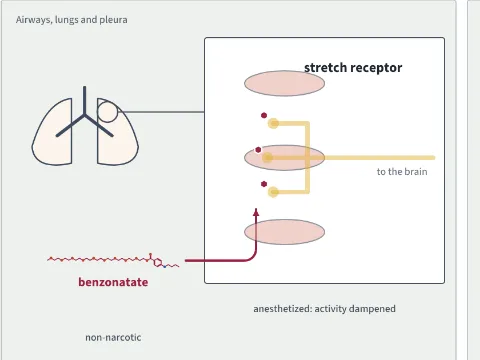
Benzonatate targets Stretch receptors in the airways
Numbs the airways' stretch receptors, so fewer signals start the cough reflex.6,7
Used forRelief of cough
What the label says
“Benzonatate is indicated for the symptomatic relief of cough.”
Source 6“Benzonatate is chemically related to anesthetic agents of the para-amino-benzoic acid class (e.g., procaine; tetracaine)”
Source 7“Benzonatate acts peripherally by anesthetizing the stretch receptors located in the respiratory passages, lungs, and pleura by dampening their activity and thereby reducing the cough reflex at its source.”
Source 6“It begins to act within 15 to 20 minutes and its effect lasts for 3 to 8 hours.”
Source 6“Benzonatate has no inhibitory effect on the respiratory center in recommended dosage.”
Source 6
See also
Body system: lungs & airways.
Can raise or cause it: captopril (“Presumably due to the inhibition of the degradation of endogenous bradykinin, persistent nonproductive cough has been reported with all ACE inhibitors, always resolving after discontinuation of therapy.”8).
Other conditions: asthma, chronic obstructive pulmonary disease (COPD), acid reflux (GERD), chronic kidney disease, heart attack and heart failure.
Side effects: why ACE inhibitors can cause a dry cough.
Sources
- 1Anatomy and neuro-pathophysiology of the cough reflex arcPolverino M et al. Multidiscip Respir Med 2012 (abstract). Saved copy
- 2Anatomy and neurophysiology of cough: CHEST guideline and expert panel reportCanning BJ et al. Chest 2014 (abstract). Saved copy
- 3Cough hypersensitivity and chronic coughChung KF et al. Nat Rev Dis Primers 2022 (abstract). Saved copy
- 4Perspective on the human cough reflexBrooks SM. Cough 2011 (abstract). Saved copy
- 5Antitussive drugs: past, present, and futureDicpinigaitis PV et al. Pharmacol Rev 2014 (abstract). Saved copy
- 6Benzonatate capsules (Amneal): FDA labelIndications and Usage; Clinical Pharmacology. Saved copy
- 7Benzonatate capsules (Amneal): FDA labelBoxed Warning; Precautions. Saved copy
- 8Captopril tablets: FDA labelPrecautions: Cough. Saved copy
Notes and limits
- There are few well-controlled studies behind many of the cough medicines in use, especially those sold without a prescription.5
- Benzonatate's label warns of deaths in children under 10 who swallowed it by accident, and of severe hypersensitivity reactions, possibly from local anesthesia when the capsule is sucked or chewed instead of swallowed.7
Notes that apply to every page are on How to read a page.
Spotted a mistake? Report an error (hello@openmechanism.com). Since launch, every published error we fix is listed on the corrections page.
Cite this page
Tran D. Cough [Internet]. OpenMechanism; 2026 [updated 2026 Oct 20; cited 2026 Oct 20]. Available from: https://openmechanism.com/conditions/cough