Montelukast
Cells such as and eosinophils release , which bind receptors in the airway; in asthma they make the airway swell and its muscle contract. Montelukast, taken by mouth, binds CysLT1 selectively and blocks the action of leukotriene D4 there, without activating the receptor. Its label lists it for preventing and treating asthma long term (from 12 months of age), for preventing exercise-induced airway narrowing (from 6 years) and for relieving the symptoms of allergic rhinitis (seasonal from 2 years, year-round from 6 months), and says it is not for treating a sudden asthma attack. For allergic rhinitis, because the benefits of montelukast may not outweigh the risk of neuropsychiatric symptoms, the label keeps it for people whom other treatments have not helped or did not suit.
- Acts on
- Cysteinyl leukotriene receptor 1 (CysLT1)
- Where
- Airway muscle and inflammatory cells
- Medicine type
- Small molecule
- Used for
- Lungs & airways
- Drug class
- Leukotriene receptor antagonists
Also called Singulair.
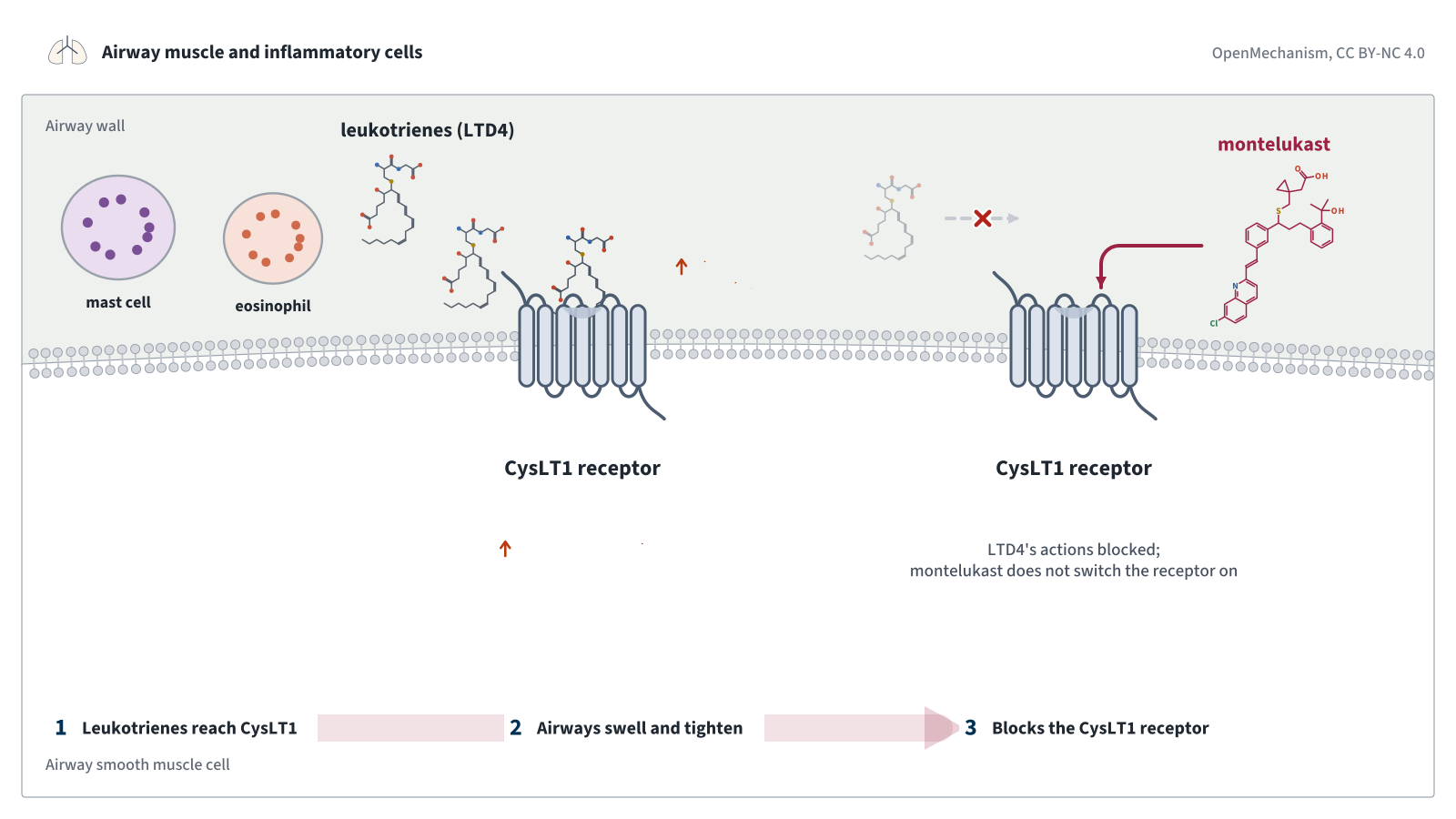
Key terms in this drawing
- CysLT1 receptor
- Cysteinyl leukotriene type 1 receptor. A receptor for cysteinyl leukotrienes, found in the airways (including on smooth muscle cells and macrophages); montelukast blocks it.
- leukotrienes
- Cysteinyl leukotrienes. Signal molecules released by cells such as mast cells and eosinophils; in asthma they swell the airways and tighten their muscle.
- LTD4
- Leukotriene D4. One of the cysteinyl leukotrienes: products of arachidonic acid that cells such as mast cells and eosinophils release.
- mast cell
- Mast cell. An immune cell in tissues such as the skin and the airways that releases histamine and other signals.
How it works
Leukotrienes reach CysLT1. The cysteinyl leukotrienes (LTC4, and LTE4), made from arachidonic acid, are released from cells such as mast cells and eosinophils and bind cysteinyl leukotriene (CysLT) receptors. The CysLT1 receptor is found in the airway (including on smooth muscle cells and macrophages) and on other cells that drive inflammation, such as eosinophils.1
Airways swell and tighten. Leukotrienes have been linked (correlated) with asthma and allergic rhinitis. In asthma, their effects include swelling of the airway (edema), contraction of the airway muscle and changed activity of cells in the inflammatory process; in allergic rhinitis, they are released in the nose after allergen exposure and are associated with its symptoms.1
Blocks the CysLT1 receptor. Montelukast, taken by mouth, binds the CysLT1 receptor with high and selectivity, in preference to other important airway receptors (such as prostanoid, cholinergic or beta-adrenergic receptors), and blocks the actions of LTD4 at this receptor without activating it. In people with asthma, it inhibits the airway narrowing (bronchoconstriction) that inhaled LTD4 causes.1
For teachers: download this drawing.
See also
Condition pages: asthma.
Explained: why montelukast carries a boxed warning about mood and behavior.
Body system: lungs & airways.
Sources
- 1Singulair (montelukast sodium): FDA label1 Indications and Usage; 12.1 Mechanism of Action; 12.2 Pharmacodynamics
- 2ChEMBL CHEMBL787Target and action classification: Cysteinyl leukotriene receptor 1 antagonist
Spotted a mistake? Report an error (hello@openmechanism.com). Since launch, every published error we fix is listed on the corrections page.
Notes and limits
- A schematic teaching drawing: not to scale, not exact structures, binding poses or a complete pathway, and not a guide to dosing, treatment or how a person will respond.
- The steps are in the order that explains them; one step is said to cause the next only where the source says so.
All recorded limits are on the evidence page, and notes that apply to every page are on How to read a page. Version 1.0.1, medically reviewed by Daniel Tran, PharmD, on 13 November 2026.
Cite this page
Tran D. Montelukast [Internet]. OpenMechanism; 2026 [updated 2026 Nov 13; cited 2026 Nov 13]. Available from: https://openmechanism.com/medicines/montelukast