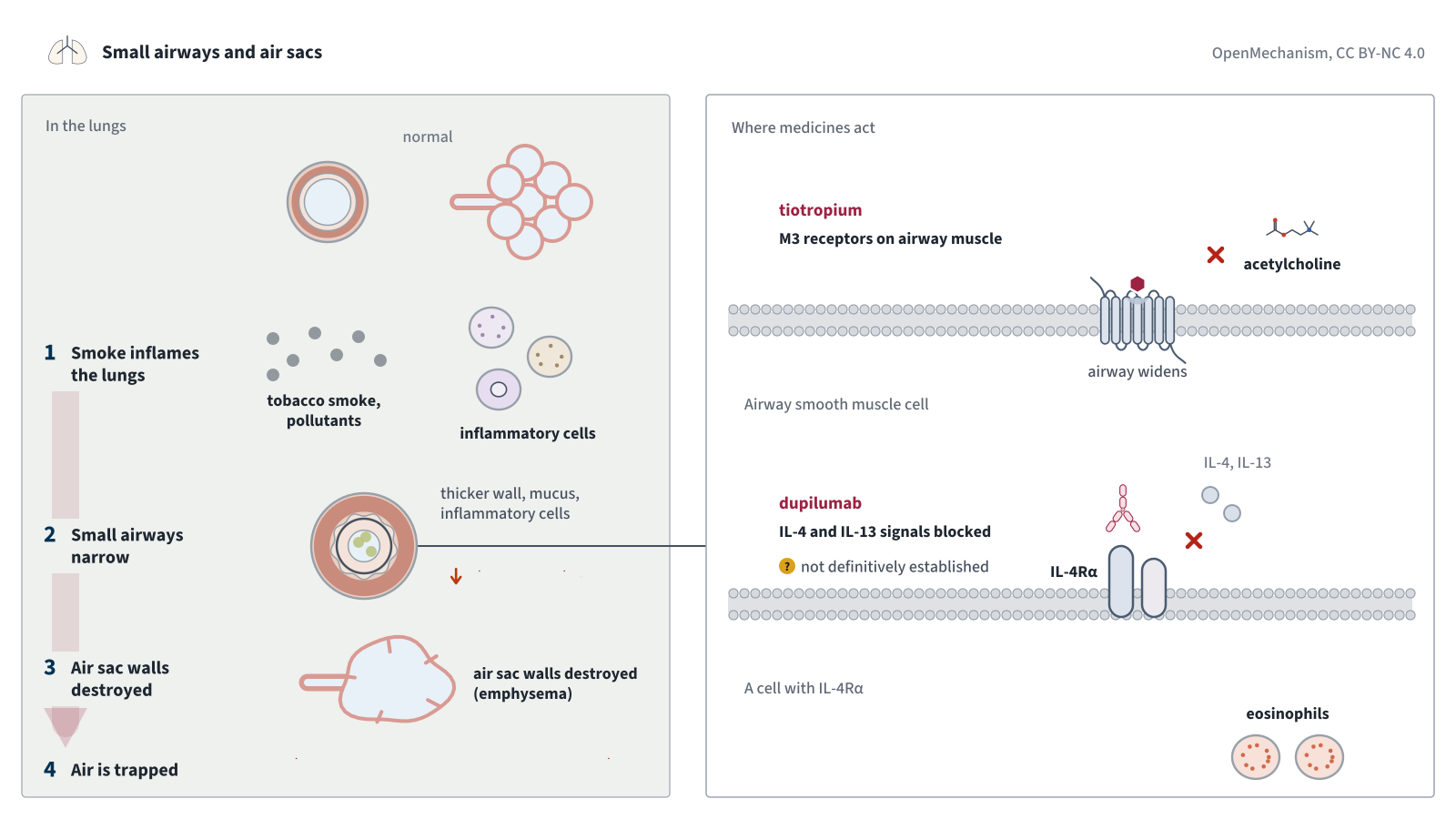
In COPD, smoke and other inhaled particles inflame the lungs for years: the small airways narrow and the walls of the air sacs are destroyed (emphysema), so air is trapped and breathing out takes longer. A 2015 review calls inhaled long-acting bronchodilators, such as tiotropium, the mainstay of managing stable COPD; the dupilumab label lists it as an add-on maintenance treatment for adults whose COPD is inadequately controlled and has an eosinophilic phenotype.
Clinical study: In Bhatt and colleagues' 2023 randomized, double-blind phase 3 trial, 939 people with COPD who had at least 300 eosinophils per microliter of blood and an elevated risk of exacerbations despite standard triple therapy received dupilumab 300 mg or placebo by injection under the skin every 2 weeks, with results through week 52; the trial measured exacerbations, lung function, quality of life and symptoms, not how dupilumab works: Among patients with COPD who had type 2 inflammation as indicated by elevated blood eosinophil counts, those who received dupilumab had fewer exacerbations, better lung function and quality of life, and less severe respiratory symptoms than those who received placebo.Bhatt SP et al., N Engl J Med 2023 (PMID 37272521)
Interleukin-13. A cytokine made by Th2 cells; with IL-4 it signals the switch from IgM to IgE antibodies.
IL-4
Interleukin-4. A cytokine made by Th2 cells; with IL-13 it signals the switch from IgM to IgE antibodies.
IL-4Rα
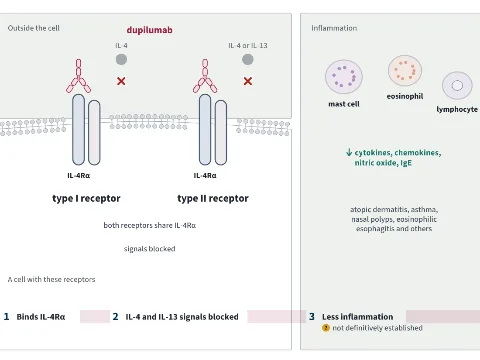
Interleukin-4 receptor alpha subunit. The receptor part shared by the IL-4 and IL-13 receptors; dupilumab binds it and blocks both signals.
M3 receptor
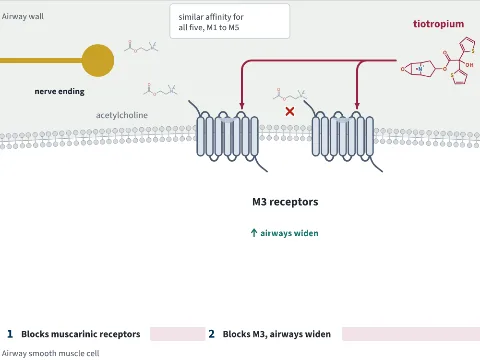
Muscarinic M3 receptor. A muscarinic receptor on airway smooth muscle; blocking it opens up (dilates) the airways.
What goes wrong
Smoke inflames the lungs. is caused by breathing in noxious particles, notably tobacco smoke and pollutants. Its damage goes with a chronic inflammatory immune response to a lifetime of inhaled toxic gases and particles.1,2
What the source says
“COPD is caused by exposure to inhaled noxious particles, notably tobacco smoke and pollutants.”
“These lesions are associated with a chronic innate and adaptive inflammatory immune response of the host to a lifetime exposure to inhaled toxic gases and particles.”
Small airways narrow. In the small airways, the lining's barrier is disrupted and mucus clearance is impaired, so inflammatory mucus collects inside them; inflammatory cells move into their walls and connective tissue is laid down. The walls thicken and the airways narrow.2
What the source says
“Processes contributing to obstruction in the small conducting airways include disruption of the epithelial barrier, interference with mucociliary clearance apparatus that results in accumulation of inflammatory mucous exudates in the small airway lumen, infiltration of the airway walls by inflammatory cells, and deposition of connective tissue in the airway wall.”
“This remodelling and repair thickens the airway walls, reduces lumen calibre, and restricts the normal increase in calibre produced by lung inflation.”
Air sac walls destroyed. In emphysema the walls of the air sacs are destroyed, with the same inflammatory cells as in the airways. The pattern most closely tied to smoking starts around the respiratory bronchioles, and separate patches merge to destroy large volumes of lung.2,3
What the source says
“whereas in COPD there is destruction of the alveolar walls and fibrosis of peripheral airways.”
“The centrilobular pattern of emphysematous destruction is most closely associated with cigarette smoking, and although it is initially focused on respiratory bronchioles, separate lesions coalesce to destroy large volumes of lung tissue.”
Air is trapped. The narrow airways resist airflow and the damaged lung stretches too easily, so the lungs take longer to empty. Air is trapped, and people get short of breath when they exert themselves; the obstruction is poorly reversible.2,4
What the source says
“The airflow limitation that defines chronic obstructive pulmonary disease (COPD) is the result of a prolonged time constant for lung emptying, caused by increased resistance of the small conducting airways and increased compliance of the lung as a result of emphysematous destruction.”
“COPD is characterized by poorly reversible airway obstruction, which is confirmed by spirometry, and includes obstruction of the small airways (chronic obstructive bronchiolitis) and emphysema, which lead to air trapping and shortness of breath in response to physical exertion.”
Tiotropiumtargets M3 receptors on airway smooth muscle
Blocks on airway muscle, which widens the airways (bronchodilation).5
Used forBronchospasm in COPD: long-term, once-daily maintenance, not for relief of acute bronchospasmCOPD exacerbations: to reduce them
What the label says
“SPIRIVA RESPIMAT (tiotropium bromide) is indicated for the long-term, once-daily, maintenance treatment of bronchospasm associated with chronic obstructive pulmonary disease (COPD), including chronic bronchitis and emphysema.”
Binds , blocking and signals; its label calls inflammation driven by IL-4 and IL-13 an important part of how COPD develops, names eosinophils among the cells that carry IL-4Rα, and says how dupilumab works has not been definitively established.6
Used forCOPD with an eosinophilic phenotype: add-on maintenance, adults, when not adequately controlled; not for relief of acute bronchospasm
What the label says
“as an add-on maintenance treatment of adult patients with inadequately controlled chronic obstructive pulmonary disease (COPD) and an eosinophilic phenotype.”
“Dupilumab is a human monoclonal IgG4 antibody that inhibits interleukin-4 (IL-4) and interleukin-13 (IL-13) signaling by specifically binding to the IL-4Rα subunit shared by the IL-4 and IL-13 receptor complexes.”
Not every smoker develops COPD; a 2015 review said the mechanisms behind it remained poorly understood.4
A 2015 review said that, apart from stopping smoking, no treatment slowed the disease; flare-ups, mostly set off by viral or bacterial infections, are linked to a poor outlook.4
text 3c164766c78d…; drawings b3c29c8bad25…; notes bba4f105365c…
AI source check
Claude Opus 5.5 (AI source check), 13 November 2026: 40 statements compared with their sources, 8 flagged for the reviewer. An automated check, not a medical review.
Next review due
14 May 2028
Cite this page
Tran D. Chronic obstructive pulmonary disease (COPD) [Internet]. OpenMechanism; 2026 [updated 2026 Nov 13; cited 2026 Nov 13]. Available from: https://openmechanism.com/conditions/copd