Albuterol
Albuterol switches on beta-2 receptors on airway muscle. This raises inside the muscle cells, which lowers calcium and myosin activity, so the airway muscle relaxes. Its label lists it for treating or preventing airway narrowing (bronchospasm) in people aged 4 and older with reversible obstructive airway disease, and for preventing exercise-induced bronchospasm from age 4.
- Acts on
- Beta-2 adrenergic receptors
- Where
- Airway muscle
- Medicine type
- Small molecule
- Used for
- Lungs & airways
- Drug class
- Beta-2 agonists (airway openers)
Also called salbutamol (the World Health Organization's recommended name) and Ventolin HFA.
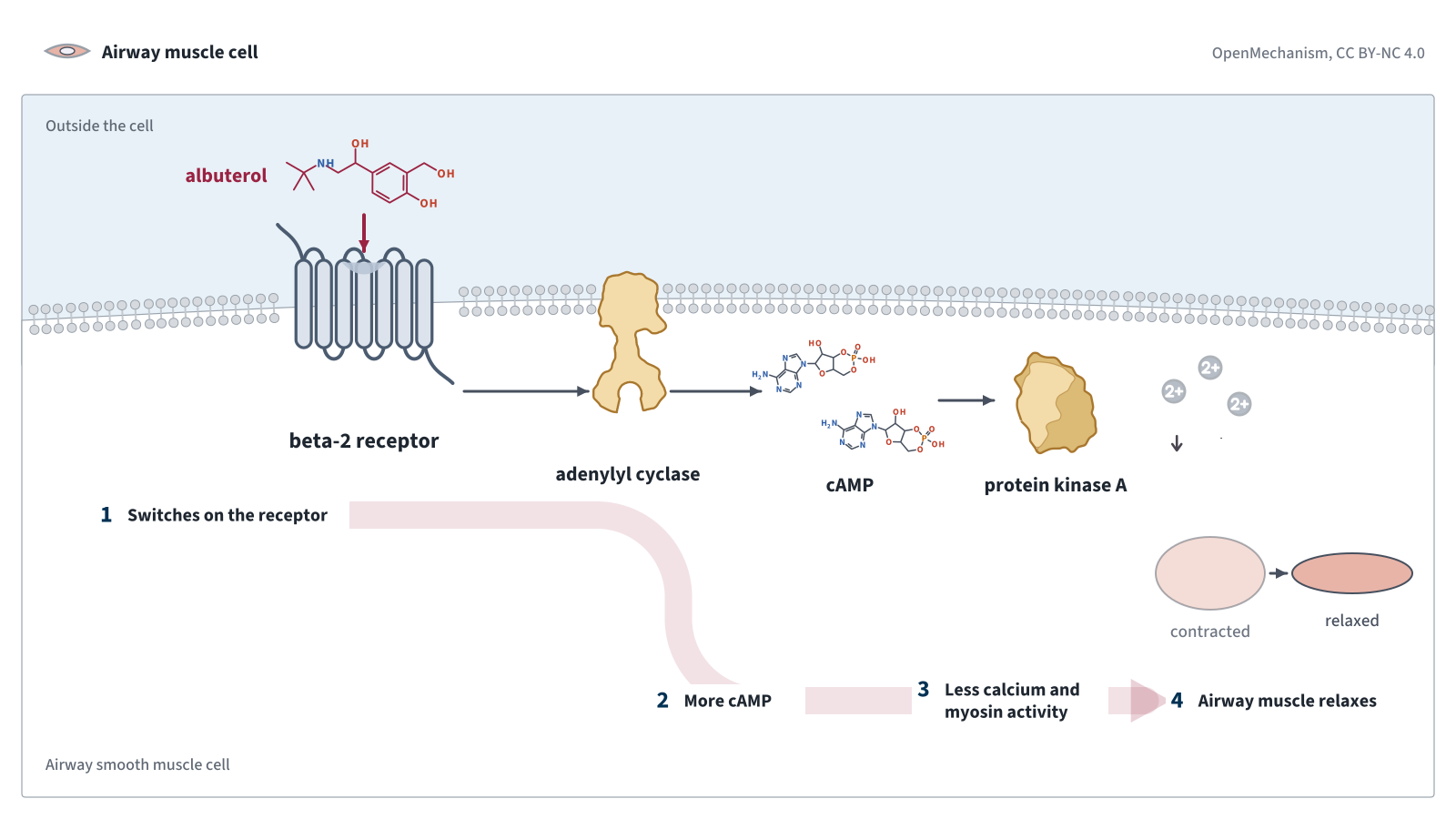
Key terms in this drawing
- cAMP
- Cyclic adenosine monophosphate (cyclic AMP). A signaling molecule inside cells; a rise in it activates protein kinase A.
How it works
Switches on the receptor. Albuterol activates beta-2 adrenergic receptors on airway smooth muscle.1
More cAMP. Receptor activation stimulates adenylyl cyclase and increases intracellular cAMP.1
Less calcium and myosin activity. cAMP activates protein kinase A, which reduces myosin phosphorylation and intracellular calcium.1
Airway muscle relaxes. These changes relax bronchial smooth muscle.1
For teachers: download this drawing or build a slide deck.
More detail
Relaxing the airway muscle
Inhaled; acts on the airway muscle. Albuterol (Ventolin HFA) is taken by inhalation and acts on beta-2 receptors on airway smooth muscle.1
Prefers beta-2 receptors. In vitro and in vivo pharmacologic studies show that albuterol has a preferential effect on beta-2 adrenergic receptors, compared with isoproterenol. These are the main adrenergic receptors in bronchial smooth muscle, but the human heart has some too (10% to 50% of its beta receptors), and the label says their presence raises the possibility that even selective beta-2 may have cardiac effects.1
More cAMP. Airway beta2 activation stimulates adenylyl cyclase and increases intracellular cAMP.1
Less calcium and myosin activity. cAMP activates , reducing myosin phosphorylation and intracellular ionic calcium.1
Airway muscle relaxes. These intracellular changes relax airway smooth muscle.1
What the source says
“This increase of cyclic AMP leads to the activation of protein kinase A, which inhibits the phosphorylation of myosin and lowers intracellular ionic calcium concentrations, resulting in relaxation.”
Source 1
“Albuterol relaxes the smooth muscles of all airways, from the trachea to the terminal bronchioles.”
Source 1
Mast cells in the airway
How much reaches the blood
Possible side effects
May lower blood potassium. Beta agonists may cause a marked fall in blood potassium (hypokalemia) in some people, possibly by moving it into cells, with the potential to cause harmful effects on the heart and blood vessels; the label says the fall is usually brief.1
Airways can tighten instead. The label says inhaled albuterol (Ventolin HFA) can produce paradoxical bronchospasm, which may be life-threatening.1
See also
Condition pages: asthma.
Side effects: low blood potassium (hypokalemia).
Explained: why beta-blockers can tighten the airways; and why insulin and albuterol can lower potassium.
Body system: lungs & airways.
Inside the body: inside the airways.
Sources
- 1Ventolin HFA (albuterol sulfate): FDA label1 Indications and Usage; 12.1 Mechanism of Action; 2.3 Administration; 12.3 Pharmacokinetics; 5.1 Paradoxical Bronchospasm; 5.8 Hypokalemia
- 2ChEMBL CHEMBL714Target and action classification: Beta-2 adrenergic receptor agonist
Also used on this page
The adenylyl cyclase and protein kinase A outlines are traced from the electron microscopy and crystal structures below.
- 3Truncated adenylyl cyclase with MANT-GTP, forskolin and an activated stimulatory Gαs proteinPDB 6R4O; Qi, C. et al. Science 2019; 364:389-394
- 4The catalytic subunit of human protein kinase A with ATPPDB 4WB5; Cheung, J. et al. Proc.Natl.Acad.Sci.USA 2015; 112:1374-1379
Spotted a mistake? Report an error (hello@openmechanism.com). Since launch, every published error we fix is listed on the corrections page.
Notes and limits
- A schematic teaching drawing: not to scale, not exact structures, binding poses or a complete pathway, and not a guide to dosing, treatment or how a person will respond.
- The steps are in the order that explains them; one step is said to cause the next only where the source says so.
- This record covers the Ventolin HFA inhaler; what it says about blood levels is not assumed to hold for other forms of albuterol.
All recorded limits are on the evidence page, and notes that apply to every page are on How to read a page. Version 1.1.1, medically reviewed by Daniel Tran, PharmD, on 13 November 2026.
Cite this page
Tran D. Albuterol [Internet]. OpenMechanism; 2026 [updated 2026 Nov 13; cited 2026 Nov 13]. Available from: https://openmechanism.com/medicines/albuterol