Why cyclophosphamide can make the bladder bleed
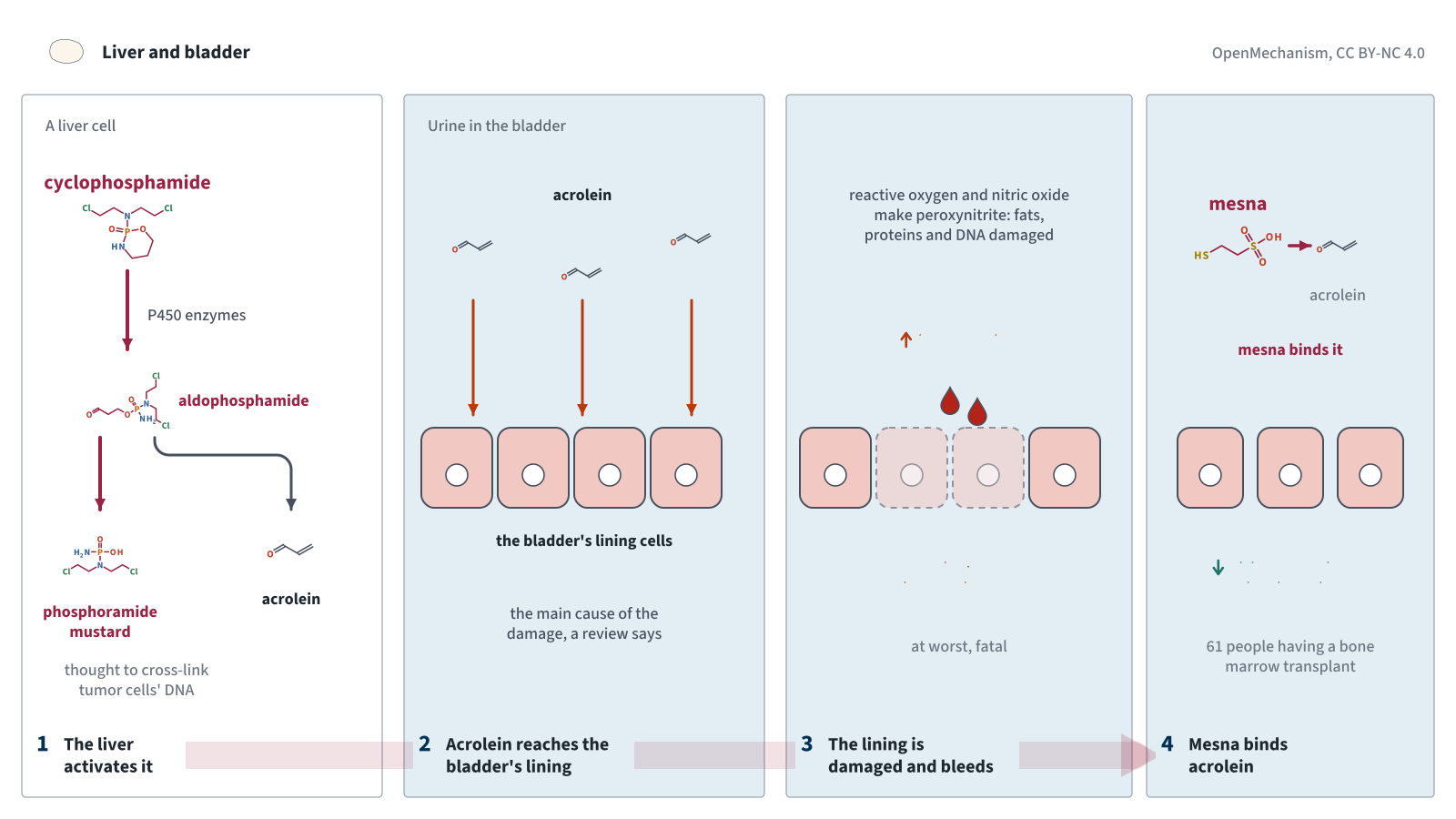
The liver activates cyclophosphamide, and one of its products splits into phosphoramide mustard and acrolein. Acrolein is the main cause of the bladder damage: it enters the cells lining the bladder and sets off damage that can make the bladder bleed. Mesna binds acrolein and has been used to prevent severe bladder toxicity.
- Kind
- Side effect
- Medicines
- Cyclophosphamide, Mesna
- Sources
- 5
For teachers: download this drawing.
Step by step
The liver activates it. The liver activates about 75% of a dose with cytochrome P450 enzymes into 4-hydroxycyclophosphamide, in balance with aldophosphamide, which splits into two active metabolites, phosphoramide mustard and acrolein. Cyclophosphamide is thought to work by cross-linking tumor cells' .1
What the source says
“The liver is the major site of cyclophosphamide activation.”
Source 1“Approximately 75% of the administered dose of cyclophosphamide is activated by hepatic microsomal cytochrome P450s including CYP2A6, 2B6, 3A4, 3A5, 2C9, 2C18 and 2C19, with 2B6 displaying the highest 4-hydroxylase activity.”
Source 1“Cyclophosphamide is activated to form 4-hydroxycyclophosphamide, which is in equilibrium with its ring-open tautomer aldophosphamide.”
Source 1“Aldophosphamide can undergo β-elimination to form active metabolites phosphoramide mustard and acrolein.”
Source 1“The mechanism of action is thought to involve cross-linking of tumor cell DNA.”
Source 1Acrolein reaches the bladder's lining. Acrolein is the main molecule behind the bladder damage, a review says: it rapidly enters the cells lining the bladder.2
What the source says
“Acrolein is the main molecule responsible of this side-effect and mesna (2-mercaptoethane sulfonate) is the commonly used preventive agent.”
Source 2“pathogenesis of CP-induced bladder toxicity can be summarized in three steps: (1) acrolein rapidly enters into the uroepithelial cells;”
Source 2The lining is damaged and bleeds. Inside, acrolein sets off reactive oxygen species and , which make peroxynitrite; this damages the cells' fats, proteins and DNA, and the cells can die. The bladder becomes inflamed: bleeding from the bladder, blood in the urine and, at worst, fatal bladder damage have been reported.2,3
What the source says
“(2) it then activates intracellular reactive oxygen species and nitric oxide production (directly or through NF-kappaB and AP-1) leading to peroxynitrite production; (3) finally, the increased peroxynitrite level damages lipids (lipid peroxidation), proteins (protein oxidation) and DNA (strand breaks) leading to activation of PARP, a DNA repair enzyme.”
Source 2“DNA damage causes PARP overactivation, resulting in the depletion of oxidized nicotinamide-adenine dinucleotide and adenosine triphosphate, and consequently in necrotic cell death.”
Source 2“There is no doubt that HC is an inflammatory process, including when caused by CP.”
Source 2“Hemorrhagic cystitis, pyelitis, ureteritis, and hematuria have been reported with cyclophosphamide.”
Source 3“Urotoxicity can be fatal.”
Source 3Mesna binds acrolein. Mesna binds acrolein's double bonds and keeps it from touching the bladder's lining, and it has been used to prevent severe bladder toxicity. In 61 people having a bone marrow transplant, visible blood in the urine was less common with mesna than with forced diuresis.2,3,4,5
What the source says
“Mesna also binds to the double bonds of acrolein and to other urotoxic metabolites and inhibits their effects on the bladder.”
Source 4“Mesna binds acrolein and prevent its direct contact with uroepithelium.”
Source 2“Mesna has been used to prevent severe bladder toxicity.”
Source 3“Sixty-one consecutive BMT recipients were randomised for treatment with forced diuresis or mesna.”
Source 5“The incidence of macroscopic haematuria was significantly lower in the mesna treated group”
Source 5
See also
Medicine pages: cyclophosphamide and mesna.
Other side effects (cancer): why bleomycin can scar the lungs, why CAR T cells can cause cytokine release syndrome, why checkpoint inhibitors can inflame healthy organs, why cisplatin can harm hearing, why cisplatin can harm the kidneys, why doxorubicin can damage the heart, why rituximab can bring hepatitis B back, why trastuzumab can weaken the heart, why vincristine can damage nerves and all 65 side effects.
Conditions: B-cell lymphomas, breast cancer, lupus nephritis and bladder bleeding from chemotherapy (hemorrhagic cystitis).
Sources
- 1Cyclophosphamide: FDA label12.1 Mechanism of Action; 12.3 Pharmacokinetics. Saved copy
- 2Pathophysiological aspects of cyclophosphamide and ifosfamide induced hemorrhagic cystitisKorkmaz A et al. Cell Biol Toxicol 2007 (abstract). Saved copy
- 3Cyclophosphamide: FDA label5.2 Urinary Tract and Renal Toxicity. Saved copy
- 4Mesnex (mesna): FDA label12.1 Mechanism of Action. Saved copy
- 5Comparison of mesna with forced diuresis to prevent cyclophosphamide induced haemorrhagic cystitis in marrow transplantationHows JM et al. Br J Cancer 1984 (abstract). Saved copy
Notes and limits
- Bladder damage can come with short- or long-term use, and can lead to scarring and bladder cancer.3
- In the transplant study, 6 of the 7 graft failures happened in people given mesna, and the authors kept watching for them.5
Notes that apply to every page are on How to read a page.
Spotted a mistake? Report an error (hello@openmechanism.com). Since launch, every published error we fix is listed on the corrections page.
Cite this page
Tran D. Why cyclophosphamide can make the bladder bleed [Internet]. OpenMechanism; 2026 [updated 2026 Oct 20; cited 2026 Oct 20]. Available from: https://openmechanism.com/explained/cyclophosphamide-and-the-bladder