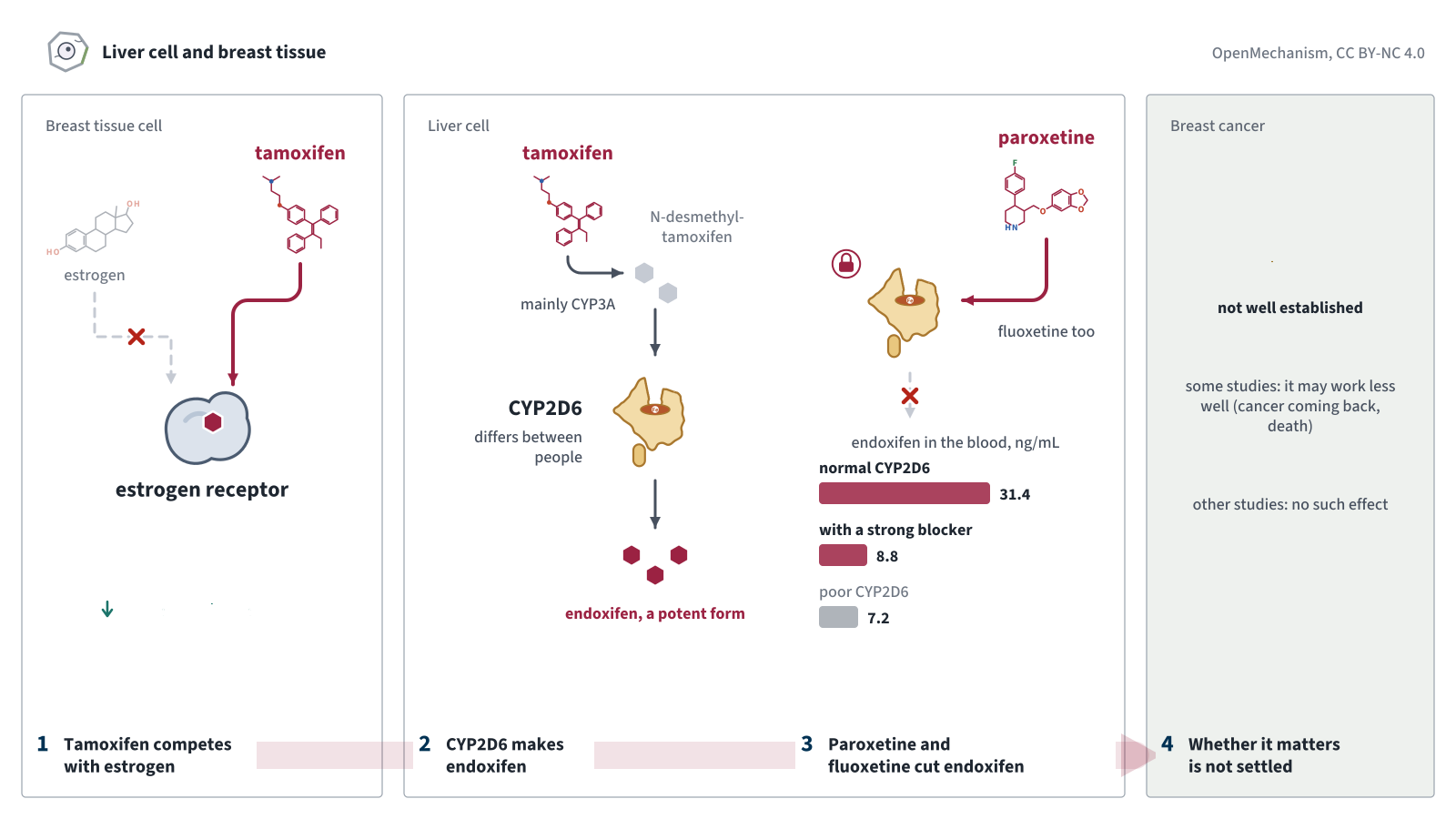
Tamoxifen competes with estrogen for the estrogen receptor in breast tissue, and the body turns it into more potent forms: CYP2D6 is the key enzyme that makes endoxifen. Paroxetine and fluoxetine strongly block CYP2D6, paroxetine irreversibly, and with them endoxifen fell to about the levels of people whose CYP2D6 works poorly. Whether this makes tamoxifen work less well is not settled: some studies found it may, others did not.
Tamoxifen competes with estrogen. Tamoxifen competes with estrogen for the estrogen receptor, which can lower estrogen-driven growth in breast tissue.1
What the source says
“Tamoxifen competes with estrogen for binding to the estrogen receptor, which can result in a decrease in estrogen receptor signaling-dependent growth in breast tissue.”
CYP2D6 makes endoxifen. Several break tamoxifen down; mainly makes N-desmethyltamoxifen. , an enzyme that differs between people, is the key one that turns N-desmethyltamoxifen into endoxifen, a minor metabolite but a potent one, with 100-fold greater for the estrogen receptor than tamoxifen.1
What the source says
“Tamoxifen is extensively metabolized by CYP450 enzymes, including CYP3A, CYP2D6, CYP2C9, CYP2C19, and CYP2B6.”
“The polymorphic enzyme CYP2D6 is involved in the formation of endoxifen and 4-hydroxytamoxifen, and it is the key enzyme that catalyzes the formation of endoxifen from N-desmethyltamoxifen.”
“Endoxifen and 4-hydroxytamoxifen, identified as minor metabolites, have 100-fold greater affinity for the estrogen receptor and 30 to 100-fold greater potency in suppressing estrogen-dependent cell proliferation than tamoxifen.”
Paroxetine and fluoxetine cut endoxifen. Strong CYP2D6 blockers such as paroxetine, which blocks it irreversibly, and fluoxetine lower endoxifen. In people whose CYP2D6 works normally, endoxifen in the blood averaged 31.4 ng/mL without them and 8.8 ng/mL with them, close to the 7.2 ng/mL of people whose CYP2D6 works poorly.1,2
What the source says
“as a result of paroxetine’s irreversible inhibition of CYP2D6 and lower blood levels of tamoxifen”
“The mean steady-state plasma concentration of endoxifen in CYP2D6 normal metabolizers who were not receiving CYP2D6 inhibitors was 31.4 ± 14.7 ng/mL compared to 8.8 ± 3.5 ng/mL in CYP2D6 normal metabolizers receiving potent CYP2D6 inhibitors (e.g., paroxetine, fluoxetine) with tamoxifen.”
“The plasma levels of endoxifen in CYP2D6 normal metabolizers taking potent CYP2D6 inhibitors were similar to the levels observed in CYP2D6 poor metabolizers taking no CYP2D6 inhibitors (8.8 versus 7.2 ng/mL)”
Whether it matters is not settled. Whether this changes tamoxifen's effect is not well established: some studies found it may work less well, judged by breast cancer coming back or death, while others found no such effect. The paroxetine label lists this among its warnings and adds that one study suggests the risk may increase the longer the two are taken together.1,2
What the source says
“The impact on the efficacy of tamoxifen with co-administration of strong CYP2D6 inhibitors (e.g., paroxetine) is not well established.”
“Some studies have shown that the efficacy of tamoxifen may be reduced when the drugs are co-administered as a result of reduced levels of potent active metabolites of tamoxifen”
“Some studies have shown that the efficacy of tamoxifen, as measured by the risk of breast cancer relapse/mortality, may be reduced with concomitant use of paroxetine”
Human CYP2D6 with quinidinePDB 4WNU; Wang, A. et al. J.Biol.Chem. 2015;290:5092-5104. The CYP2D6 outline in the drawing is traced from this structure. Saved copy
Claude Opus 5.5 (AI source check), 7 November 2026: 22 statements compared with their sources, 4 flagged for the reviewer. An automated check, not a medical review.
Key terms
Definitions reworded since this review: CYP3A. Definitions are shared across pages, so a later rewording does not take the review line off (what a review covers).
Next review due
8 May 2028
Cite this page
Tran D. Tamoxifen and CYP2D6 blockers [Internet]. OpenMechanism; 2026 [updated 2026 Nov 7; cited 2026 Nov 7]. Available from: https://openmechanism.com/explained/tamoxifen-and-cyp2d6-blockers