Why doxorubicin can damage the heart
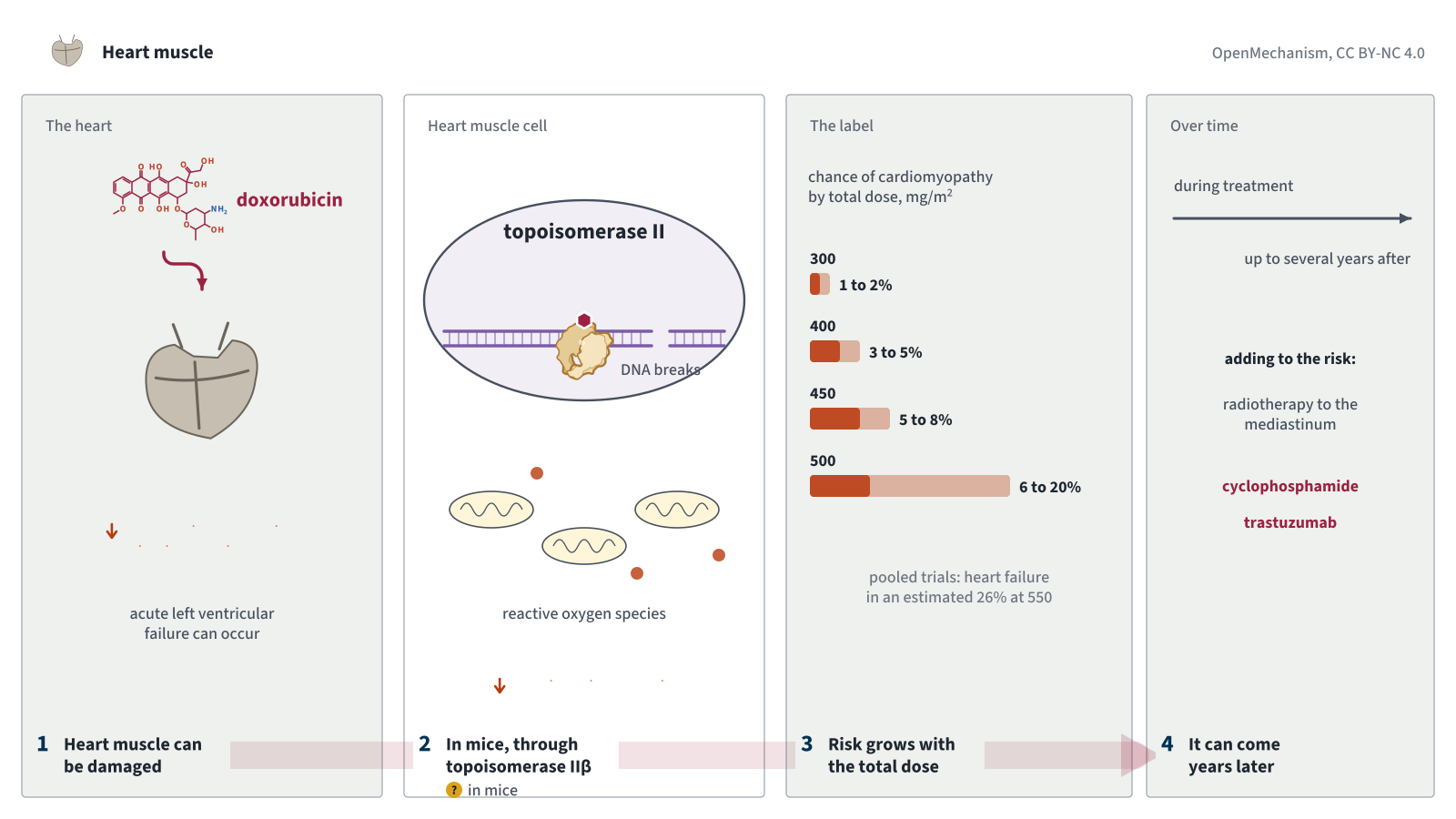
Doxorubicin can damage heart muscle, even causing heart failure, and the risk grows with the total dose: the label estimates 1 to 2% at 300 mg/m² and 6 to 20% at 500 mg/m². In mice, the damage ran through topoisomerase IIβ in heart muscle cells, with DNA breaks and failing mitochondria. It can appear during treatment or up to several years later.
- Kind
- Side effect
- Medicines
- Doxorubicin
- Sources
- 5
Step 2: in mice
The mouse study says: Furthermore, cardiomyocyte-specific deletion of Top2b protects mice from the development of doxorubicin-induced progressive heart failure, suggesting that doxorubicin-induced cardiotoxicity is mediated by topoisomerase-IIβ in cardiomyocytes.
Clinical study: Pooling the doxorubicin arms of three trials, the authors estimated how often heart failure followed each total dose; the study measured heart failure, not how it happens: Thirty-two of 630 patients had a diagnosis of CHF. … Analysis indicated that an estimated cumulative 26% of patients would experience doxorubicin-related CHF at a cumulative dose of 550 mg/m(2).
Swain SM et al., Cancer 2003 (PMID 12767102)
This study was picked with a literature search and is not yet checked by our reviewer.
For teachers: download this drawing.
Step by step
Heart muscle can be damaged. Doxorubicin can damage heart muscle (cardiomyopathy), including acute left ventricular failure. The damage can include a fall in the left ventricle's ejection fraction and signs of heart failure.1
In mice, through topoisomerase IIβ. Doxorubicin has been believed to harm the heart by producing reactive oxygen species. In mice, heart muscle cells lacking topoisomerase IIβ were protected from doxorubicin's breaks and from the gene changes behind failing mitochondria and reactive oxygen species, and the mice were protected from heart failure; the authors suggest the damage runs through topoisomerase IIβ in heart muscle cells.2
What the source says
“Doxorubicin is believed to cause dose-dependent cardiotoxicity through redox cycling and the generation of reactive oxygen species (ROS).”
Source 2“Here we show that cardiomyocyte-specific deletion of Top2b (encoding topoisomerase-IIβ) protects cardiomyocytes from doxorubicin-induced DNA double-strand breaks and transcriptome changes that are responsible for defective mitochondrial biogenesis and ROS formation.”
Source 2“Furthermore, cardiomyocyte-specific deletion of Top2b protects mice from the development of doxorubicin-induced progressive heart failure, suggesting that doxorubicin-induced cardiotoxicity is mediated by topoisomerase-IIβ in cardiomyocytes.”
Source 2Risk grows with the total dose. The risk is generally proportional to the total (cumulative) dose: the label estimates 1 to 2% at 300 mg/m², 3 to 5% at 400, 5 to 8% at 450 and 6 to 20% at 500, given every 3 weeks. Pooling the doxorubicin arms of three trials (630 patients), one analysis estimated heart failure in 26% at 550 mg/m².1,3
What the source says
“The risk of cardiomyopathy is generally proportional to the cumulative exposure.”
Source 1“The probability of developing cardiomyopathy is estimated to be 1 to 2% at a total cumulative dose of 300 mg/m 2 of doxorubicin hydrochloride, 3 to 5% at a dose of 400 mg/m 2 , 5 to 8% at a dose of 450 mg/m 2 , and 6 to 20% at a dose of 500 mg/m 2 , when doxorubicin hydrochloride is administered every 3 weeks.”
Source 1“A group of 630 patients who were randomized to a doxorubicin-plus-placebo arm of three Phase III studies”
Source 3“Analysis indicated that an estimated cumulative 26% of patients would experience doxorubicin-related CHF at a cumulative dose of 550 mg/m(2).”
Source 3It can come years later. Cardiomyopathy may develop during treatment or up to several years after it ends. Radiotherapy to the mediastinum and other heart-toxic medicines, such as cyclophosphamide and trastuzumab, add to the risk, possibly more than additively.1
What the source says
“Cardiomyopathy may develop during treatment or up to several years after completion of treatment”
Source 1“There is an additive or potentially synergistic increase in the risk of cardiomyopathy in patients who have received radiotherapy to the mediastinum or concomitant therapy with other known cardiotoxic agents, such as cyclophosphamide and trastuzumab.”
Source 1
See also
Medicine pages: doxorubicin.
Other side effects (cancer): why bleomycin can scar the lungs, why CAR T cells can cause cytokine release syndrome, why checkpoint inhibitors can inflame healthy organs, why cisplatin can harm hearing, why cisplatin can harm the kidneys, why cyclophosphamide can make the bladder bleed, why rituximab can bring hepatitis B back, why trastuzumab can weaken the heart, why vincristine can damage nerves and all 65 side effects.
Conditions: breast cancer and Hodgkin lymphoma.
Sources
- 1Doxorubicin hydrochloride injection (Pfizer): FDA labelBoxed Warning; 5.1 Cardiomyopathy. Saved copy
- 2Identification of the molecular basis of doxorubicin-induced cardiotoxicityZhang S et al. Nat Med 2012 (abstract). Saved copy
- 3Congestive heart failure in patients treated with doxorubicin: a retrospective analysis of three trialsSwain SM et al. Cancer 2003 (abstract). Saved copy
- 4Doxorubicin hydrochloride injection (Pfizer): FDA label12.1 Mechanism of Action. Saved copy
- 5Human topoisomerase II alpha with DNA and etoposidePDB 5GWK; Wang, Y.R. et al. Nucleic Acids Res. 2017;45:10861-10871. The topoisomerase II outline in the drawing is traced from this structure. Saved copy
Notes and limits
- In the pooled trials, age appeared to matter: after 400 mg/m², patients over 65 had more heart failure.3
- The label says doxorubicin's toxic effects on organs are thought to be related to its insertion between DNA bases and its binding to cell membrane lipids.4
Notes that apply to every page are on How to read a page.
Spotted a mistake? Report an error (hello@openmechanism.com). Since launch, every published error we fix is listed on the corrections page.
Cite this page
Tran D. Why doxorubicin can damage the heart [Internet]. OpenMechanism; 2026 [updated 2026 Oct 20; cited 2026 Oct 20]. Available from: https://openmechanism.com/explained/doxorubicin-and-the-heart