Fluorouracil and the DPYD gene
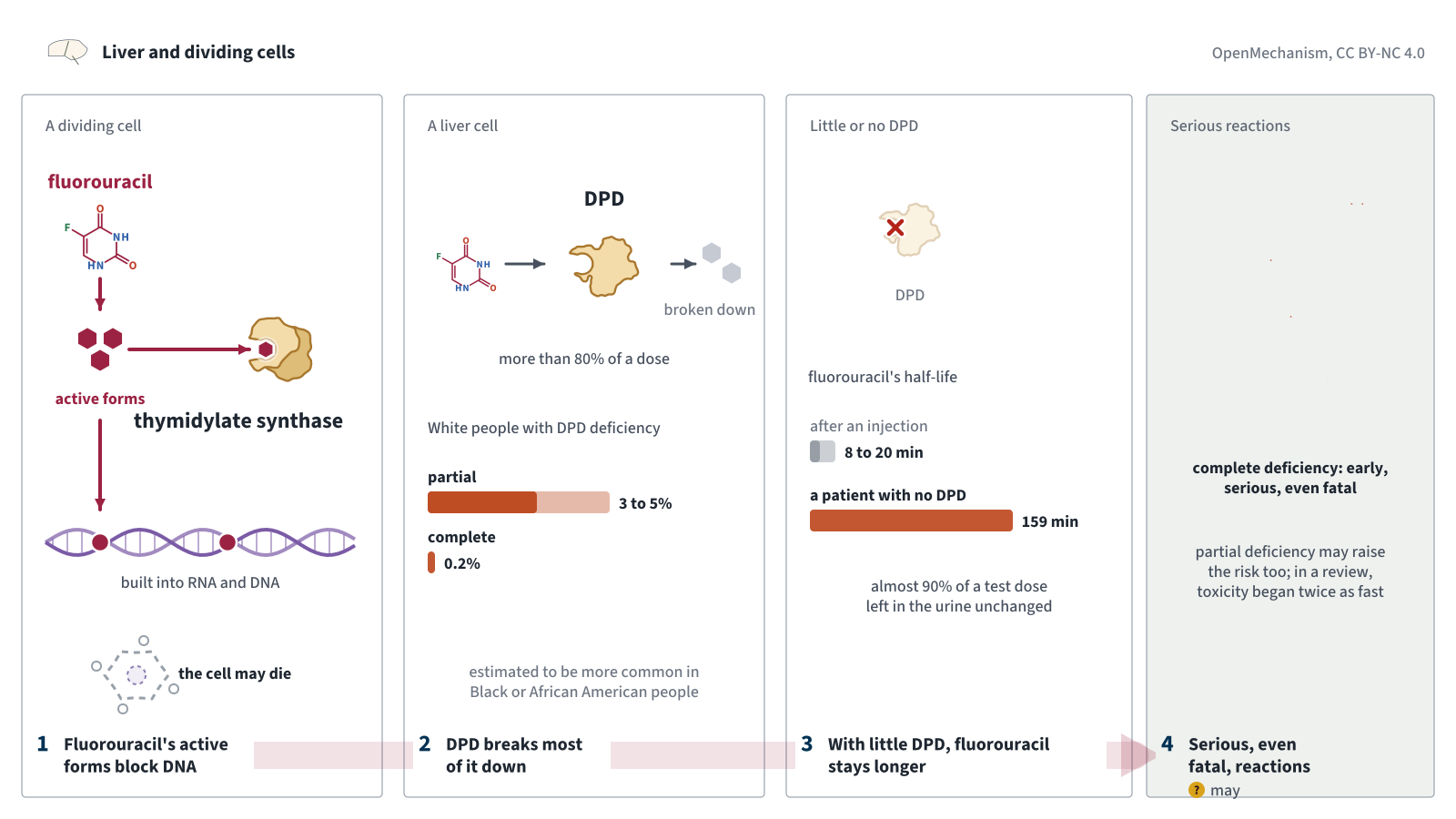
Fluorouracil's active forms block thymidylate synthase and get built into RNA and DNA, which can kill fast-growing cells. DPD, made from the DPYD gene, breaks down more than 80% of it. With little DPD, fluorouracil is thought to stay longer, and people with complete DPD deficiency are at risk of serious, even fatal, reactions.
- Kind
- In the body
- Medicines
- Fluorouracil
- Sources
- 8
Step 4: may
The fluorouracil label says: Patients with partial DPD activity (partial DPD deficiency) may also have increased risk of serious, or fatal, adverse reactions.
Source 4: Fluorouracil injection: FDA label, 5.1 Serious Adverse Reactions or Death from DPD Deficiency
Clinical study: Pooling the records of individual patients from studies of fluorouracil and related medicines, the authors tested three DPYD variants linked with DPD deficiency; they found: 7365 patients from eight studies were included in the meta-analysis. … DPYD variants c.1679T>G and c.1236G>A/HapB3 are clinically relevant predictors of fluoropyrimidine-associated toxicity.
Meulendijks D et al., Lancet Oncol 2015 (PMID 26603945)
This study was picked with a literature search and is not yet checked by our reviewer.
For teachers: download this drawing.
Step by step
Fluorouracil's active forms block DNA. Fluorouracil is turned into three active metabolites: FdUMP blocks thymidylate synthase, and the other two are built into and . Fluorouracil interferes with making DNA, which affects fast-growing cells and may lead to their death.1
What the source says
“Fluorouracil is a nucleoside metabolic inhibitor that interferes with the synthesis of deoxyribonucleic acid (DNA) and to a lesser extent inhibits the formation of ribonucleic acid (RNA); these affect rapidly growing cells and may lead to cell death.”
Source 1“Fluorouracil is converted to three main active metabolites: 5-fluoro-2′-deoxyuridine-5′-monophosphate (FdUMP), 5-fluorouridine-5′- triphosphate (FUTP) and 5-fluoro-2′-deoxyuridine-5′-triphosphate (FdUTP).”
Source 1“These metabolites have several effects including the inhibition of thymidylate synthase by FdUMP, incorporation of FUTP into RNA and incorporation of FdUTP into DNA.”
Source 1DPD breaks most of it down. The enzyme DPD, made from the DPYD gene, breaks down more than 80% of a dose of fluorouracil. About 3 to 5% of White people have partial DPD deficiency and 0.2% complete deficiency, which may be due to DPYD variants; deficiency is estimated to be more common in Black or African American people.1
What the source says
“The DPYD gene encodes the enzyme DPD, which is responsible for the catabolism of >80% of fluorouracil.”
Source 1“Approximately 3-5% of White populations have partial DPD deficiency and 0.2% of White populations have complete DPD deficiency, which may be due to certain genetic no function or decreased function variants in DPYD resulting in partial to complete or near complete absence of enzyme activity.”
Source 1“DPD deficiency is estimated to be more prevalent in Black or African American populations compared to White populations.”
Source 1With little DPD, fluorouracil stays longer. Reduced DPD activity is thought to lengthen fluorouracil's and so raise the risk of toxicity. After an injection into a vein its half-life is 8 to 20 minutes, rising with the dose; in a patient with no DPD activity it was 159 minutes, and almost 90% of a test dose left in the urine unchanged.1,2,3
What the source says
“As a key enzyme in the catabolism of 5-FU, DPD is the top candidate for pharmacogenetic studies on 5-FU toxicity, since a reduced DPD activity is thought to result in an increased half-life of the drug, and thus, an increased risk of toxicity.”
Source 2“Following bolus intravenous injection of fluorouracil, as a single agent, the elimination half-life increased with dose from 8 to 20 minutes.”
Source 1“After administration of a "test" dose of FUra (25 mg/m2, 600 microCi[6-3H]FUra by intravenous bolus) to a patient who had previously developed neurotoxicity after FUra, a markedly prolonged elimination half-life (159 min) was observed with no evidence of FUra catabolites in plasma or cerebrospinal fluid and with 89.7% of the administered dose being excreted into the urine as unchanged FUra.”
Source 3“Using a sensitive assay for dihydropyrimidine dehydrogenase in peripheral blood mononuclear cells, we demonstrated complete deficiency of enzyme activity in the patient”
Source 3Serious, even fatal, reactions. People with complete DPD deficiency are at higher risk of early, serious and even fatal reactions to fluorouracil, such as mouth sores (mucositis), diarrhea, low white cells (neutropenia) and nerve damage. Partial deficiency may also raise the risk: a review says it raises the risk of severe neutropenia, and that toxicity began twice as fast.4,5
What the source says
“Patients with certain homozygous or compound heterozygous variants in the DPYD gene known to result in complete or near complete absence of DPD activity (complete DPD deficiency) are at increased risk for acute early-onset toxicity and serious, including fatal, adverse reactions due to fluorouracil (e.g., mucositis, diarrhea, neutropenia, and neurotoxicity).”
Source 4“Patients with partial DPD activity (partial DPD deficiency) may also have increased risk of serious, or fatal, adverse reactions.”
Source 4“Patients with a partial DPD deficiency have an increased risk of developing grade IV neutropenia.”
Source 5“In addition, the onset of toxicity occurred twice as fast compared with patients with a normal DPD activity.”
Source 5
See also
Medicine pages: fluorouracil.
Other pages on what the body does with a medicine (cancer): irinotecan and the UGT1A1 gene; mercaptopurine and the TPMT and NUDT15 genes; and all 16 pages on what the body does with a medicine.
Conditions: colorectal cancer, breast cancer, stomach cancer and pancreatic cancer.
Interactions: leucovorin with methotrexate and with fluorouracil.
Sources
- 1Fluorouracil injection: FDA label12.1 Mechanism of Action; 12.3 Pharmacokinetics; 12.5 Pharmacogenomics. Saved copy
- 2Dihydropyrimidine dehydrogenase gene as a major predictor of severe 5-fluorouracil toxicityAmstutz U et al. Pharmacogenomics 2011 (abstract). Saved copy
- 3Familial deficiency of dihydropyrimidine dehydrogenase: biochemical basis for familial pyrimidinemia and severe 5-fluorouracil-induced toxicityDiasio RB et al. J Clin Invest 1988 (abstract). Saved copy
- 4Fluorouracil injection: FDA label5.1 Serious Adverse Reactions or Death from DPD Deficiency. Saved copy
- 5Dihydropyrimidine dehydrogenase and the efficacy and toxicity of 5-fluorouracilvan Kuilenburg AB. Eur J Cancer 2004 (abstract). Saved copy
- 6
- 7Human thymidylate synthase (the dimer) with FdUMP, the active form of fluorouracilPDB 6QXG; Pozzi, C. et al. Molecules 2019;24. The thymidylate synthase outline in the drawing is traced from this structure. Saved copy
- 8Pig dihydropyrimidine dehydrogenase (DPD; a mutant made for the study) with fluorouracil and NADPHPDB 1H7X; Dobritzsch, D. et al. Embo J. 2001;20:650. The DPD outline in the drawing is traced from this structure. Saved copy
Notes and limits
- Serious reactions may still happen when no DPYD variant is found.4
- Too little is known to estimate how common DPD deficiency is in other populations.1
Notes that apply to every page are on How to read a page.
Spotted a mistake? Report an error (hello@openmechanism.com). Since launch, every published error we fix is listed on the corrections page.
Cite this page
Tran D. Fluorouracil and the DPYD gene [Internet]. OpenMechanism; 2026 [updated 2026 Oct 20; cited 2026 Oct 20]. Available from: https://openmechanism.com/explained/fluorouracil-and-dpyd