Medically reviewed by Daniel Tran, PharmD, on 12 November 2026.
Why metformin can cause lactic acidosis
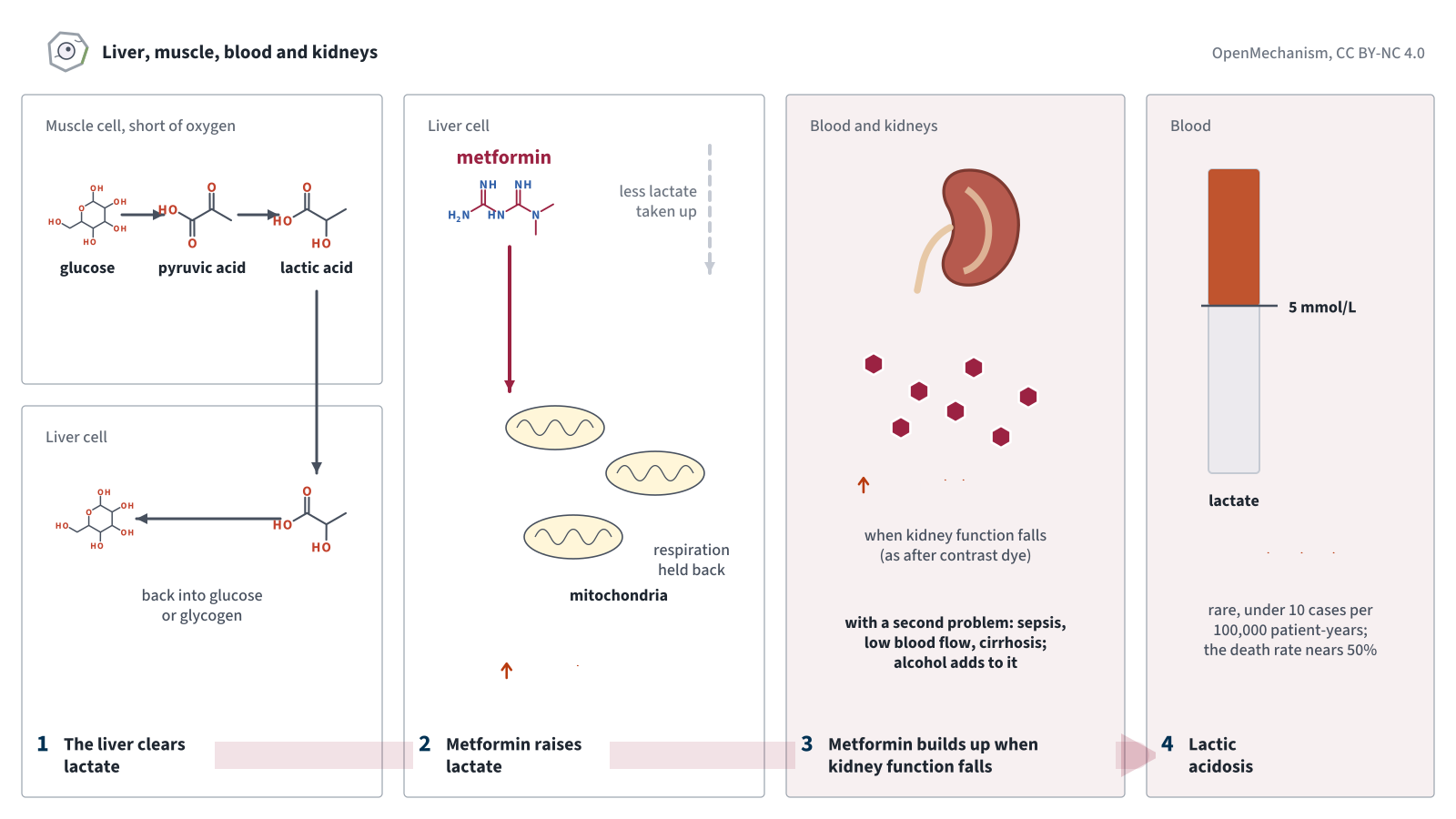
Muscle cells short of oxygen turn pyruvic acid into lactic acid (lactate), and the liver turns lactic acid back into glucose. Metformin raises lactate in the blood: it lowers the liver's uptake of lactate and holds back the respiration of mitochondria, mostly in the liver, more so at higher metformin levels. The kidneys remove metformin, so it builds up when their function falls, and with a second problem such as sepsis, low blood flow or liver cirrhosis, lactate can build up into lactic acidosis, which is rare but often fatal.
- Kind
- Side effect
- Medicines
- Metformin
- Sources
- 5
For teachers: download this drawing.
Step by step
The liver clears lactate. When oxygen is short, muscle cells turn pyruvic acid, made from glucose, into lactic acid (lactate). The liver turns lactic acid back into glucose or glycogen.1,2,3
What the source says
“Pyruvate is the final product of glycolysis and, when hypoxic conditions arise, can be metabolized anaerobically to form lactate.”
Source 1“Lactate produced by the skeletal muscle during physical exercise is conducted to the liver, which uses the metabolite as a gluconeogenic precursor”
Source 2“In the liver, lactate is metabolized to glycogen”
Source 3Metformin raises lactate. Metformin lowers the liver's uptake of lactate and holds back the respiration of mitochondria, mostly in the liver, so lactate in the blood rises: the higher the metformin level, the higher the lactate.4,5
What the source says
“Metformin decreases liver uptake of lactate increasing lactate blood levels which may increase the risk of lactic acidosis, especially in patients at risk.”
Source 4“Metformin, along with other drugs in the biguanide class, increases plasma lactate levels in a plasma concentration-dependent manner by inhibiting mitochondrial respiration predominantly in the liver.”
Source 5Metformin builds up when kidney function falls. The kidneys remove metformin, so it builds up as kidney function worsens, as after iodinated contrast dye has suddenly lowered it. A 2016 review says lactic acidosis usually also needs a second problem that raises lactate or slows its clearance, such as sepsis, low blood flow or liver cirrhosis; alcohol adds to metformin's effect on lactate.4,5
What the source says
“The risk of metformin accumulation and metformin-associated lactic acidosis increases with the severity of renal impairment because metformin is substantially excreted by the kidney.”
Source 4“Administration of intravascular iodinated contrast agents in metformin-treated patients has led to an acute decrease in renal function and the occurrence of lactic acidosis.”
Source 4“Elevated plasma metformin concentrations (as occur in individuals with renal impairment) and a secondary event or condition that further disrupts lactate production or clearance (e.g., cirrhosis, sepsis, or hypoperfusion), are typically necessary to cause metformin-associated lactic acidosis (MALA).”
Source 5“Alcohol potentiates the effect of metformin on lactate metabolism.”
Source 4Lactic acidosis. In the reported cases, lactate in the blood was above 5 mmol/L and the blood was acidic (lactic acidosis), with metformin levels usually above 5 mcg/mL. A 2016 review says that in practice its reported rate is very low, under 10 cases per 100,000 patient-years, but that the death rate approaches 50%; the metformin label puts it in a boxed warning.4,5
What the source says
“Lactic Acidosis: See boxed warning”
Source 4“There have been postmarketing cases of metformin-associated lactic acidosis, including fatal cases.”
Source 4“Metformin-associated lactic acidosis was characterized by elevated blood lactate concentrations (> 5 mmol/L), anion gap acidosis (without evidence of ketonuria or ketonemia), and an increased lactate: pyruvate ratio; metformin plasma levels were generally > 5 mcg/mL.”
Source 4“the mortality rate for MALA approaches 50%”
Source 5“the reported incidence of lactic acidosis in clinical practice has proved to be very low (<10 cases per 100,000 patient-years)”
Source 5
See also
Medicine pages: metformin.
Other side effects (hormones & metabolism): why GLP-1 medicines slow the stomach; why insulin and albuterol can lower potassium; why SGLT2 inhibitors can cause genital yeast infections; why steroid medicines can raise blood sugar; why steroid medicines can suppress the adrenal glands; why steroid medicines can weaken bones; why sulfonylureas can cause low blood sugar; and all 65 side effects.
The medicine in the body: what the body does with metformin.
Conditions: type 2 diabetes and chronic kidney disease.
Sources
- 1Pyruvate: NCI Thesaurus definitionNCI definition, concept C116012. Saved copy
- 2The multiple roles of lactate in the skeletal muscleBartoloni B et al. Cells 2024 (abstract). Saved copy
- 3Sodium lactate injection: FDA labelClinical Pharmacology. Saved copy
- 4Metformin hydrochloride extended-release tablets: FDA label5.1 Lactic Acidosis. Saved copy
- 5Metformin-associated lactic acidosis: current perspectives on causes and riskDeFronzo R et al. Metabolism 2016 (abstract). Saved copy
Notes and limits
- The label's advice on checking kidney function, on contrast dye and on surgery is left out: this page explains the mechanism, not what to do.
- Conditions that starve tissues of oxygen, such as shock, heart attack and sepsis, have themselves been linked with lactic acidosis.4
- The risk rises with age, since older people more often have liver, kidney or heart problems; people with liver disease may clear lactate less well; and some mitochondrial diseases, such as MELAS (mitochondrial encephalomyopathy with lactic acidosis and stroke-like episodes), may raise the risk. So may some other medicines: those that impair kidney function, significantly change blood flow, upset the body's acid-base balance or make metformin build up.4
- A 2016 review notes that several groups had suggested the kidney-function cutoffs of that time, which ruled out metformin in moderate and severe kidney impairment, were too conservative; it adds that cautious labeling may be why metformin succeeded, since without it excess risk to patients could have led to its withdrawal from the market, as happened with earlier medicines of its class.5
Notes that apply to every page are on How to read a page.
Spotted a mistake? Report an error (hello@openmechanism.com). Since launch, every published error we fix is listed on the corrections page.
Medical review
Earlier reviews (1)
Cite this page
Tran D. Why metformin can cause lactic acidosis [Internet]. OpenMechanism; 2026 [updated 2026 Nov 12; cited 2026 Nov 12]. Available from: https://openmechanism.com/explained/metformin-and-lactic-acidosis