Why NSAIDs can harm the kidneys
In some people the kidneys rely on their own prostaglandins to keep blood flowing through them. NSAIDs such as naproxen and ibuprofen block the COX enzymes that make prostaglandins, so less blood may reach the kidneys and they can fail. Weaker kidneys, dehydration, heart failure, older age and taking diuretics or ACE inhibitors raise the risk; NSAIDs can also raise blood potassium.
- Kind
- Side effect
- Sources
- 5
For teachers: download this drawing.
Step by step
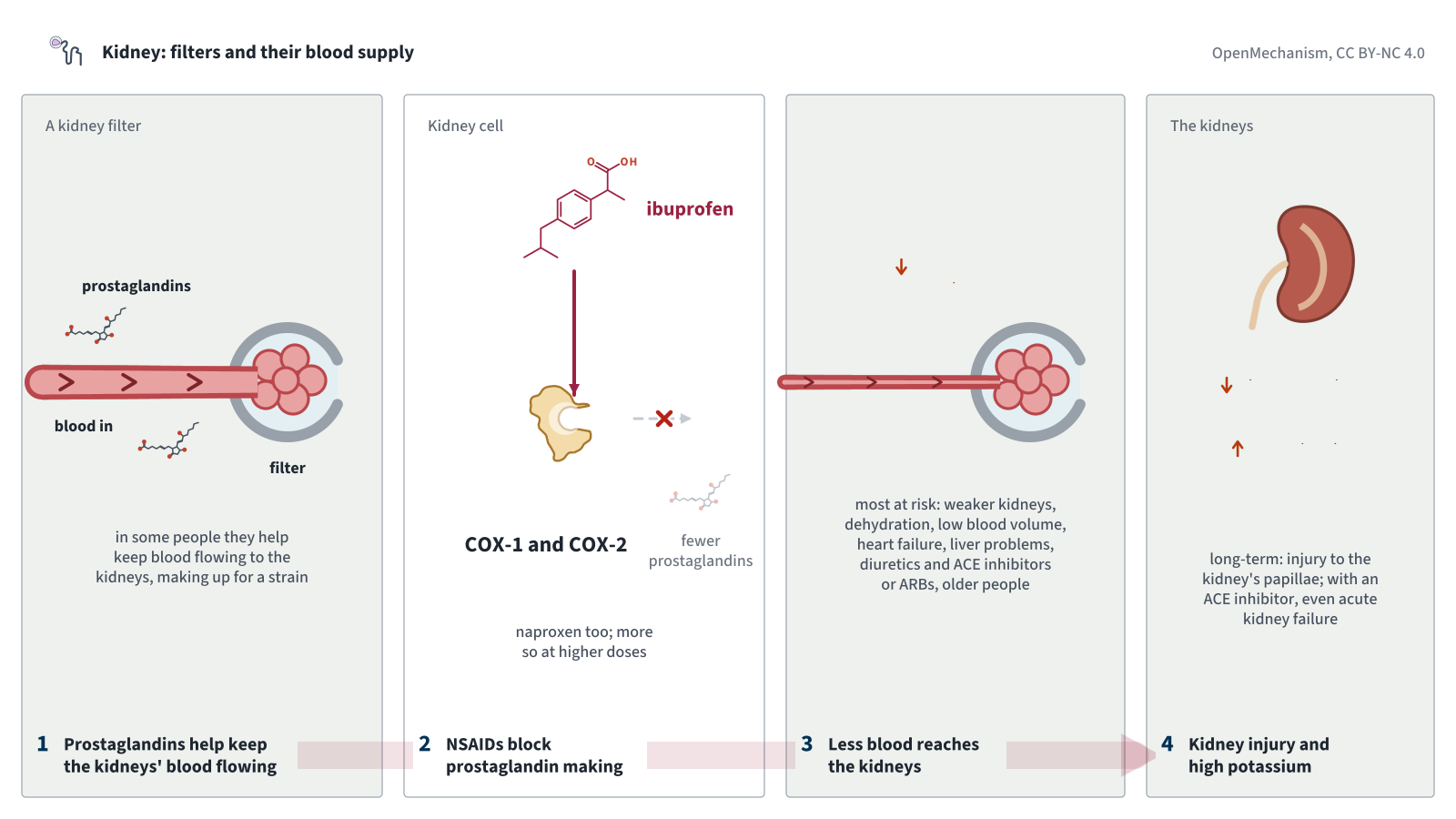
Prostaglandins help keep the kidneys' blood flowing. In some people, the kidneys' own prostaglandins have a part in keeping blood flowing through them, making up for a strain.1
What the source says
“Renal toxicity has also been seen in patients in whom renal prostaglandins have a compensatory role in the maintenance of renal perfusion.”
Source 1NSAIDs block prostaglandin making. Naproxen and ibuprofen block the enzymes (COX-1 and ) that make prostaglandins. In these people they can lower the kidneys' prostaglandins, more so at higher doses.1,2
What the source says
“The mechanism of action of CALDOLOR, like that of other NSAIDs, is not completely understood but involves inhibition of cyclooxygenase (COX-1 and COX-2).”
Source 2“Naproxen is a potent inhibitor of prostaglandin synthesis in vitro.”
Source 1“In these patients, administration of an NSAID may cause a dose-dependent reduction in prostaglandin formation”
Source 1Less blood reaches the kidneys. With fewer prostaglandins, less blood may flow through the kidneys, which can tip them into failure. Most at risk are people with weaker kidneys, dehydration, low blood volume, heart failure or liver problems, people taking diuretics and or ARBs, and older people.1
What the source says
“and, secondarily, in renal blood flow, which may precipitate overt renal decompensation.”
Source 1“Patients at greatest risk of this reaction are those with impaired renal function, dehydration, hypovolemia, heart failure, liver dysfunction, those taking diuretics and ACE inhibitors or ARBs, and the elderly.”
Source 1Kidney injury and high potassium. Long-term use has caused kidney injury, including the death of the kidney's papillae. Blood potassium can rise too, even in some people with healthy kidneys. With an ACE inhibitor, in older or dehydrated people or those with weaker kidneys, kidney function can worsen, even to acute kidney failure.1,3
What the source says
“Long-term administration of NSAIDs has resulted in renal papillary necrosis and other renal injury.”
Source 1“Increases in serum potassium concentration, including hyperkalemia, have been reported with use of NSAIDs, even in some patients without renal impairment.”
Source 1“coadministration of NSAIDs, including selective COX-2 inhibitors, with ACE inhibitors, including lisinopril, may result in deterioration of renal function, including possible acute renal failure.”
Source 3
See also
Medicine pages: naproxen and ibuprofen.
Can raise or cause it: lisinopril (“In patients who are elderly, volume-depleted (including those on diuretic therapy), or with compromised renal function, coadministration of NSAIDs, including selective COX-2 inhibitors, with ACE inhibitors, including lisinopril, may result in deterioration of renal function, including possible acute renal failure.”3); and furosemide (“There are case reports of patients who developed increased BUN, serum creatinine and serum potassium levels, and weight gain when furosemide was used in conjunction with NSAIDs.”4).
Other side effects (muscles, bones & joints): why alendronate can irritate the esophagus; why NSAIDs can cause stomach ulcers and bleeding; and all 65 side effects.
Interactions: lithium and NSAIDs, diuretics or ACE inhibitors; and methotrexate with NSAIDs or trimethoprim-sulfamethoxazole.
Conditions: chronic kidney disease.
Sources
- 1Naproxen tablets: FDA label5.6 Renal Toxicity and Hyperkalemia; 12.1 Mechanism of Action. Saved copy
- 2Caldolor (ibuprofen) injection: FDA label5.6 Renal Toxicity and Hyperkalemia; 12.1 Mechanism of Action. Saved copy
- 3Zestril (lisinopril): FDA label7.3 Non-Steroidal Anti-Inflammatory Agents. Saved copy
- 4Lasix (furosemide) tablets: FDA labelPrecautions: Drug Interactions. Saved copy
- 5Ovine cyclooxygenase-1 (COX-1) with ibuprofenPDB 1EQG; Selinsky, B.S. et al. Biochemistry 2001;40:5172-5180. The COX-1 outline in the drawing is traced from this structure. Saved copy
Notes and limits
- The labels' monitoring and management advice are left out: this page explains the mechanism, not what to do.
- After the NSAID is stopped, the kidneys usually recover.1
- In people with healthy kidneys, the rise in potassium has been put down to low renin and aldosterone.2
- NSAIDs can also weaken an ACE inhibitor's lowering of blood pressure.3
Notes that apply to every page are on How to read a page.
Spotted a mistake? Report an error (hello@openmechanism.com). Since launch, every published error we fix is listed on the corrections page.
Cite this page
Tran D. Why NSAIDs can harm the kidneys [Internet]. OpenMechanism; 2026 [updated 2026 Oct 20; cited 2026 Oct 20]. Available from: https://openmechanism.com/explained/nsaids-and-the-kidneys