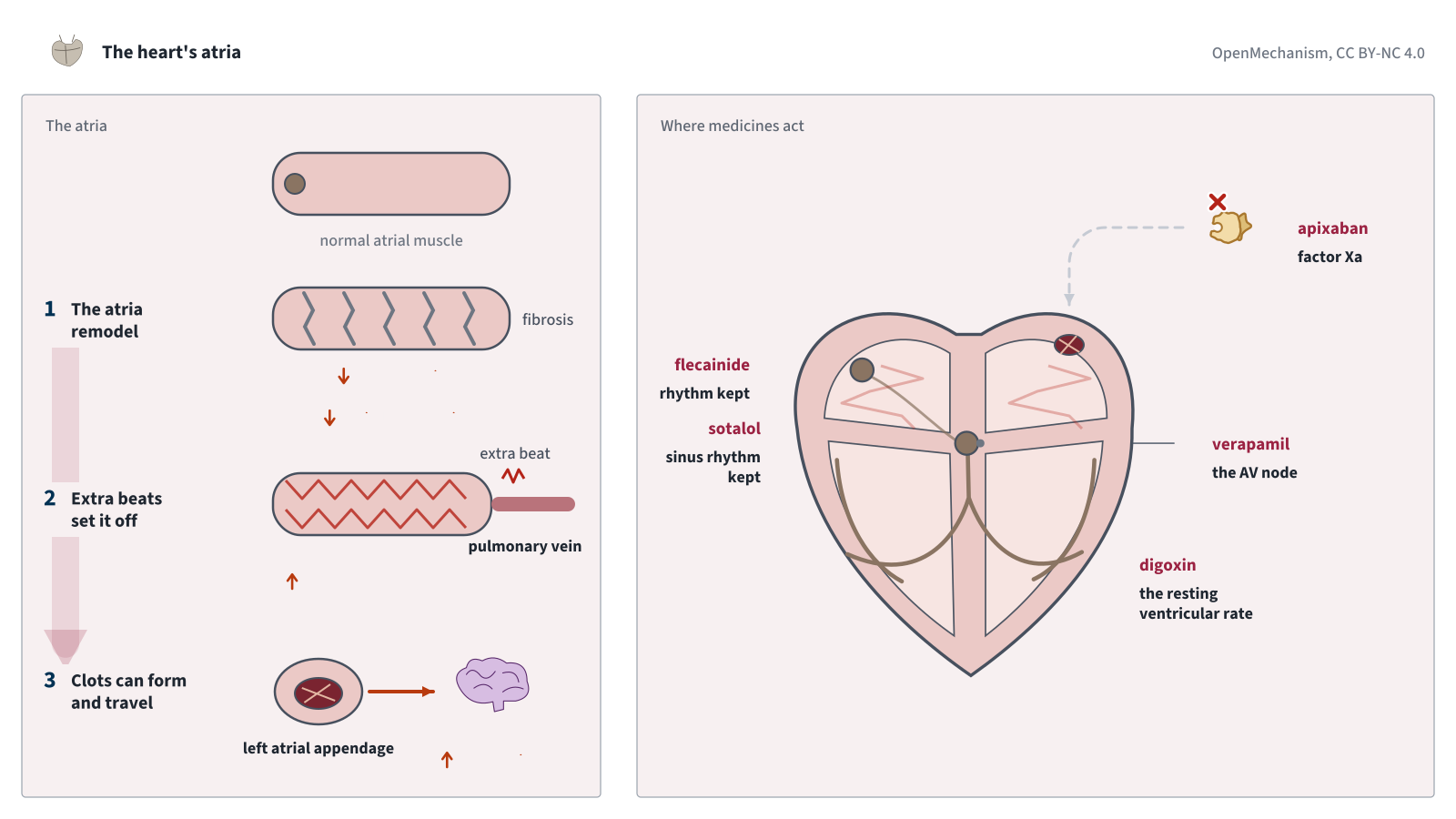
In atrial fibrillation, age, nerve and hormone activation, and long-standing stretch from structural heart disease remodel the atria, and the fast rhythm itself stops them contracting well. Extra beats from the pulmonary veins or other sites trigger longer episodes. Clots can form, mostly in the left atrial appendage, and travel to the brain. Medicines help keep the normal rhythm, slow the rate through the AV node, or make clots less likely.
Atrioventricular node. The part of the heart's wiring that passes each beat's electrical impulse from the upper chambers (atria) to the lower chambers (ventricles).
factor Xa
Activated coagulation factor X. A clotting enzyme that turns prothrombin into thrombin.
fibrosis
Fibrosis. A change in the material between an organ's cells (the extracellular matrix).
What goes wrong
The atria remodel. Age, nerve and hormone activation, and long-standing stretch from structural heart disease change the atrial tissue, with ; and the fast rhythm itself shortens the atria's recovery time and stops them contracting well.1
What the source says
“Atrial tachycardia or AF itself shortens atrial refractoriness and causes loss of atrial contractility.”
“Aging, neurohumoral activation, and chronic atrial stretch due to structural heart disease activate a variety of signaling pathways leading to histological changes in the atria including myocyte hypertrophy, fibroblast proliferation, and complex alterations of the extracellular matrix including tissue fibrosis.”
Extra beats set it off. In remodeled atria, extra (ectopic) beats, from the pulmonary veins or other sites, are more likely and trigger longer episodes of atrial fibrillation, a fast, abnormal rhythm in the atria.1,2
What the source says
“Atrial fibrillation (AF) is an arrhythmia that can occur as the result of numerous different pathophysiological processes in the atria.”
Clots can form and travel. Clots can form in the left atrium, mostly in the left atrial appendage, and raise the risk of stroke and of clots elsewhere in the body.3,4
What the source says
“201 of 222 (91%) of nonrheumatic atrial fibrillation-related left atrial thrombi were isolated to, or originated in the left atrial appendage”
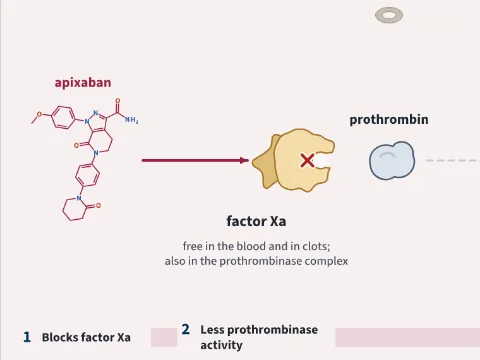
Apixaban blocks , so less thrombin and clot is made; it reduces the risk of stroke and of clots elsewhere in the body (systemic embolism) in adults with nonvalvular atrial fibrillation.4
What the source says
“By inhibiting FXa, apixaban decreases thrombin generation and thrombus development.”
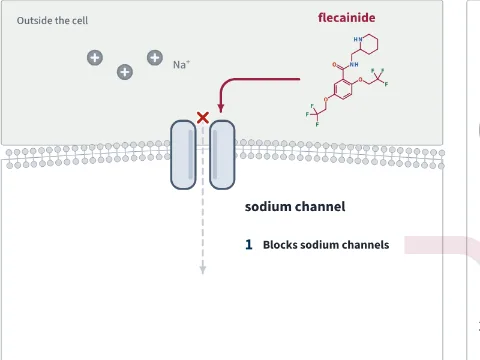
Flecainide, a class IC antiarrhythmic that slows conduction throughout the heart, is used to prevent episodes of paroxysmal atrial fibrillation or flutter with disabling symptoms in people without structural heart disease. Its label says use in chronic atrial fibrillation has not been adequately studied and is not recommended.5
What the source says
“In patients without structural heart disease, Flecainide Acetate Tablets, USP are indicated for the prevention of: paroxysmal supraventricular tachycardias (PSVT), including atrioventricular nodal reentrant tachycardia, atrioventricular reentrant tachycardia and other supraventricular tachycardias of unspecified mechanism associated with disabling symptoms paroxysmal atrial fibrillation/flutter (PAF) associated with disabling symptoms”
“In man, flecainide acetate produces a dose-related decrease in intracardiac conduction in all parts of the heart with the greatest effect on the His-Purkinje system (H-V conduction).”
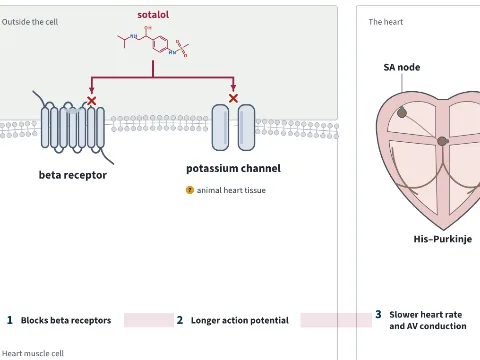
Sotalol helps maintain normal sinus rhythm in people with highly symptomatic atrial fibrillation or flutter who are now in sinus rhythm: it delays the next episode.6
What the source says
“Betapace/Betapace AF is indicated for the maintenance of normal sinus rhythm (delay in time to recurrence of AFIB/AFL) in patients with highly symptomatic AFIB/AFL who are currently in sinus rhythm.”
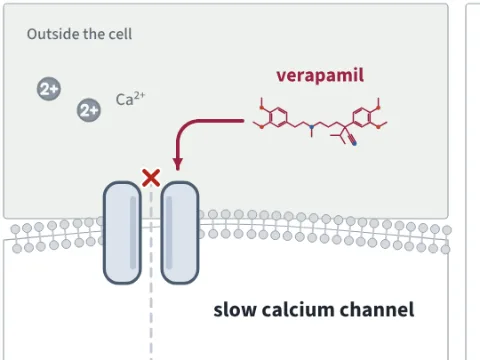
By letting less calcium in, verapamil slows conduction through the and so slows the ventricular rate in chronic atrial fibrillation or flutter; the label lists this use with digitalis.7
What the source says
“In association with digitalis for the control of ventricular rate at rest and during stress in patients with chronic atrial flutter and/or atrial fibrillation”
“By decreasing the influx of calcium, verapamil hydrochloride prolongs the effective refractory period within the AV node and slows AV conduction in a rate-related manner. This property accounts for the ability of verapamil hydrochloride to slow the ventricular rate in patients with chronic atrial flutter or atrial fibrillation.”
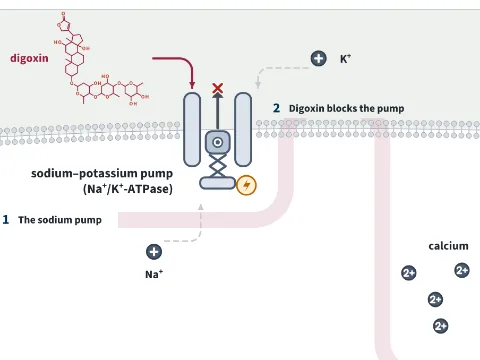
Also used for it: heparin (for atrial fibrillation with embolization (a clot that has traveled): “Atrial fibrillation with embolization”9); esmolol (for short-term treatment: “rapid control of ventricular rate in patients with atrial fibrillation or atrial flutter in perioperative, postoperative, or other emergent circumstances”2); and propranolol (“to control ventricular rate in patients with atrial fibrillation and a rapid ventricular response”10).
Factor Xa with apixabanPDB 2P16; Pinto, D.J. et al. J.Med.Chem. 2007;50:5339-5356. The factor Xa outline in the drawing is traced from this structure. Saved copy
Notes and limits
Some of the structural and electrical changes that promote atrial fibrillation have been studied extensively in animal models; many also occur in people with atrial fibrillation or at risk of it, though showing the mechanisms directly in people is sometimes hard. Many different causes and electrical mechanisms promote atrial fibrillation, which holds back the development of more effective treatment.1
The labels warn that sotalol can cause life-threatening ventricular arrhythmias and that flecainide has proarrhythmic effects (it can bring on arrhythmias); the verapamil label reports a faster ventricular rate, or ventricular fibrillation, after verapamil in people with atrial fibrillation or flutter who also have an accessory pathway.5,6,7
Claude Opus 5.5 (AI source check), 29 October 2026: 41 statements compared with their sources, 12 flagged for the reviewer. An automated check, not a medical review.
Conflict of interest
Apixaban: Pfizer, the reviewer's former employer, makes or markets this medicine. Heparin: Pfizer, the reviewer's former employer, makes or markets this medicine. Details
Next review due
29 April 2028
Cite this page
Tran D. Atrial fibrillation [Internet]. OpenMechanism; 2026 [updated 2026 Oct 29; cited 2026 Oct 29]. Available from: https://openmechanism.com/conditions/atrial-fibrillation