Flecainide
Flecainide blocks the heart's sodium channels (class IC). Electrical conduction slows in all parts of the heart, most in the His-Purkinje system, the recovery time changes significantly only in the ventricles, and premature beats from the ventricles become less frequent. Its label lists it to prevent documented life-threatening ventricular arrhythmias and, in people without structural heart disease, sudden bouts of fast rhythm that start above the ventricles (PSVT, and paroxysmal atrial fibrillation or flutter) with disabling symptoms.
- Acts on
- Cardiac sodium channels
- Where
- Heart muscle and the His-Purkinje system
- Medicine type
- Small molecule
- Used for
- Heart & circulation
- Drug class
- Antiarrhythmics (class I and III)
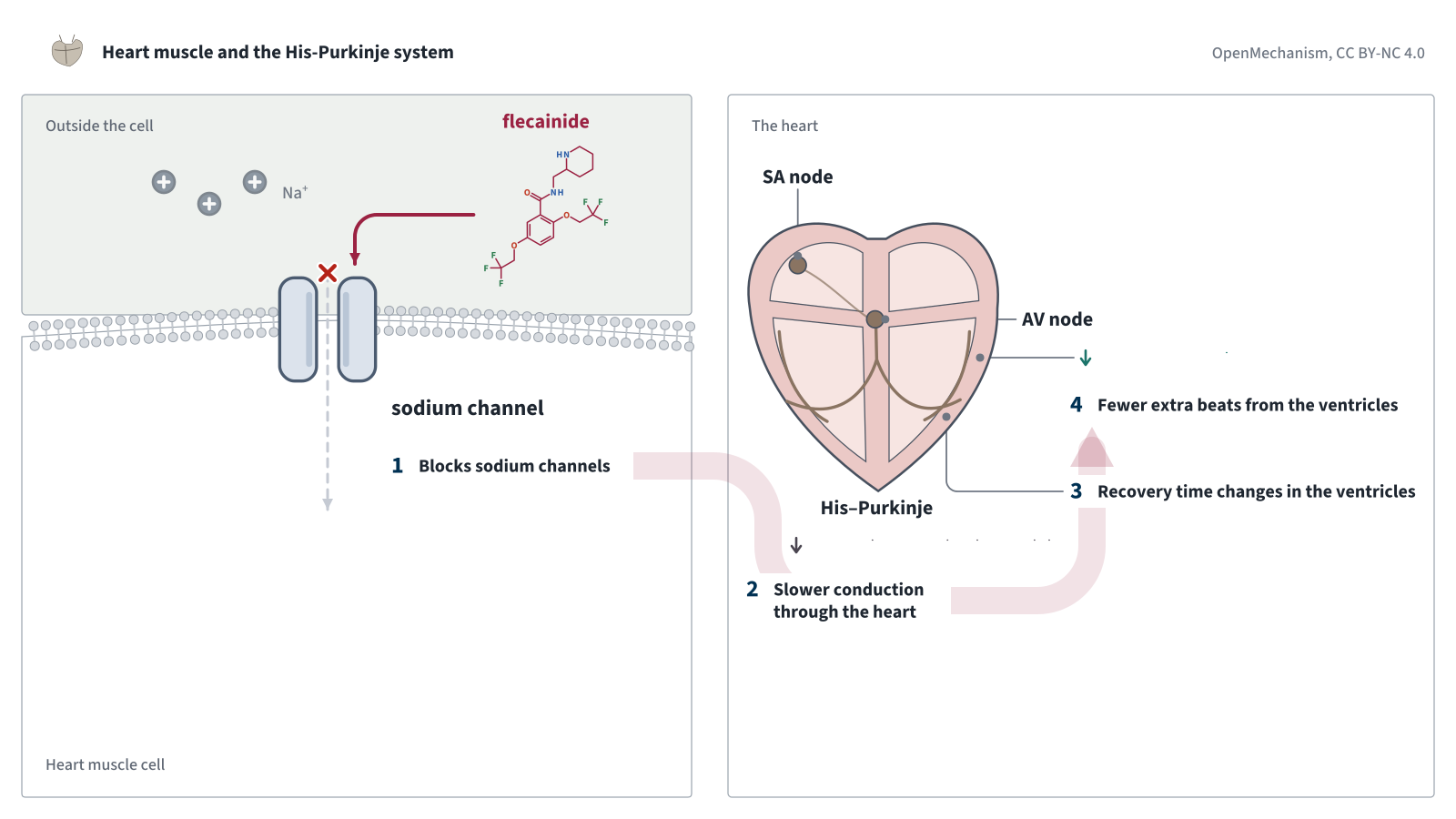
Key terms in this drawing
- AV node
- Atrioventricular node. The part of the heart's wiring that passes each beat's electrical impulse from the upper chambers (atria) to the lower chambers (ventricles).
- SA node
- Sinoatrial node. The place in the heart where each heartbeat's electrical impulse starts.
How it works
Blocks sodium channels. Flecainide has local anesthetic activity and belongs to the membrane-stabilizing (class I) antiarrhythmics, with the effects of class IC; it is a type IC sodium-channel blocker, acting on the cardiac sodium channel (encoded by ).1,2
Slower conduction through the heart. In people, flecainide produces a dose-related decrease in conduction in all parts of the heart, with the greatest effect on the His-Purkinje system; effects on nodal and atrial conduction are smaller.1
Recovery time changes in the ventricles. Significant effects on refractory periods are seen only in the ventricle.1
Fewer extra beats from the ventricles. Flecainide causes a dose-related decrease in single and multiple premature ventricular contractions (PVCs) and can suppress recurrence of ventricular tachycardia.1
For teachers: download this drawing.
See also
Condition pages: atrial fibrillation, supraventricular tachycardia (SVT) and ventricular arrhythmias.
Other antiarrhythmics (class I and III): amiodarone, lidocaine and sotalol.
Body system: heart, vessels & cholesterol.
Inside the body: the heartbeat.
Sources
- 1Flecainide acetate tablets: FDA labelIndications and Usage; Clinical Pharmacology
- 2Effects of flecainide in patients with new SCN5A mutation: mutation-specific therapy for long-QT syndrome?Benhorin J et al., Circulation 2000 (abstract)
- 3ChEMBL CHEMBL652Target and action classification: Sodium channel protein type V alpha subunit blocker
Spotted a mistake? Report an error (hello@openmechanism.com). Since launch, every published error we fix is listed on the corrections page.
Notes and limits
- A schematic teaching drawing: not to scale, not exact structures, binding poses or a complete pathway, and not a guide to dosing, treatment or how a person will respond.
- The steps are in the order that explains them; one step is said to cause the next only where the source says so.
- The label notes flecainide's proarrhythmic effects (it can bring on arrhythmias), does not recommend it for less severe ventricular arrhythmias, even when they cause symptoms, and says that, as for other antiarrhythmics, there is no evidence from controlled trials that it improves survival or lowers the rate of sudden death. It also says flecainide should not be used in people with a recent myocardial infarction, and that its use in chronic atrial fibrillation has not been adequately studied and is not recommended.
All recorded limits are on the evidence page, and notes that apply to every page are on How to read a page. Version 1.0.1, medically reviewed by Daniel Tran, PharmD, on 29 October 2026.
Cite this page
Tran D. Flecainide [Internet]. OpenMechanism; 2026 [updated 2026 Oct 29; cited 2026 Oct 29]. Available from: https://openmechanism.com/medicines/flecainide