Digoxin and P-glycoprotein blockers
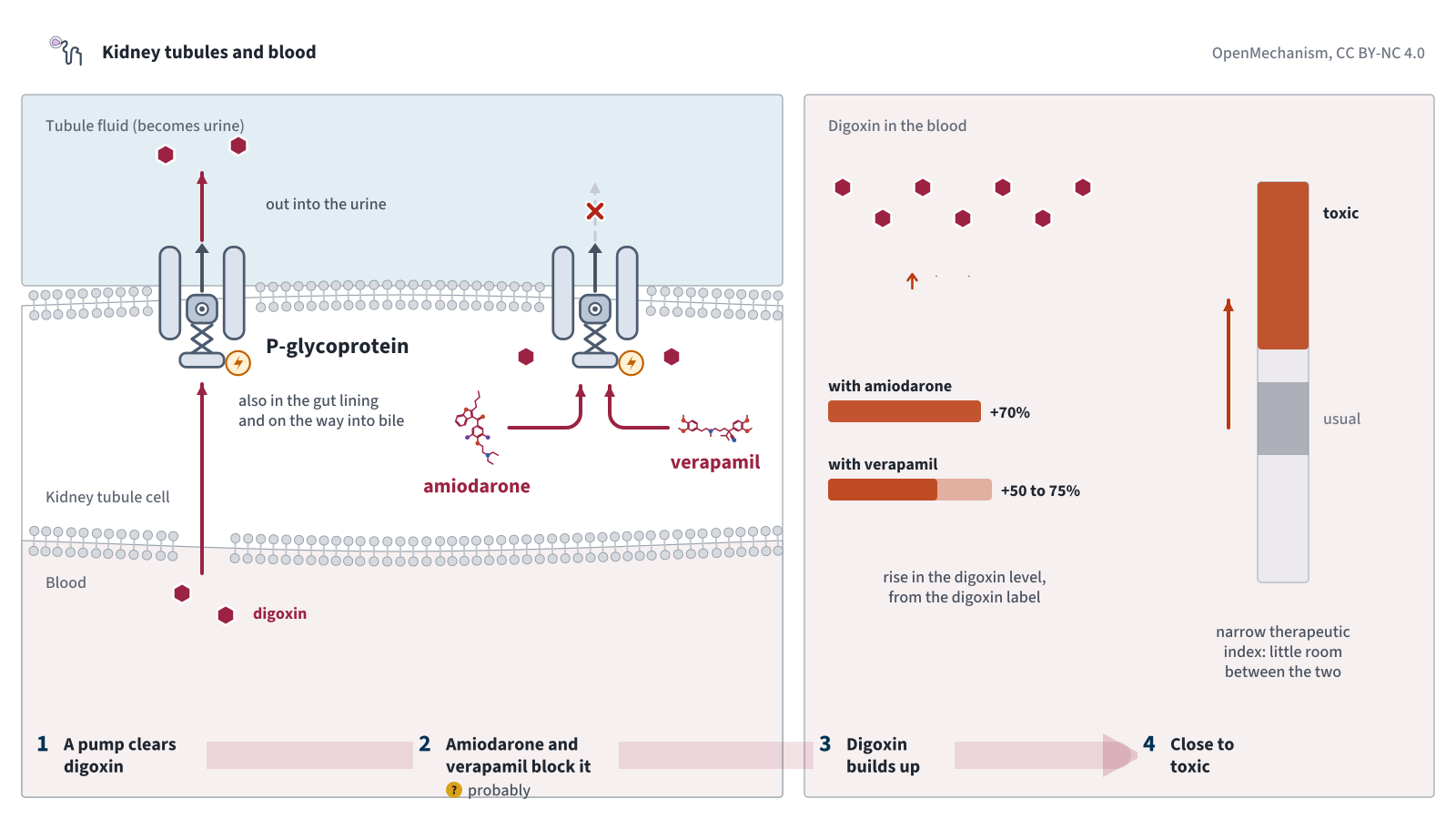
P-glycoprotein is a pump that moves digoxin out of cells: from the gut lining back into the gut, from the kidney's tubules into the urine, and into the bile. Amiodarone blocks this pump, and verapamil probably does too, so less digoxin is cleared and more stays in the blood: about 70% more with amiodarone and 50% to 75% more with verapamil. Digoxin has a narrow therapeutic index, so the rise can bring on its toxic effects.
- Kind
- Interaction
- Medicines
- Digoxin, Amiodarone, Verapamil
- Sources
- 6
Step 2: probably
A 1999 review of the interaction says: it is likely that P-glycoprotein modulation accounts for the digoxin-verapamil interaction
Clinical study: In a study of 49 patients with chronic atrial fibrillation on a steady dose of digoxin who were given verapamil, the kidneys' clearance of digoxin was measured in seven (the study did not look at the pump itself); the authors conclude: The process is dose-dependent and gradual, and it is at least partially explained by reduced renal excretion without reduction in glomerular filtration.
Klein HO et al., Circulation 1982 (PMID 7074765)
This study was picked with a literature search and is not yet checked by our reviewer.
For teachers: download this drawing.
Step by step
A pump clears digoxin. Digoxin is carried by P-glycoprotein, a pump in the gut lining, in the kidney's tubules and on the way into the bile. Most digoxin leaves the body through the kidneys, where the pump actively secretes it into the urine; about a quarter leaves through the gut and the bile.1,2
What the source says
“Digoxin is a substrate for P-glycoprotein, at the level of intestinal absorption, renal tubular section and biliary-intestinal secretion.”
Source 1“The discovery that digoxin is actively secreted by the renal tubular cell via the p-glycoprotein drug efflux pump”
Source 2“Elimination of digoxin is predominantly renal, although in adult volunteers about a quarter of serum digoxin is eliminated through the intestine, excreted in bile or secreted directly into the lumen by P-glycoprotein.”
Source 1Amiodarone and verapamil block it. Amiodarone blocks P-glycoprotein. Verapamil probably does too: a 1999 review puts the interaction down, as likely, to verapamil holding back P-glycoprotein, so the kidney's tubules secrete less digoxin.3,4
What the source says
“Amiodarone inhibits P-glycoprotein and CYP1A2, CYP2C9, CYP2D6, and CYP3A, increasing exposure to other drugs.”
Source 3“it is likely that P-glycoprotein modulation accounts for the digoxin-verapamil interaction”
Source 4“Current knowledge suggest that the non-competitive digoxin-verapamil interaction is due to inhibition of P-glycoprotein activity by verapamil resulting in a decreased renal tubular elimination of digoxin.”
Source 4Digoxin builds up. With the pump held back, more digoxin stays in the blood: in the digoxin label's table, its level rose by 70% with amiodarone and by 50% to 75% with verapamil.1,3
Close to toxic. Digoxin has a narrow therapeutic index, so such a rise can bring on its toxic effects.1,5
What the source says
“Digoxin has a narrow therapeutic index”
Source 1“The calcium channel antagonist, verapamil and the cardiac glycoside, digoxin, exhibit DDIs with Pgp through non-competitive inhibition of digoxin transport, which leads to elevated digoxin plasma concentrations and digoxin toxicity.”
Source 5
See also
Medicine pages: digoxin, amiodarone and verapamil.
Other interactions (heart & circulation): ACE inhibitors and spironolactone; ACE inhibitors with ARBs or aliskiren; amiodarone and warfarin; atorvastatin and medicines that block CYP3A4; digoxin and diuretics; grapefruit juice and simvastatin; nitrates and PDE5 inhibitors such as sildenafil; simvastatin and clarithromycin; verapamil with beta-blockers; why beta-blockers can hide low blood sugar; and all 40 interactions.
Side effects: why amiodarone can upset the thyroid.
Conditions: atrial fibrillation, heart failure and digoxin toxicity.
Sources
- 1Digoxin oral solution: FDA label7.1 P-Glycoprotein (PGP) Inducers/Inhibitors; 7.2 Pharmacokinetic Drug Interactions; 12.3 Pharmacokinetics. Saved copy
- 2Toxic digoxin-drug interactions: the major role of renal P-glycoproteinKoren G et al. Vet Hum Toxicol 1998 (abstract). Saved copy
- 3Pacerone (amiodarone hydrochloride) tablets: FDA label7 Drug Interactions. Saved copy
- 4P-glycoprotein system as a determinant of drug interactions: the case of digoxin-verapamilVerschraagen M et al. Pharmacol Res 1999 (abstract). Saved copy
- 5Unravelling the complex drug-drug interactions of the cardiovascular drugs, verapamil and digoxin, with P-glycoproteinLedwitch KV et al. Biosci Rep 2016 (abstract). Saved copy
- 6The influence of verapamil on serum digoxin concentrationKlein HO et al. Circulation 1982 (abstract). Saved copy
Notes and limits
- The labels' dose changes and monitoring advice are left out: this page explains the mechanism, not what to do.
- For verapamil the precise mechanism is not known; a lower kidney clearance of digoxin is what most studies found.4
- Other medicines that block or speed up P-glycoprotein can change digoxin levels too, up or down.1
Notes that apply to every page are on How to read a page.
Spotted a mistake? Report an error (hello@openmechanism.com). Since launch, every published error we fix is listed on the corrections page.
Cite this page
Tran D. Digoxin and P-glycoprotein blockers [Internet]. OpenMechanism; 2026 [updated 2026 Oct 20; cited 2026 Oct 20]. Available from: https://openmechanism.com/explained/digoxin-and-p-glycoprotein-blockers