Why heparin can lower platelets and cause clots
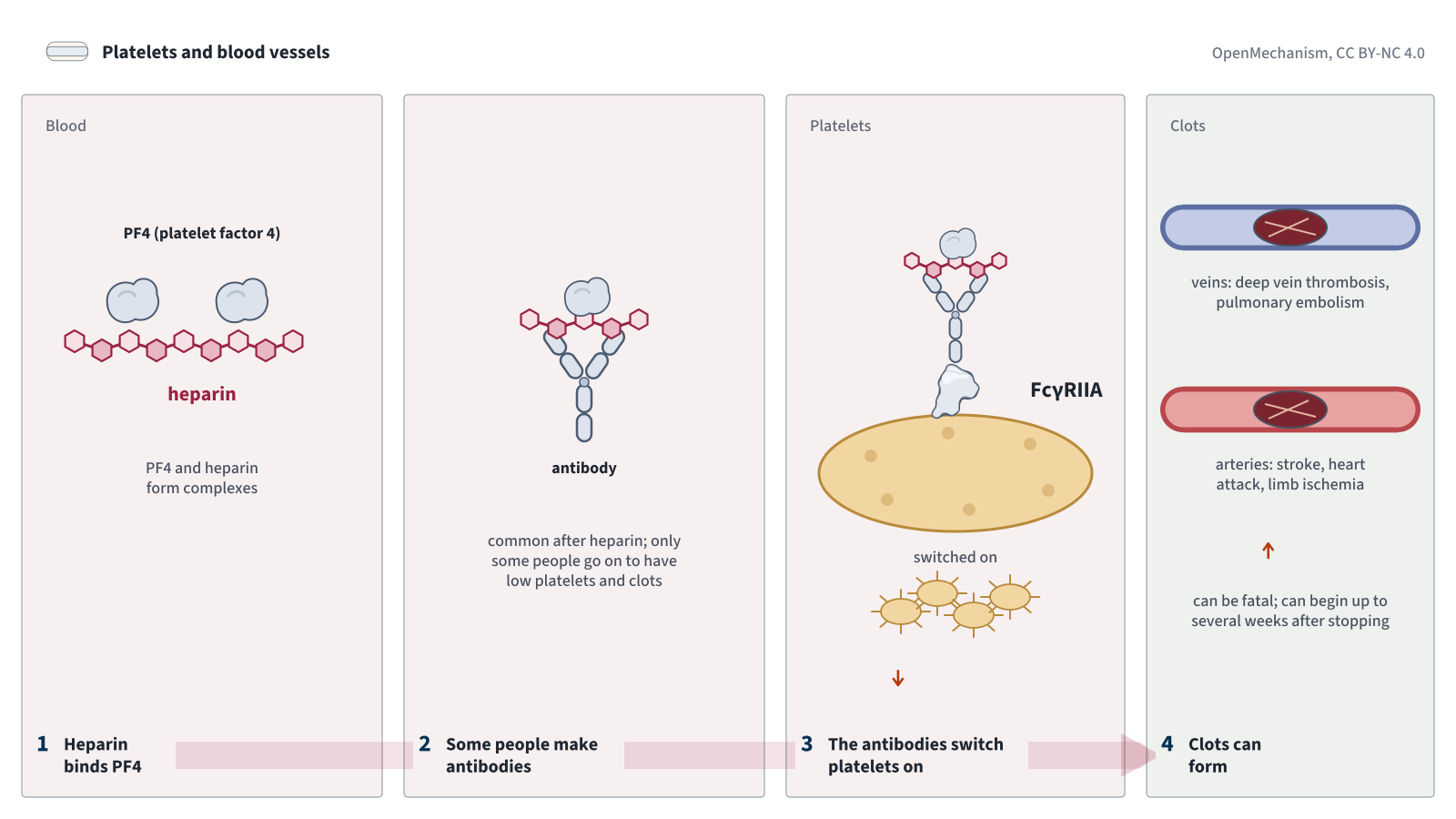
Heparin binds a protein called platelet factor 4 (PF4). Some people make antibodies against these PF4 and heparin complexes, and the antibodies switch platelets on through their FcγRIIA receptors, so the platelets clump and their count falls: heparin-induced thrombocytopenia (HIT). The blood clots more easily, and clots in veins and arteries can be life-threatening. HIT can begin up to several weeks after heparin is stopped.
- Kind
- Side effect
- Medicines
- Heparin
- Sources
- 4
For teachers: download this drawing.
Step by step
Heparin binds PF4. Heparin forms complexes with a protein called platelet factor 4 (PF4).1,2
What the source says
“Heparin-induced thrombocytopenia (HIT) is an immune complication of heparin therapy caused by antibodies to complexes of platelet factor 4 (PF4) and heparin.”
Source 1“HIT occurs in patients treated with heparin and is due to the development of antibodies to a platelet Factor 4-heparin complex that induce in vivo platelet aggregation.”
Source 2Some people make antibodies. Some people make antibodies against the PF4 and heparin complexes. These antibodies are common after heparin, but only some of the people who make them go on to have low platelets and clots.1,2
What the source says
“Heparin-induced thrombocytopenia (HIT) is a serious antibody-mediated reaction.”
Source 2“It is now recognized that anti-PF4/heparin antibodies develop commonly after heparin exposure, but only a subset of sensitized patients progress to life-threatening complications of thrombocytopenia and thrombosis.”
Source 1The antibodies switch platelets on. The antibodies bind a receptor called FcγRIIA on platelets and monocytes and switch these cells on. The platelets clump, and the platelet count falls (thrombocytopenia).1,2
What the source says
“Pathogenic antibodies to PF4/heparin bind and activate cellular FcγRIIA on platelets and monocytes to propagate a hypercoagulable state culminating in life-threatening thrombosis.”
Source 1“antibodies to a platelet Factor 4-heparin complex that induce in vivo platelet aggregation”
Source 2Clots can form. With fewer platelets, the blood still clots more easily, and clots can form in veins and arteries: deep vein thrombosis, pulmonary embolism, stroke, heart attack, limb ischemia and others, sometimes fatal. HIT can begin up to several weeks after heparin is stopped.1,2
What the source says
“to propagate a hypercoagulable state culminating in life-threatening thrombosis”
Source 1“HIT may progress to the development of venous and arterial thromboses, a condition referred to as heparin-induced thrombocytopenia with thrombosis (HITT).”
Source 2“These serious thromboembolic events include deep vein thrombosis, pulmonary embolism, cerebral vein thrombosis, limb ischemia, stroke, myocardial infarction, mesenteric thrombosis, renal arterial thrombosis, skin necrosis, gangrene of the extremities that may lead to amputation, and possibly death.”
Source 2“HIT or HITT can occur up to several weeks after the discontinuation of heparin therapy.”
Source 2
See also
Medicine pages: heparin.
Can raise or cause it: enoxaparin (“Lovenox may cause heparin-induced thrombocytopenia (HIT) or heparin-induced thrombocytopenia with thrombosis (HITTS).”3).
Other side effects (blood & clotting): why heparin can raise potassium and all 65 side effects.
Conditions: blood clots in the veins and atrial fibrillation.
Interactions: protamine and heparin.
Sources
- 1Heparin-induced thrombocytopeniaArepally GM. Blood 2017 (abstract). Saved copy
- 2Heparin sodium injection (Fresenius Kabi): FDA label5.3 Heparin-Induced Thrombocytopenia and Heparin-Induced Thrombocytopenia and Thrombosis; 5.5 Thrombocytopenia. Saved copy
- 3Lovenox (enoxaparin sodium): FDA label5.4 Risk of Heparin-Induced Thrombocytopenia with or without Thrombosis. Saved copy
- 4Human Fc gamma receptor IIa (FcγRIIa, CD32a), from its structure with the stem (Fc) of an IgG1 antibodyPDB 3RY6; Ramsland, P.A. et al. J.Immunol. 2011;187:3208-3217. The FcγRIIA outline in the drawing is traced from this structure. Saved copy
Notes and limits
- The labels' advice on checking platelet counts, stopping heparin and choosing another anticoagulant is left out: this page explains the mechanism, not what to do.
- A clot may be the first sign of HIT.2
- The heparin label reports thrombocytopenia in up to 30% of patients receiving heparin, in its own section apart from HIT.2
- Monocytes as well as platelets carry the FcγRIIA receptor that the antibodies switch on; this page draws only the platelets.1
Notes that apply to every page are on How to read a page.
Spotted a mistake? Report an error (hello@openmechanism.com). Since launch, every published error we fix is listed on the corrections page.
Cite this page
Tran D. Why heparin can lower platelets and cause clots [Internet]. OpenMechanism; 2026 [updated 2026 Oct 20; cited 2026 Oct 20]. Available from: https://openmechanism.com/explained/heparin-induced-thrombocytopenia