Why amiodarone can upset the thyroid
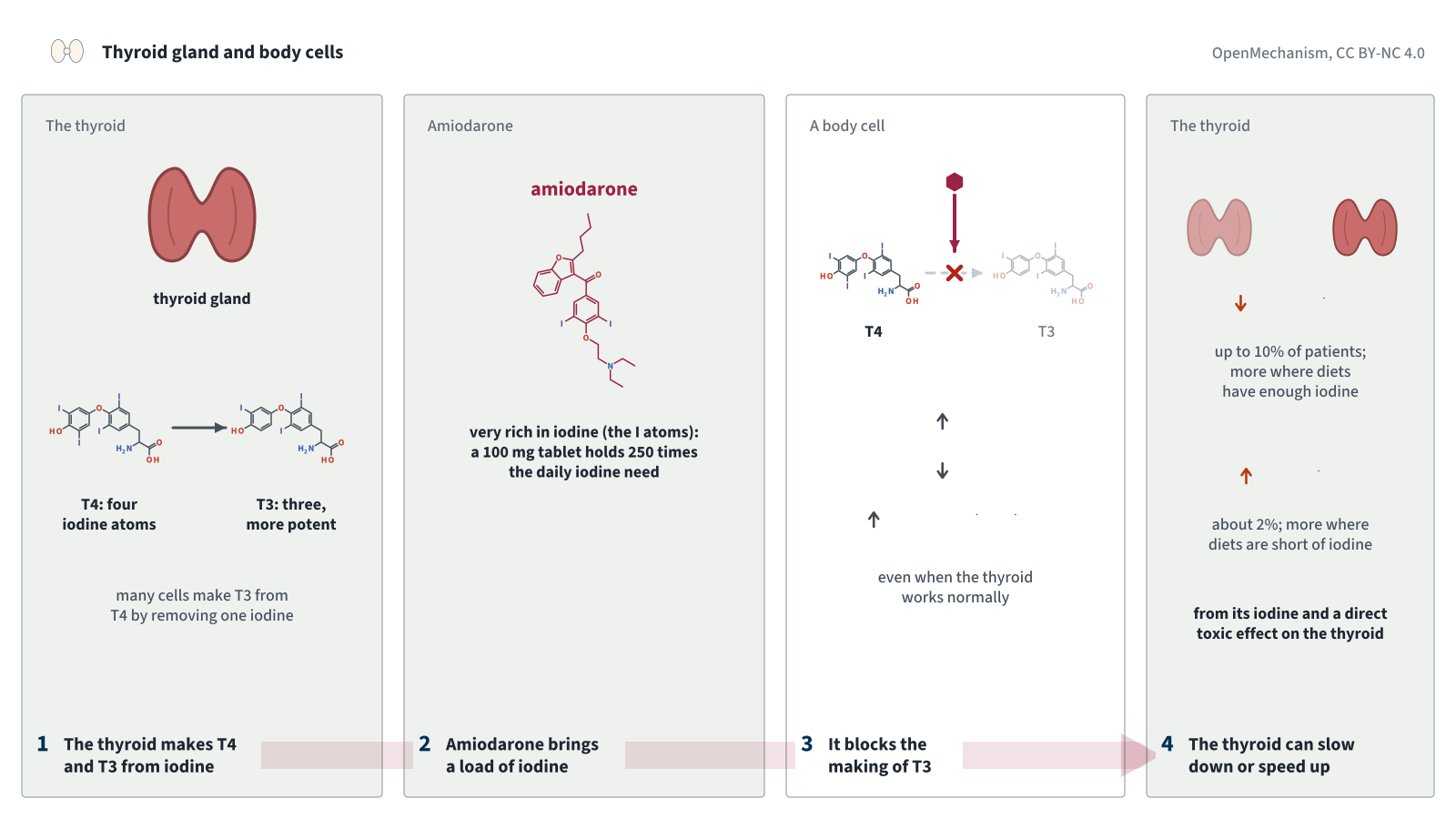
The thyroid builds its hormones, T4 and T3, from iodine, and many cells turn T4 into the more potent T3. Amiodarone is very rich in iodine, a 100 mg tablet holding 250 times the daily iodine need, and it blocks the conversion of T4 to T3. Through its iodine and a direct toxic effect on the thyroid, it can cause an underactive thyroid (in up to 10% of patients) or an overactive one (in about 2%).
- Kind
- Side effect
- Medicines
- Amiodarone
- Sources
- 7
For teachers: download this drawing.
Step by step
The thyroid makes T4 and T3 from iodine. The thyroid builds its hormones from iodine: thyroxine () carries four iodine atoms and triiodothyronine () three. T3 is the more potent, and many cells make it from T4 by removing an iodine atom.1,2,3,4
What the source says
“The thyroid is a small, butterfly-shaped gland in the front of your neck that makes two thyroid hormones: thyroxine (T4) and triiodothyronine (T3).”
Source 1“The thyroid “takes up” iodine from the blood to make thyroid hormones, which is why this is called an uptake test.”
Source 1“A hormone synthesized and secreted by the thyroid gland containing four iodine atoms and is converted to triiodothyronine (T3) in the body, influencing metabolism and organ function.”
Source 2“A thyroid hormone containing 3 iodine atoms generally synthesized from levothyroxine, and has greater biological activity.”
Source 3“The physiological actions of thyroid hormones are produced predominantly by T3, the majority of which (approximately 80%) is derived from T4 by deiodination in peripheral tissues.”
Source 4Amiodarone brings a load of iodine. Amiodarone is very rich in iodine: a 100 mg tablet holds 250 times the recommended daily iodine intake.5
What the source says
“It is very rich in iodine, with a 100-mg tablet containing an amount of iodine that is 250 times the recommended daily iodine requirement.”
Source 5It blocks the making of T3. Amiodarone blocks the conversion of T4 to T3 in the body's cells, so even in people whose thyroid works normally, T4 can rise, T3 fall, and an inactive form, reverse T3, rise.6
What the source says
“Amiodarone hydrochloride inhibits peripheral conversion of thyroxine (T 4 ) to triiodothyronine (T 3 ) and may cause increased thyroxine levels, decreased T 3 levels, and increased levels of inactive reverse T 3 (rT 3 ) in clinically euthyroid patients.”
Source 6The thyroid can slow down or speed up. Through its iodine and a direct toxic effect on thyroid tissue, amiodarone can cause an underactive thyroid (hypothyroidism, in up to 10% of patients) or an overactive one (hyperthyroidism, in about 2%). The overactive kind is more common where diets are short of iodine, and the underactive kind where they have enough.5,6
What the source says
“Amiodarone-induced thyroid dysfunction occurs because of both its iodine content and the direct toxic effects of the compound on thyroid parenchyma.”
Source 5“Amiodarone hydrochloride can cause either hypothyroidism (reported in up to 10% of patients) or hyperthyroidism (occurring in about 2% of patients).”
Source 6“Amiodarone-induced hyperthyroidism is more common in iodine-deficient regions of the world, whereas amiodarone-induced hypothyroidism is usually seen in iodine-sufficient areas.”
Source 5
See also
Medicine pages: amiodarone.
Related medicines: levothyroxine.
Other side effects (heart & circulation): why ACE inhibitors and ARBs can harm a fetus; why ACE inhibitors can cause a dry cough; why ACE inhibitors can cause angioedema; why amlodipine can cause swelling; why beta-blockers can tighten the airways; why diuretics can lower potassium; why spironolactone can cause breast growth; why statins can cause muscle problems; why stopping clonidine suddenly can raise blood pressure; and all 65 side effects.
Conditions: hypothyroidism, hyperthyroidism and atrial fibrillation.
Interactions: amiodarone and warfarin; and digoxin and P-glycoprotein blockers.
Sources
- 1Thyroid testsNIDDK, last reviewed May 2017 (opening; Radioactive iodine uptake test). Saved copy
- 2Thyroxine: NCI Thesaurus definitionNCI definition, concept C2302. Saved copy
- 3Triiodothyronine: NCI Thesaurus definitionNCI definition, concept C2303. Saved copy
- 4Synthroid (levothyroxine): FDA label12.1 Mechanism of Action. Saved copy
- 5Amiodarone and the thyroidBasaria S, Cooper DS. Am J Med 2005 (abstract). Saved copy
- 6Pacerone (amiodarone hydrochloride) tablets: FDA label5.6 Thyroid Abnormalities. Saved copy
- 7Amiodarone-induced thyroid dysfunctionDanzi S, Klein I. J Intensive Care Med 2015 (abstract). Saved copy
Notes and limits
- The label's advice on testing and treating the thyroid is left out: this page explains the mechanism, not what to do.
- How amiodarone acts on the thyroid is poorly understood; its likeness to thyroid hormones, iodine atoms included, may play a part.7
- The overactive thyroid comes in two main types: type 1, usually in a gland that already had a problem or a goiter, and type 2, in a normal gland whose tissue is destroyed by inflammation (thyroiditis).7
- An overactive thyroid may bring back the heart rhythm problems amiodarone is given for, and severe hypothyroidism, including myxedema coma, has sometimes been fatal.6
Notes that apply to every page are on How to read a page.
Spotted a mistake? Report an error (hello@openmechanism.com). Since launch, every published error we fix is listed on the corrections page.
Cite this page
Tran D. Why amiodarone can upset the thyroid [Internet]. OpenMechanism; 2026 [updated 2026 Nov 13; cited 2026 Nov 13]. Available from: https://openmechanism.com/explained/amiodarone-and-the-thyroid