Sotalol
Sotalol blocks beta receptors, which slows the heart rate and conduction, and it lengthens the heart's action potential, so atria and ventricles take longer to recover. The lengthens with dose.
- Acts on
- Beta-adrenergic receptors (non-cardioselective) and a cardiac potassium current
- Where
- Heart muscle and the conduction system
- Medicine type
- Small molecule
- Used for
- Heart & circulation
- Drug class
- Beta blockers, Antiarrhythmics (class I and III)
Also called Betapace and Betapace AF.
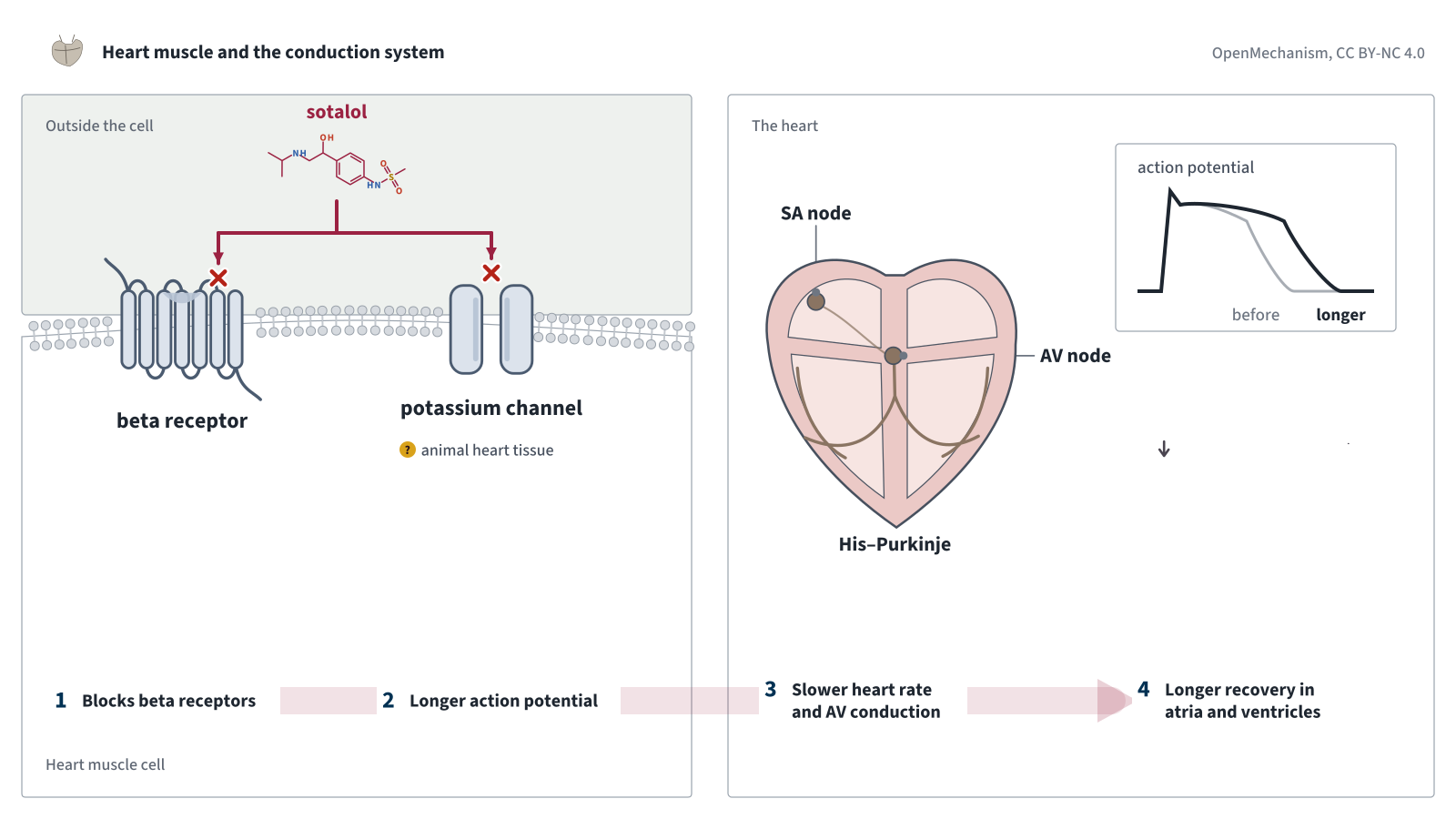
Step 2: animal heart tissue
Carmeliet's 1985 study of animal heart tissue says: In voltage clamp experiments this effect correlated with a substantial reduction of the time-dependent K current activated during the plateau of the action potential and a small reduction of the background K current.
Clinical study: In a double-blind, placebo-controlled trial in 665 people with persistent atrial fibrillation, given amiodarone, sotalol or placebo; the trial measured return to and keeping of normal rhythm, not potassium currents: Amiodarone and sotalol are equally efficacious in converting atrial fibrillation to sinus rhythm.
Singh BN et al., N Engl J Med 2005 (PMID 15872201)
This study was picked with a literature search and is not yet checked by our reviewer.
Key terms in this drawing
- AV node
- Atrioventricular node. The part of the heart's wiring that passes each beat's electrical impulse from the upper chambers (atria) to the lower chambers (ventricles).
- SA node
- Sinoatrial node. The place in the heart where each heartbeat's electrical impulse starts.
How it works
Blocks beta receptors. Sotalol blocks beta-adrenoreceptors (Vaughan Williams class II); the blockade is non-cardioselective, and the l-isomer accounts for virtually all of it.1
Longer action potential. It also prolongs the cardiac action potential (class III), lengthening its plateau phase; in animal heart tissue this went with a large reduction of the time-dependent potassium current active during the plateau. Significant class III effects are seen only at daily doses of 160 mg and above.1,2
Slower heart rate and AV conduction. In people, its beta-blocking effects slow the heart rate, decrease AV nodal conduction and increase AV nodal refractoriness.1
Longer recovery in atria and ventricles. Its class III effects in people prolong the atrial and ventricular action potentials and the refractory periods of atrial and ventricular muscle; the QT interval on the lengthens with dose.1
For teachers: download this drawing.
See also
Condition pages: atrial fibrillation and ventricular arrhythmias.
Other beta blockers: atenolol, carvedilol, esmolol, labetalol, metoprolol, nebivolol, propranolol and timolol.
Other antiarrhythmics (class I and III): amiodarone, flecainide and lidocaine.
Explained: why some medicines lengthen the QT interval.
Body system: heart, vessels & cholesterol.
Sources
- 1Betapace and Betapace AF (sotalol hydrochloride) tablets: FDA label12.1 Mechanism of Action; 12.2 Pharmacodynamics
- 2Electrophysiologic and voltage clamp analysis of the effects of sotalol on isolated cardiac muscle and Purkinje fibersCarmeliet E, J Pharmacol Exp Ther 1985 (abstract)
- 3ChEMBL CHEMBL471Target and action classification: Beta-1 adrenergic receptor antagonist; Beta-2 adrenergic receptor antagonist; HERG blocker
- 4Amiodarone versus sotalol for atrial fibrillationSingh BN et al. N Engl J Med 2005 (abstract)
Spotted a mistake? Report an error (hello@openmechanism.com). Since launch, every published error we fix is listed on the corrections page.
Notes and limits
- A schematic teaching drawing: not to scale, not exact structures, binding poses or a complete pathway, and not a guide to dosing, treatment or how a person will respond.
All recorded limits are on the evidence page, and notes that apply to every page are on How to read a page. Version 1.0.0, not yet medically reviewed.
Cite this page
Tran D. Sotalol [Internet]. OpenMechanism; 2026 [updated 2026 Oct 14; cited 2026 Oct 14]. Available from: https://openmechanism.com/medicines/sotalol