Warfarin and NSAIDs or aspirin
Warfarin lowers the clotting factors the body makes. Aspirin blocks the platelets' cyclooxygenase for good, NSAIDs such as naproxen may also make platelets clump less, and both carry warnings of stomach bleeding. The labels say bleeding is more likely when they are taken with warfarin.
- Kind
- Interaction
- Sources
- 6
Step 2: may
The naproxen label says: Naproxen may decrease platelet aggregation and prolong bleeding time.
Clinical study: In a crossover study in 9 healthy people who took naproxen or low-dose aspirin for 6 days each, the study measured the thromboxane their blood made, an index of the platelets' COX-1 activity: The administration of naproxen or aspirin caused a similar suppression of whole-blood TXB2 production, an index of platelet COX-1 activity ex vivo, by 94+/-3% and 99+/-0.3% (mean+/-SD), respectively
Capone ML et al., Circulation 2004 (PMID 15037526)
This study was picked with a literature search and is not yet checked by our reviewer.
For teachers: download this drawing.
Step by step
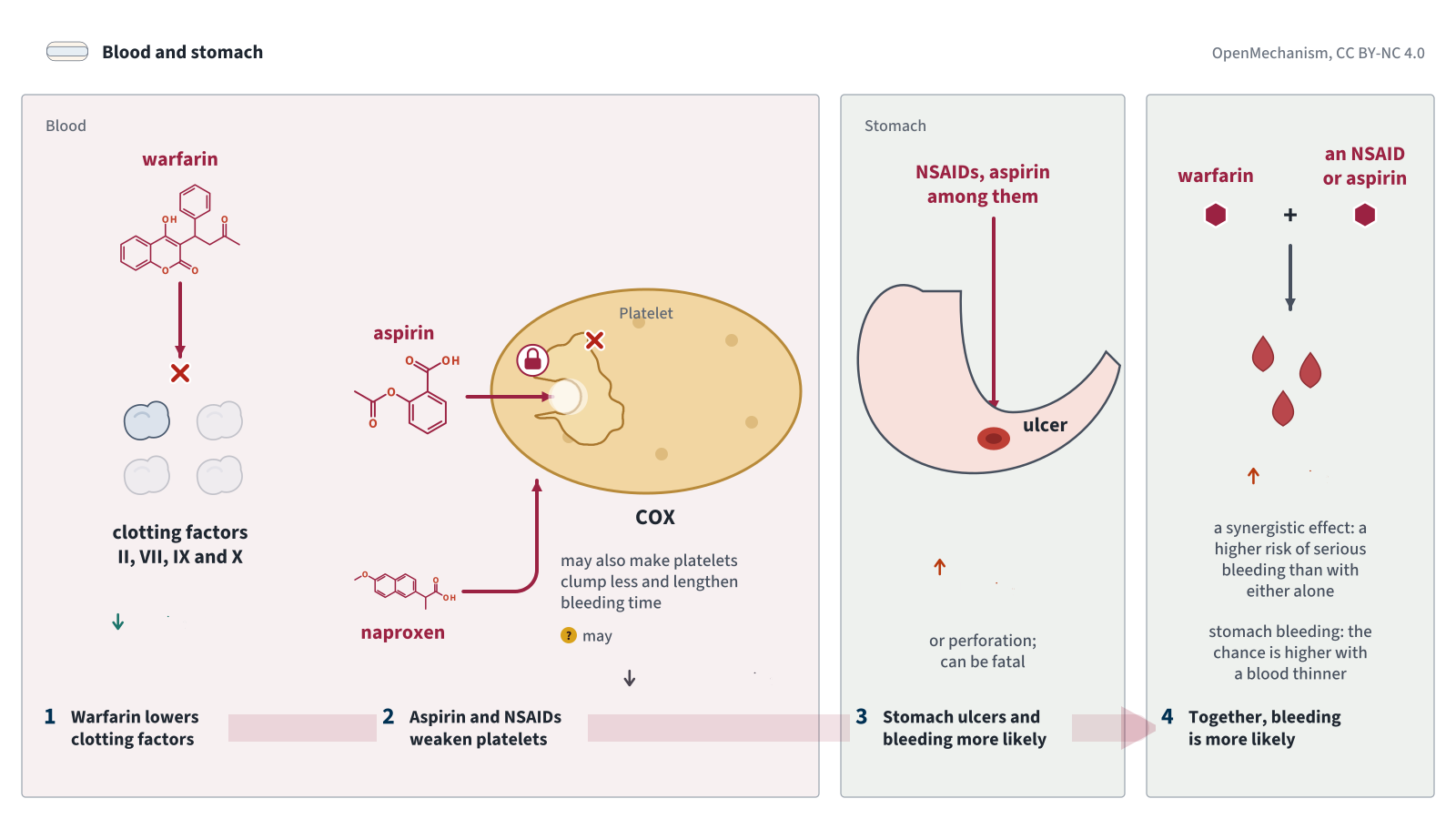
Warfarin lowers clotting factors. Warfarin works by inhibiting the making of the clotting factors that depend on vitamin K: factors II, VII, IX and X. Its label warns that on its own it can cause major or fatal bleeding.1
Aspirin and NSAIDs weaken platelets. Aspirin makes platelets clump less by blocking their cyclooxygenase () for good. Naproxen, an , may also make platelets clump less and lengthen bleeding time.2,3
Stomach ulcers and bleeding more likely. NSAIDs raise the risk of serious bleeding, ulcers and perforation (a hole through the wall) of the stomach or intestines, which can be fatal. The aspirin label calls aspirin an NSAID and warns that it may cause severe stomach bleeding.3,4
Together, bleeding is more likely. The naproxen label says naproxen and such as warfarin have a synergistic effect on bleeding: together, the risk of serious bleeding is higher than with either medicine alone. The warfarin label lists aspirin and NSAIDs such as ibuprofen, naproxen, diclofenac and celecoxib among the medicines that raise the risk of bleeding, and the aspirin label says the chance of stomach bleeding is higher in people who take a blood thinner (an anticoagulant).1,3,4
What the source says
“Naproxen and anticoagulants such as warfarin have a synergistic effect on bleeding. The concomitant use of naproxen and anticoagulants have an increased risk of serious bleeding compared to the use of either drug alone.”
Source 3“Examples of drugs known to increase the risk of bleeding are presented in Table 3. Because bleeding risk is increased when these drugs are used concomitantly with warfarin”
Source 1“Antiplatelet Agents aspirin”
Source 1“Nonsteroidal Anti-Inflammatory Agents celecoxib, diclofenac, diflunisal, fenoprofen, ibuprofen, indomethacin, ketoprofen, ketorolac, mefenamic acid, naproxen”
Source 1“The chance is higher if you are age 60 or older have had stomach ulcers or bleeding problems take a blood thinning (anticoagulant) or steroid drug”
Source 4
See also
Medicine pages: warfarin, aspirin and naproxen.
Related medicines: ibuprofen, diclofenac and celecoxib.
Other interactions (blood & clotting): clopidogrel and omeprazole; vitamin K and warfarin; and all 40 interactions.
Side effects: why NSAIDs can cause stomach ulcers and bleeding; and why SSRIs can raise the risk of bleeding.
The medicine in the body: warfarin and the CYP2C9 and VKORC1 genes.
Conditions: bleeding on blood thinners and blood clots on artificial heart valves.
Sources
- 1Warfarin sodium tablets: FDA labelBoxed Warning; 5.1 Hemorrhage; 7.3 Drugs that Increase Bleeding Risk; 12.1 Mechanism of Action. Saved copy
- 2Aspirin and extended-release dipyridamole capsules: FDA label12.1 Mechanism of Action. Saved copy
- 3Naproxen tablets: FDA labelBoxed Warning; 5.2 Gastrointestinal Bleeding, Ulceration, and Perforation; 7 Drug Interactions. Saved copy
- 4Bayer Low Dose (aspirin): FDA labelWarnings: Stomach bleeding warning. Saved copy
- 5Clinical pharmacology of platelet, monocyte, and vascular cyclooxygenase inhibition by naproxen and low-dose aspirin in healthy subjectsCapone ML et al. Circulation 2004 (abstract). Saved copy
- 6Ovine cyclooxygenase-1 (COX-1) with ibuprofenPDB 1EQG; Selinsky, B.S. et al. Biochemistry 2001;40:5172-5180. The COX-1 outline in the drawing is traced from this structure. Saved copy
Notes and limits
- The labels' doses and management advice are left out: this page explains the mechanism, not what to do.
- The warfarin label lists other medicines that raise the risk of bleeding too, such as clopidogrel and serotonin reuptake inhibitors, a group of antidepressants.1
- Why NSAIDs can injure the stomach lining is on its own page, Why NSAIDs can cause stomach ulcers and bleeding.
Notes that apply to every page are on How to read a page.
Spotted a mistake? Report an error (hello@openmechanism.com). Since launch, every published error we fix is listed on the corrections page.
Cite this page
Tran D. Warfarin and NSAIDs or aspirin [Internet]. OpenMechanism; 2026 [updated 2026 Oct 20; cited 2026 Oct 20]. Available from: https://openmechanism.com/explained/warfarin-and-nsaids-or-aspirin