Warfarin and the CYP2C9 and VKORC1 genes
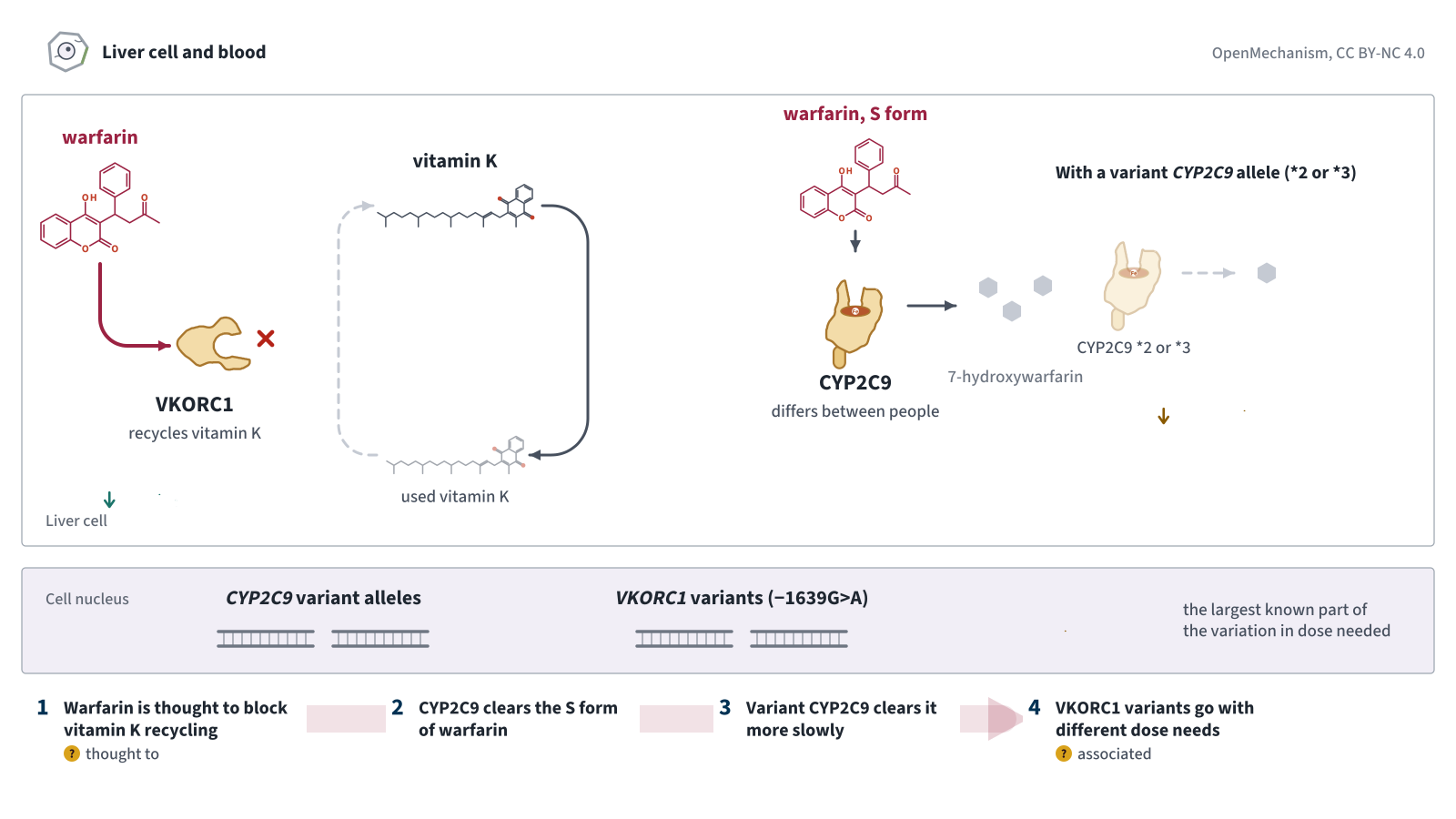
Warfarin works by blocking VKORC1, the enzyme that recycles vitamin K, and the liver enzyme CYP2C9 clears it. Variant forms of CYP2C9 clear it more slowly, and variants in the VKORC1 gene go with different dose needs. Together, the label says, these two genes explain the largest known part of that variation.
- Kind
- In the body
- Medicines
- Warfarin
- Sources
- 5
Step 1: thought to
The warfarin label says: Warfarin is thought to interfere with clotting factor synthesis by inhibition of the C1 subunit of vitamin K epoxide reductase (VKORC1) enzyme complex, thereby reducing the regeneration of vitamin K 1 epoxide
Clinical study: In two inherited human disorders and a warfarin-resistant rat strain, the study found the gene for the enzyme and then tested the enzyme it makes in cells, so it tests the step itself: VKORC1 contains missense mutations in both human disorders and in a warfarin-resistant rat strain. … Overexpression of wild-type VKORC1, but not VKORC1 carrying the VKCFD2 mutation, leads to a marked increase in VKOR activity, which is sensitive to warfarin inhibition.
Rost S et al., Nature 2004 (PMID 14765194)
This study was picked with a literature search and is not yet checked by our reviewer.
Step 4: associated
The warfarin label says: Certain single nucleotide polymorphisms in the VKORC1 gene (e.g., –1639G>A) have been associated with variable warfarin dose requirements. … VKORC1 and CYP2C9 gene variants generally explain the largest proportion of known variability in warfarin dose requirements.
Clinical study: In European-American patients taking warfarin long term, the study compared versions of the VKORC1 gene with the dose each person needed and with the gene's messenger RNA in liver samples; it measured the dose needed, not how the variants change the enzyme: VKORC1 haplotypes can be used to stratify patients into low-, intermediate-, and high-dose warfarin groups
Rieder MJ et al., N Engl J Med 2005 (PMID 15930419)
This study was picked with a literature search and is not yet checked by our reviewer.
For teachers: download this drawing.
Step by step
Warfarin is thought to block vitamin K recycling. Warfarin stops the body making the clotting factors that need vitamin K; it is thought to do so by blocking the C1 subunit of the vitamin K epoxide reductase () enzyme complex, so less used vitamin K is regenerated.1
What the source says
“Warfarin acts by inhibiting the synthesis of vitamin K-dependent clotting factors, which include Factors II, VII, IX, and X, and the anticoagulant proteins C and S.”
Source 1“Warfarin is thought to interfere with clotting factor synthesis by inhibition of the C1 subunit of vitamin K epoxide reductase (VKORC1) enzyme complex, thereby reducing the regeneration of vitamin K 1 epoxide”
Source 1CYP2C9 clears the S form of warfarin. The S form of warfarin is mainly broken down by , a liver enzyme that differs between people (a polymorphic enzyme), and the label calls it the P450 enzyme most likely to set how strongly warfarin acts.1
Variant CYP2C9 clears it more slowly. People with one or more variant CYP2C9 clear S-warfarin more slowly; in the laboratory the two the label names, CYP2C9*2 and CYP2C9*3, hydroxylate S-warfarin less.1
VKORC1 variants go with different dose needs. Single-letter changes in the VKORC1 gene, the one that codes for warfarin's target, have been associated with needing a different warfarin dose, and the label says the two genes together explain the largest known part of that variation.1
What the source says
“Certain single nucleotide polymorphisms in the VKORC1 gene (e.g., –1639G>A) have been associated with variable warfarin dose requirements.”
Source 1“VKORC1 and CYP2C9 gene variants generally explain the largest proportion of known variability in warfarin dose requirements.”
Source 1
See also
Medicine pages: warfarin.
Other pages on what the body does with a medicine (blood & clotting): clopidogrel and the CYP2C19 gene; and all 16 pages on what the body does with a medicine.
Interactions: warfarin and NSAIDs or aspirin; amiodarone and warfarin; and vitamin K and warfarin.
Sources
- 1Warfarin Sodium (warfarin): FDA label12.1 Mechanism of Action; 12.3 Pharmacokinetics; 12.5 Pharmacogenomics; Boxed Warning. Saved copy
- 2Mutations in VKORC1 cause warfarin resistance and multiple coagulation factor deficiency type 2Rost S et al. Nature 2004 (abstract). Saved copy
- 3Effect of VKORC1 haplotypes on transcriptional regulation and warfarin doseRieder MJ et al. N Engl J Med 2005 (abstract). Saved copy
- 4Human vitamin K epoxide reductase (VKORC1) with warfarinPDB 6WV3; Liu, S. et al. Science 2021;371. The VKORC1 outline in the drawing is traced from this structure. Saved copy
- 5Human CYP2C9 with S-warfarinPDB 1OG5; Williams, P.A. et al. Nature 2003;424:464. The CYP2C9 outline in the drawing is traced from this structure. Saved copy
Notes and limits
- CYP2C9 is not the only enzyme that breaks warfarin down.1
- How common these alleles are differs between groups, and other reduced-activity CYP2C9 alleles are rarer.1
- Genes are not the whole story: other things change how warfarin acts.1
- The label's dosing, genotyping and INR monitoring instructions are left out: this page explains the mechanism, not what to do.
Notes that apply to every page are on How to read a page.
Spotted a mistake? Report an error (hello@openmechanism.com). Since launch, every published error we fix is listed on the corrections page.
Cite this page
Tran D. Warfarin and the CYP2C9 and VKORC1 genes [Internet]. OpenMechanism; 2026 [updated 2026 Oct 20; cited 2026 Oct 20]. Available from: https://openmechanism.com/explained/warfarin-cyp2c9-and-vkorc1