Digoxin
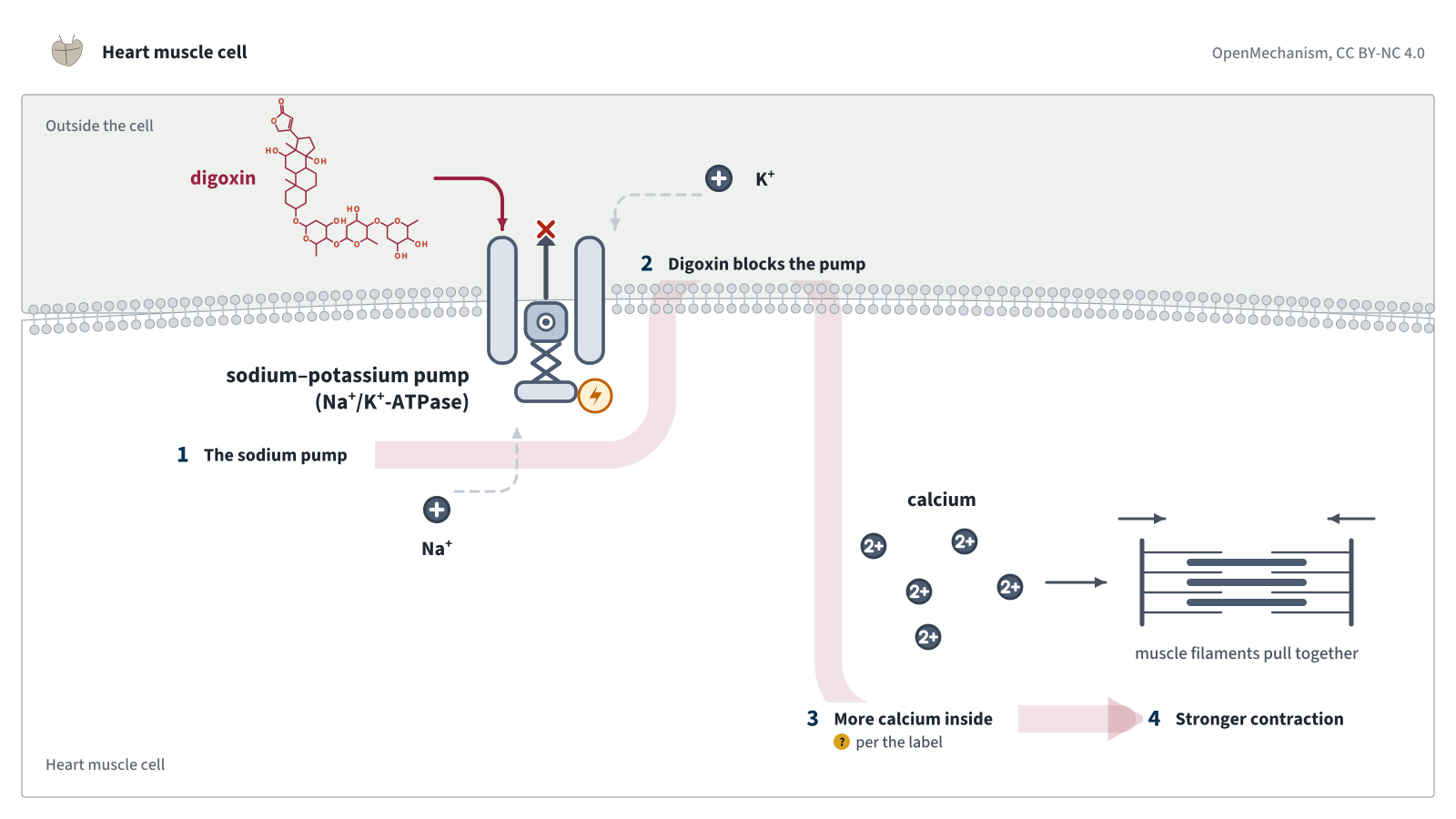
Digoxin blocks the sodium–potassium pump () in heart muscle cells. The label says this makes more calcium available inside the cells, which leads to stronger contractions. Its label lists it for mild to moderate heart failure in adults, where it improves symptoms but has no effect on mortality; to strengthen heart contractions in children with heart failure; and to control the resting ventricular rate in adults with chronic atrial fibrillation.
- Acts on
- Na+/K+-ATPase
- Where
- Heart muscle cells
- Medicine type
- Small molecule
- Used for
- Heart & circulation
Also called Lanoxin.
Step 3: per the label
The digoxin label says: By inhibiting Na-K ATPase, digoxin causes increased availability of intracellular calcium in the myocardium and conduction system, with consequent increased inotropy, increased automaticity, and reduced conduction velocity
Source 1: Lanoxin (digoxin): FDA label, 1 Indications and Usage; 12.1 Mechanism of Action
Study: In a 1996 lab study of heart muscle from people with end-stage heart failure, ouabain, another cardiac glycoside, made each twitch stronger: Ouabain (0.38 +/- 0.11 mumol/L) increased peak twitch tension and relaxation time by 41% and 20%, respectively
Hasenfuss G et al., Circulation 1996 (PMID 8989123)
How it works
The sodium pump. Na+/K+-ATPase normally moves sodium out of cells and potassium into cells.1
Digoxin blocks the pump. Digoxin inhibits the Na+/K+-ATPase.1
More calcium inside. The label says that by inhibiting the pump, digoxin causes increased intracellular myocardial calcium availability.1
Stronger contraction. The label says greater calcium availability leads to increased myocardial contractile force.1
For teachers: download this drawing or build a slide deck.
See also
Condition pages: atrial fibrillation and heart failure.
Side effects: digoxin toxicity.
Explained: digoxin and diuretics; digoxin and P-glycoprotein blockers; and digoxin immune Fab and digoxin.
Related drawings: digoxin immune fab (antibody fragments that bind digoxin in life-threatening toxicity).
Body system: heart, vessels & cholesterol.
Sources
- 1Lanoxin (digoxin): FDA label1 Indications and Usage; 12.1 Mechanism of Action
- 2ChEMBL CHEMBL1751Target and action classification: Sodium/potassium-transporting ATPase inhibitor
- 3Influence of isoproterenol and ouabain on excitation-contraction coupling, cross-bridge function, and energetics in failing human myocardiumHasenfuss G et al. Circulation 1996 (abstract)
Spotted a mistake? Report an error (hello@openmechanism.com). Since launch, every published error we fix is listed on the corrections page.
Notes and limits
- A schematic teaching drawing: not to scale, not exact structures, binding poses or a complete pathway, and not a guide to dosing, treatment or how a person will respond.
- The steps are in the order that explains them; one step is said to cause the next only where the source says so.
- The label doesn't say how blocking the pump makes more calcium available inside the cell, so the drawing leaves that link out.
- The drawing shows only the stronger contraction. The label also lists a slower heart rate and slower conduction through the AV node, which are not drawn.
All recorded limits are on the evidence page, and notes that apply to every page are on How to read a page. Version 1.0.1, medically reviewed by Daniel Tran, PharmD, on 29 October 2026.
Cite this page
Tran D. Digoxin [Internet]. OpenMechanism; 2026 [updated 2026 Oct 29; cited 2026 Oct 29]. Available from: https://openmechanism.com/medicines/digoxin