Vitamin K and warfarin
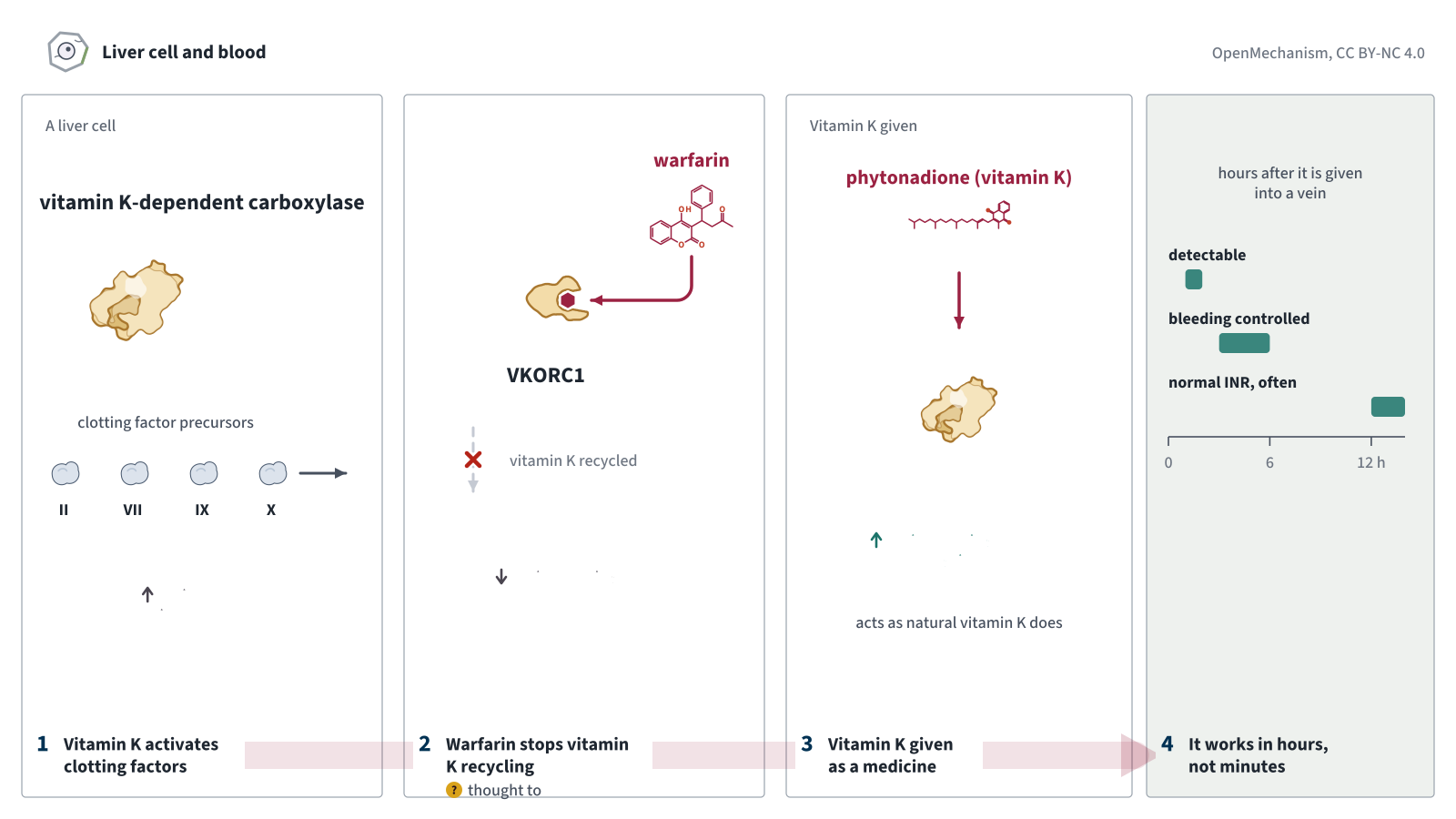
The liver needs vitamin K to turn clotting factors II, VII, IX and X into their active forms. Warfarin is thought to stop vitamin K being recycled, so fewer active factors are made. Vitamin K given as a medicine acts as natural vitamin K does; into a vein it starts working within an hour or two and usually stops bleeding within 3 to 6 hours.
- Kind
- Interaction
- Medicines
- Phytonadione (vitamin K1), Warfarin
- Sources
- 5
Step 2: thought to
The warfarin label says: Warfarin is thought to interfere with clotting factor synthesis by inhibition of the C1 subunit of vitamin K epoxide reductase (VKORC1) enzyme complex, thereby reducing the regeneration of vitamin K 1 epoxide
Source 2: Warfarin sodium: FDA label, 12.1 Mechanism of Action
Clinical study: In two inherited human disorders and a warfarin-resistant rat strain, the study found the gene for the enzyme and then tested the enzyme it makes in cells, so it tests the step itself: VKORC1 contains missense mutations in both human disorders and in a warfarin-resistant rat strain. … Overexpression of wild-type VKORC1, but not VKORC1 carrying the VKCFD2 mutation, leads to a marked increase in VKOR activity, which is sensitive to warfarin inhibition.
Rost S et al., Nature 2004 (PMID 14765194)
This study was picked with a literature search and is not yet checked by our reviewer.
For teachers: download this drawing.
Step by step
Vitamin K activates clotting factors. In the liver, vitamin K is the essential helper of an enzyme that adds carboxyl groups to the precursors of factors II, VII, IX and X, turning them into active clotting factors that the liver releases into the blood.1
What the source says
“Vitamin K is an essential cofactor for a microsomal enzyme that catalyzes the post-translational carboxylation of multiple, specific, peptide-bound glutamic acid residues in inactive hepatic precursors of factors II, VII, IX, and X.”
Source 1“The resulting gamma-carboxy-glutamic acid residues convert the precursors into active coagulation factors that are subsequently secreted by liver cells into the blood.”
Source 1Warfarin stops vitamin K recycling. Warfarin is thought to block , part of the enzyme that regenerates vitamin K, so fewer active clotting factors are made.2
What the source says
“Warfarin acts by inhibiting the synthesis of vitamin K-dependent clotting factors, which include Factors II, VII, IX, and X, and the anticoagulant proteins C and S.”
Source 2“Warfarin is thought to interfere with clotting factor synthesis by inhibition of the C1 subunit of vitamin K epoxide reductase (VKORC1) enzyme complex, thereby reducing the regeneration of vitamin K 1 epoxide”
Source 2Vitamin K given as a medicine. Phytonadione, vitamin K made as a medicine, acts as natural vitamin K does, and is used when coumarin have lowered prothrombin; warfarin is one, chemically a 4-hydroxycoumarin.1,2
What the source says
“Phytonadione Injectable Emulsion aqueous colloidal solution of vitamin K for parenteral injection, possesses the same type and degree of activity as does naturally-occurring vitamin K”
Source 1“Anticoagulant-induced hypoprothrombinemia deficiency caused by coumarin or indanedione derivatives;”
Source 1“The chemical name of warfarin sodium is 3-(α-acetonylbenzyl)-4-hydroxycoumarin sodium salt”
Source 2It works in hours, not minutes. Given into a vein, it is usually detectable within an hour or two, bleeding is usually controlled within 3 to 6 hours, and a normal INR may often come in 12 to 14 hours.1
What the source says
“The action of the aqueous dispersion, when administered intravenously, is generally detectable within an hour or two and hemorrhage is usually controlled within 3 to 6 hours. A normal INR may often be obtained in 12 to 14 hours.”
Source 1
See also
Medicine pages: phytonadione (vitamin K1) and warfarin.
Other interactions (blood & clotting): clopidogrel and omeprazole; warfarin and NSAIDs or aspirin; and all 40 interactions.
The medicine in the body: warfarin and the CYP2C9 and VKORC1 genes.
Conditions: blood clots in the veins, bleeding on blood thinners and blood clots on artificial heart valves.
Sources
- 1Phytonadione injectable emulsion: FDA label1.1 Indications; 12.1 Mechanism of Action; 12.2 Pharmacodynamics. Saved copy
- 2Warfarin sodium: FDA label12.1 Mechanism of Action. Saved copy
- 3Mutations in VKORC1 cause warfarin resistance and multiple coagulation factor deficiency type 2Rost S et al. Nature 2004 (abstract). Saved copy
- 4Human vitamin K-dependent gamma-carboxylase with a factor IX precursor peptide and vitamin K1 hydroquinonePDB 9BVK; Cao, Q. et al. Nature 2025;639:816-824. The vitamin K-dependent carboxylase outline in the drawing is traced from this structure. Saved copy
- 5Human vitamin K epoxide reductase (VKORC1) with warfarinPDB 6WV3; Liu, S. et al. Science 2021;371. The VKORC1 outline in the drawing is traced from this structure. Saved copy
Notes and limits
- In people and animals with enough vitamin K, phytonadione does almost nothing; its effect is that of vitamin K where vitamin K is lacking.1
Notes that apply to every page are on How to read a page.
Spotted a mistake? Report an error (hello@openmechanism.com). Since launch, every published error we fix is listed on the corrections page.
Cite this page
Tran D. Vitamin K and warfarin [Internet]. OpenMechanism; 2026 [updated 2026 Oct 20; cited 2026 Oct 20]. Available from: https://openmechanism.com/explained/vitamin-k-and-warfarin