Why rituximab can bring hepatitis B back
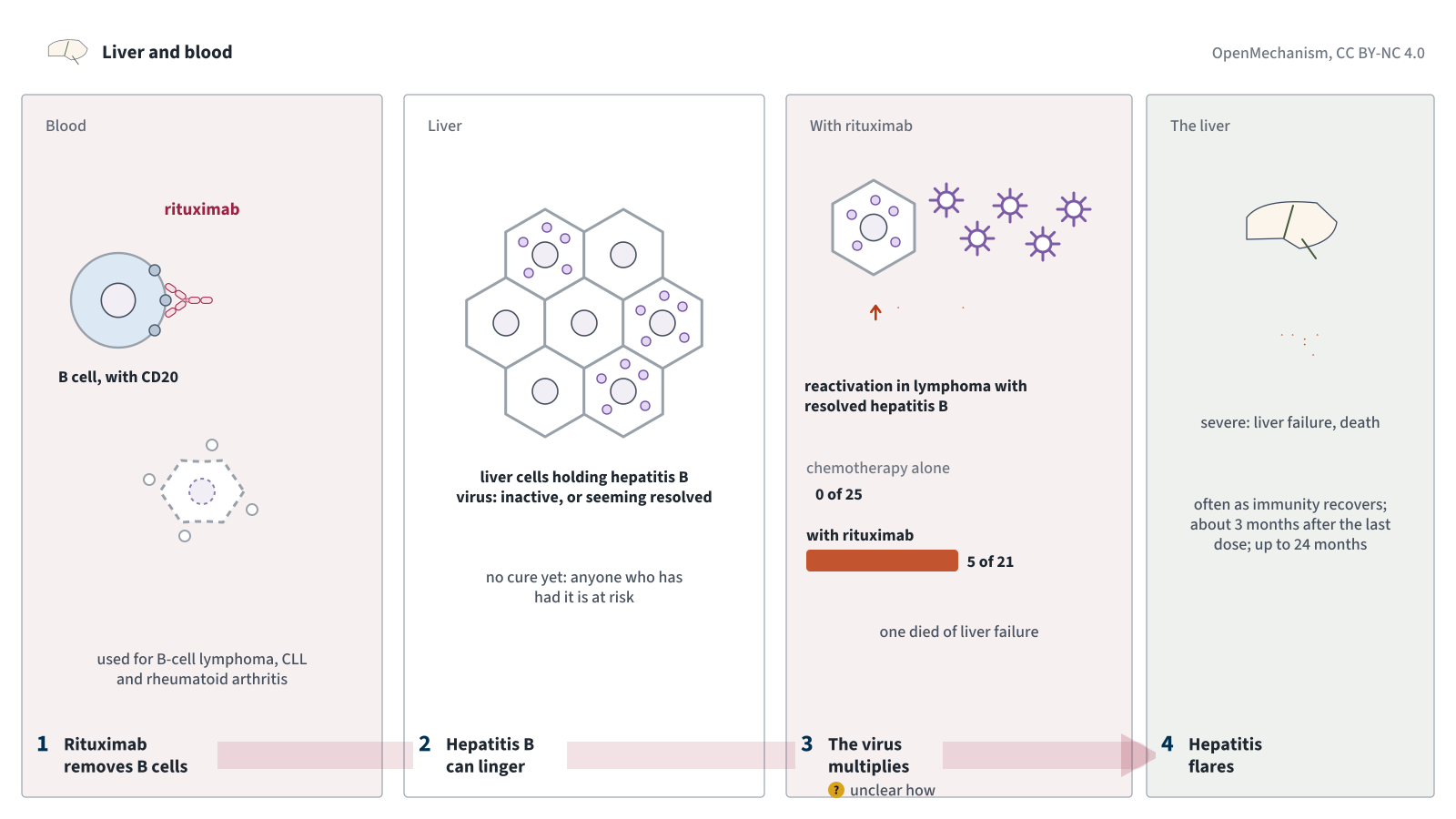
Rituximab, used for B-cell lymphomas and rheumatoid arthritis, destroys B cells. Hepatitis B cannot yet be cured, and in people who have had it, even those who seem to have recovered, the virus can then multiply again: hepatitis can follow, sometimes with liver failure, up to two years after the last dose.
- Kind
- Side effect
- Medicines
- Rituximab
- Sources
- 5
Step 3: unclear how
The Hoofnagle 2009 review says: Future research should address the underlying molecular mechanisms of reactivation as well as its optimal means of diagnosis, treatment, and prevention in different patient populations.
Source 2: Reactivation of hepatitis B, Hoofnagle JH. Hepatology 2009 (abstract)
Clinical study: A study of 46 people with lymphoma and resolved hepatitis B, given chemotherapy with or without rituximab; it measured how often the virus came back, not how losing B cells lets it: In contrast, among the 21 patients treated with R-CHOP, five developed HBV reactivation, including one patient who died of hepatic failure (P = .0148). … Exploratory analysis identified male sex, absence of anti-HBs, and use of rituximab to be predictive of HBV reactivation.
Yeo W et al., J Clin Oncol 2009 (PMID 19075267)
This study was picked with a literature search and is not yet checked by our reviewer.
For teachers: download this drawing.
Step by step
Rituximab removes B cells. Rituximab, an antibody used for B-cell , chronic lymphocytic leukemia and rheumatoid arthritis, binds on B cells and destroys them, possibly with the help of or of other immune cells.1
What the source says
“RITUXAN is a CD20-directed cytolytic antibody indicated for the treatment of: Adult patients with Non-Hodgkin's Lymphoma (NHL) ( 1.1 ).”
Source 1“Previously untreated and previously treated CD20-positive CLL in combination with fludarabine and cyclophosphamide (FC).”
Source 1“Rheumatoid Arthritis (RA) in combination with methotrexate in adult patients with moderately-to severely-active RA who have inadequate response to one or more TNF antagonist therapies”
Source 1“Rituximab is a monoclonal antibody that targets the CD20 antigen expressed on the surface of pre-B and mature B-lymphocytes.”
Source 1“Upon binding to CD20, rituximab mediates B-cell lysis.”
Source 1“Possible mechanisms of cell lysis include complement dependent cytotoxicity (CDC) and antibody dependent cell mediated cytotoxicity (ADCC).”
Source 1Hepatitis B can linger. Hepatitis B can be inactive, or seem resolved, without being cured: no treatment yet clears the virus, so anyone who has had it is at risk. Reactivation has followed rituximab in people with the virus's surface antigen in their blood and in people without it but with antibodies to its core, even in people who appear to have recovered.1,2,3
What the source says
“Reactivation of hepatitis B refers to the abrupt increase in hepatitis B virus (HBV) replication in a patient with inactive or resolved hepatitis B.”
Source 2“The population at risk for HBV reactivation includes those who either currently are infected with HBV or have had past exposure to HBV.”
Source 3“Because curative and eradicative therapy for HBV is not currently available, there is a large reservoir of individuals at risk for HBV reactivation in the general population.”
Source 3“Cases have been reported in patients who are hepatitis B surface antigen (HBsAg) positive and also in patients who are HBsAg negative but are hepatitis B core antibody (anti-HBc) positive.”
Source 1“Reactivation also has occurred in patients who appear to have resolved hepatitis B infection (i.e., HBsAg negative, anti-HBc positive and hepatitis B surface antibody [anti-HBs] positive).”
Source 1The virus multiplies. Reactivation is an abrupt rise in the virus's copying, seen as a rapid rise of its in the blood. In 46 people with lymphoma and resolved hepatitis B, none of 25 given chemotherapy alone had it, against 5 of 21 given rituximab with it (25%), one of whom died of liver failure; in an exploratory analysis, rituximab, male sex and lacking antibodies to the surface antigen predicted it.1,4,5
What the source says
“HBV reactivation is defined as an abrupt increase in HBV replication manifesting as a rapid increase in serum HBV DNA levels or detection of HBsAg in a person who was previously HBsAg negative and anti-HBc positive.”
Source 1“Of the latter, 46 patients (44.2%) were HBsAg negative/anti-HBc positive; 25 of these patients were treated with CHOP, and none had HBV reactivation.”
Source 4“In contrast, among the 21 patients treated with R-CHOP, five developed HBV reactivation, including one patient who died of hepatic failure (P = .0148).”
Source 4“Exploratory analysis identified male sex, absence of anti-HBs, and use of rituximab to be predictive of HBV reactivation.”
Source 4“Among HBsAg-negative/anti-HBc-positive DLBCL patients treated with R-CHOP, 25% developed HBV reactivation.”
Source 4“meta-analysis of HBcAb(+) series identified a more than fivefold increased rate of rituximab-associated HBV-R.”
Source 5Hepatitis flares. Hepatitis often follows, seen as rising liver enzymes; in severe cases bilirubin rises and the liver can fail, sometimes fatally. Typically the virus rises during treatment and the flare comes as immunity recovers after it stops. In published cases reactivation came 3 months after the last rituximab (range 0 to 12), though 29% came more than 6 months after, and it has been reported up to 24 months later.1,2,5
What the source says
“Reactivation of HBV replication is often followed by hepatitis, i.e., increase in transaminase levels.”
Source 1“In severe cases increase in bilirubin levels, liver failure, and death can occur.”
Source 1“Typically, serum HBV DNA rises during chemotherapy, followed by a disease flare and HBV DNA clearance with immune reconstitution after chemotherapy is stopped.”
Source 2“The time from last rituximab to reactivation was 3 months (range 0-12), although 29% occurred >6 months after last rituximab.”
Source 5“HBV reactivation has been reported up to 24 months following completion of RITUXAN therapy.”
Source 1
See also
Medicine pages: rituximab.
Other side effects (cancer): why bleomycin can scar the lungs, why CAR T cells can cause cytokine release syndrome, why checkpoint inhibitors can inflame healthy organs, why cisplatin can harm hearing, why cisplatin can harm the kidneys, why cyclophosphamide can make the bladder bleed, why doxorubicin can damage the heart, why trastuzumab can weaken the heart, why vincristine can damage nerves and all 65 side effects.
Conditions: hepatitis B, B-cell lymphomas, chronic lymphocytic leukemia, rheumatoid arthritis and ANCA vasculitis.
Sources
- 1Rituxan (rituximab): FDA labelBoxed Warning; 1 Indications and Usage; 5.3 Hepatitis B Virus (HBV) Reactivation; 5.4 Progressive Multifocal Leukoencephalopathy (PML); 12.1 Mechanism of Action. Saved copy
- 2Reactivation of hepatitis BHoofnagle JH. Hepatology 2009 (abstract). Saved copy
- 3Hepatitis B Reactivation Associated With Immune Suppressive and Biological Modifier Therapies: Current Concepts, Management Strategies, and Future DirectionsLoomba R, Liang TJ. Gastroenterology 2017 (abstract). Saved copy
- 4Hepatitis B virus reactivation in lymphoma patients with prior resolved hepatitis B undergoing anticancer therapy with or without rituximabYeo W et al. J Clin Oncol 2009 (abstract). Saved copy
- 5Rituximab-associated hepatitis B virus (HBV) reactivation in lymphoproliferative diseases: meta-analysis and examination of FDA safety reportsEvens AM et al. Ann Oncol 2011 (abstract). Saved copy
Notes and limits
- Reactivation can pass unnoticed, and most cases resolve on their own, but it can be severe, and with continued immune suppression chronic hepatitis returns and can lead to cirrhosis.2
- In randomized trials, antiviral medicines given in advance prevented reactivation.2
- Rituximab can also lead to PML from the JC virus, sometimes fatal, mostly in people also given chemotherapy or other immune-suppressing treatment.1
Notes that apply to every page are on How to read a page.
Spotted a mistake? Report an error (hello@openmechanism.com). Since launch, every published error we fix is listed on the corrections page.
Cite this page
Tran D. Why rituximab can bring hepatitis B back [Internet]. OpenMechanism; 2026 [updated 2026 Oct 21; cited 2026 Oct 21]. Available from: https://openmechanism.com/explained/rituximab-and-hepatitis-b