Naproxen
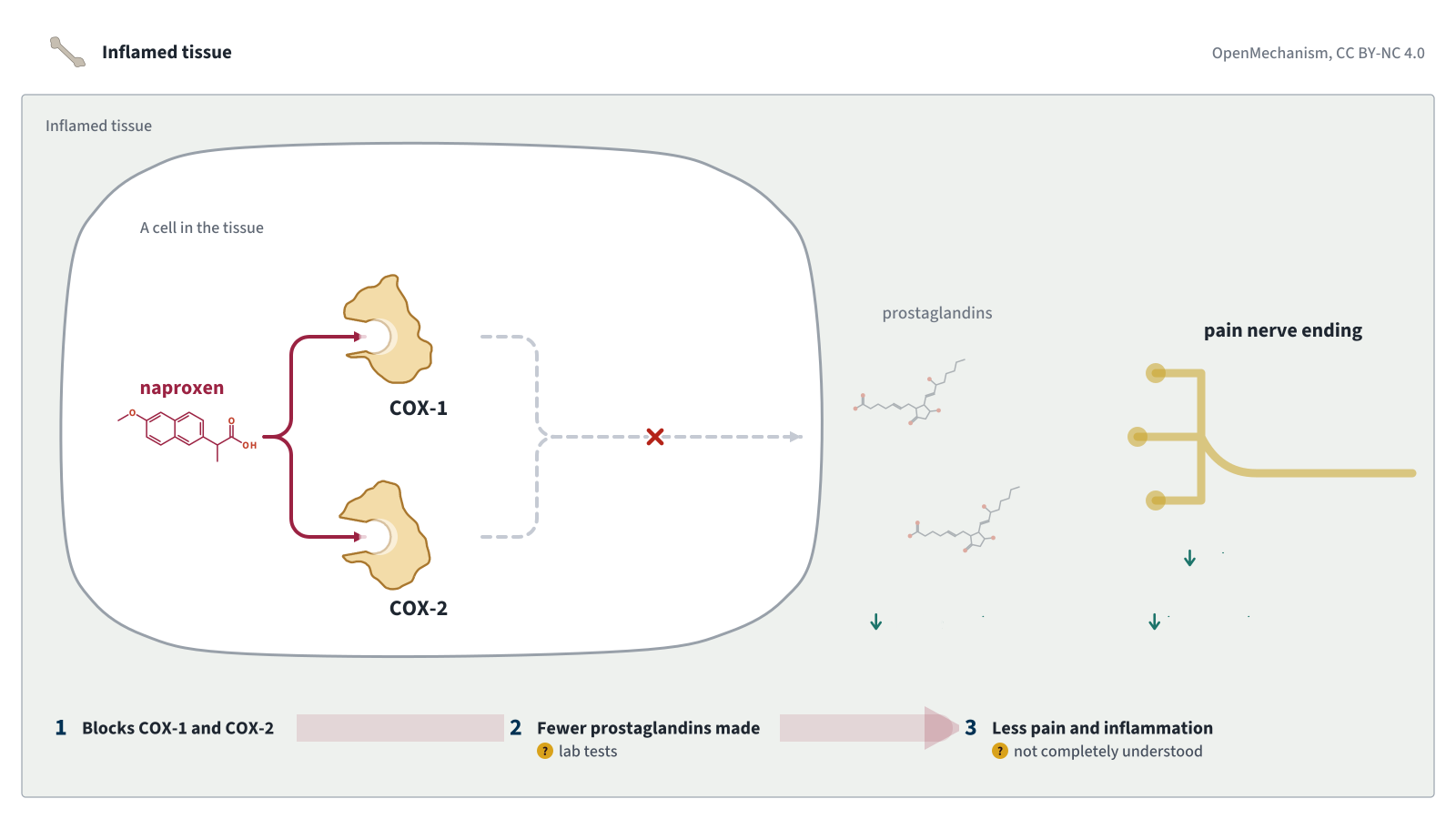
Naproxen blocks the cyclooxygenase enzymes and , which make prostaglandins. In animal models, prostaglandins make pain nerves more sensitive, and they drive inflammation, so fewer prostaglandins may mean less pain and inflammation. Like that of other , its mechanism is not completely understood.
- Acts on
- Cyclooxygenase enzymes (COX-1 and COX-2)
- Where
- Tissues outside the brain and spinal cord
- Medicine type
- Small molecule
- Used for
- Muscles, bones & joints
- Drug class
- NSAIDs and other COX inhibitors
Step 2: lab tests
The naproxen tablets label says: Naproxen is a potent inhibitor of prostaglandin synthesis in vitro.
Source 1: Naproxen tablets: FDA label, 12.1 Mechanism of Action
Clinical study: In a randomized study in 76 healthy volunteers taking diclofenac, ibuprofen, naproxen, meloxicam, rofecoxib or placebo, blood taken during treatment was tested for how much the prostaglandin-making enzymes were blocked; a laboratory test of blood from people, not a trial of pain relief: Mean inhibition of COX-2 (measured as the weighted average inhibition [WAI] of lipopolysaccharide [LPS]-induced PGE2 generation over 8 hours on day 6 vs. baseline) was -2.4%, 66.7%, 69.2%, 77.5%, 93.9%, 71.4%, and 71.5% for placebo, rofecoxib 12.5 mg, rofecoxib 25 mg, meloxicam, diclofenac, ibuprofen, and naproxen, respectively.
Van Hecken A et al., J Clin Pharmacol 2000 (PMID 11028250)
This study was picked with a literature search and is not yet checked by our reviewer.
Step 3: not completely understood
The naproxen tablets label says: The mechanism of action of naproxen, like that of other NSAIDs, is not completely understood but involves inhibition of cyclooxygenase (COX-1 and COX-2). … Because naproxen is an inhibitor of prostaglandin synthesis, its mode of action may be due to a decrease of prostaglandins in peripheral tissues.
Source 1: Naproxen tablets: FDA label, 12.1 Mechanism of Action
Clinical study: In a Cochrane review of 15 placebo-controlled trials of single doses of naproxen or naproxen sodium for pain after surgery, which measured pain relief, not how naproxen works, at the doses it reviewed: About half of participants treated with these doses experienced clinically useful levels of pain relief, compared to 15% with placebo
Derry C et al., Cochrane Database Syst Rev 2009 (PMID 19160232)
This study was picked with a literature search and is not yet checked by our reviewer.
Key terms in this drawing
- COX
- Cyclooxygenase. The enzymes, COX-1 and COX-2, that make prostaglandins.
- COX-2
- Cyclooxygenase-2. An enzyme that makes prostaglandins.
How it works
Blocks COX-1 and COX-2. Naproxen relieves pain (analgesic), eases inflammation (anti-inflammatory) and lowers fever (antipyretic). How it works involves blocking the cyclooxygenase enzymes COX-1 and COX-2.1
Fewer prostaglandins made. In laboratory tests, naproxen is a potent blocker of prostaglandin production, and the levels reached in treatment have had effects in the body.1
Less pain and inflammation. In animal models, prostaglandins make pain nerves more sensitive and strengthen the pain-causing action of bradykinin; prostaglandins also drive (mediate) inflammation. Naproxen may work through fewer prostaglandins in the tissues outside the brain and spinal cord (peripheral tissues), but, like that of other NSAIDs, its mechanism is not completely understood.1
For teachers: download this drawing.
See also
Condition pages: acute pain and period pain; ankylosing spondylitis; gout; juvenile idiopathic arthritis; osteoarthritis; and rheumatoid arthritis.
Other NSAIDs and other COX inhibitors: aspirin, celecoxib, diclofenac, ibuprofen and meloxicam.
Explained: lithium and NSAIDs, diuretics or ACE inhibitors; why NSAIDs can cause stomach ulcers and bleeding; why NSAIDs can harm the kidneys; and warfarin and NSAIDs or aspirin.
Body system: muscles, bones & joints.
Sources
- 1Naproxen tablets: FDA label12.1 Mechanism of Action
- 2ChEMBL CHEMBL154Target and action classification: Cyclooxygenase inhibitor
- 3Comparative inhibitory activity of rofecoxib, meloxicam, diclofenac, ibuprofen, and naproxen on COX-2 versus COX-1 in healthy volunteersVan Hecken A et al. J Clin Pharmacol 2000 (abstract)
- 4Single dose oral naproxen and naproxen sodium for acute postoperative pain in adultsDerry C et al. Cochrane Database Syst Rev 2009 (abstract)
Also used for the drawing
The COX-1 and COX-2 outlines are traced from the crystal structures below.
- 5Ovine cyclooxygenase-1 (COX-1) with ibuprofenPDB 1EQG; Selinsky, B.S. et al. Biochemistry 2001; 40:5172-5180
- 6Human cyclooxygenase-2 (COX-2) with mefenamic acidPDB 5IKR; Orlando, B.J., Malkowski, M.G. J.Biol.Chem. 2016; 291:15069-15081
Spotted a mistake? Report an error (hello@openmechanism.com). Since launch, every published error we fix is listed on the corrections page.
Notes and limits
- A schematic teaching drawing: not to scale, not exact structures, binding poses or a complete pathway, and not a guide to dosing, treatment or how a person will respond.
- The label says the mechanism of action of naproxen, like that of other NSAIDs, is not completely understood, and that its mode of action may be due to a decrease of prostaglandins in peripheral tissues.
All recorded limits are on the evidence page, and notes that apply to every page are on How to read a page. Version 1.0.0, not yet medically reviewed.
Cite this page
Tran D. Naproxen [Internet]. OpenMechanism; 2026 [updated 2026 Oct 14; cited 2026 Oct 14]. Available from: https://openmechanism.com/medicines/naproxen