Meloxicam
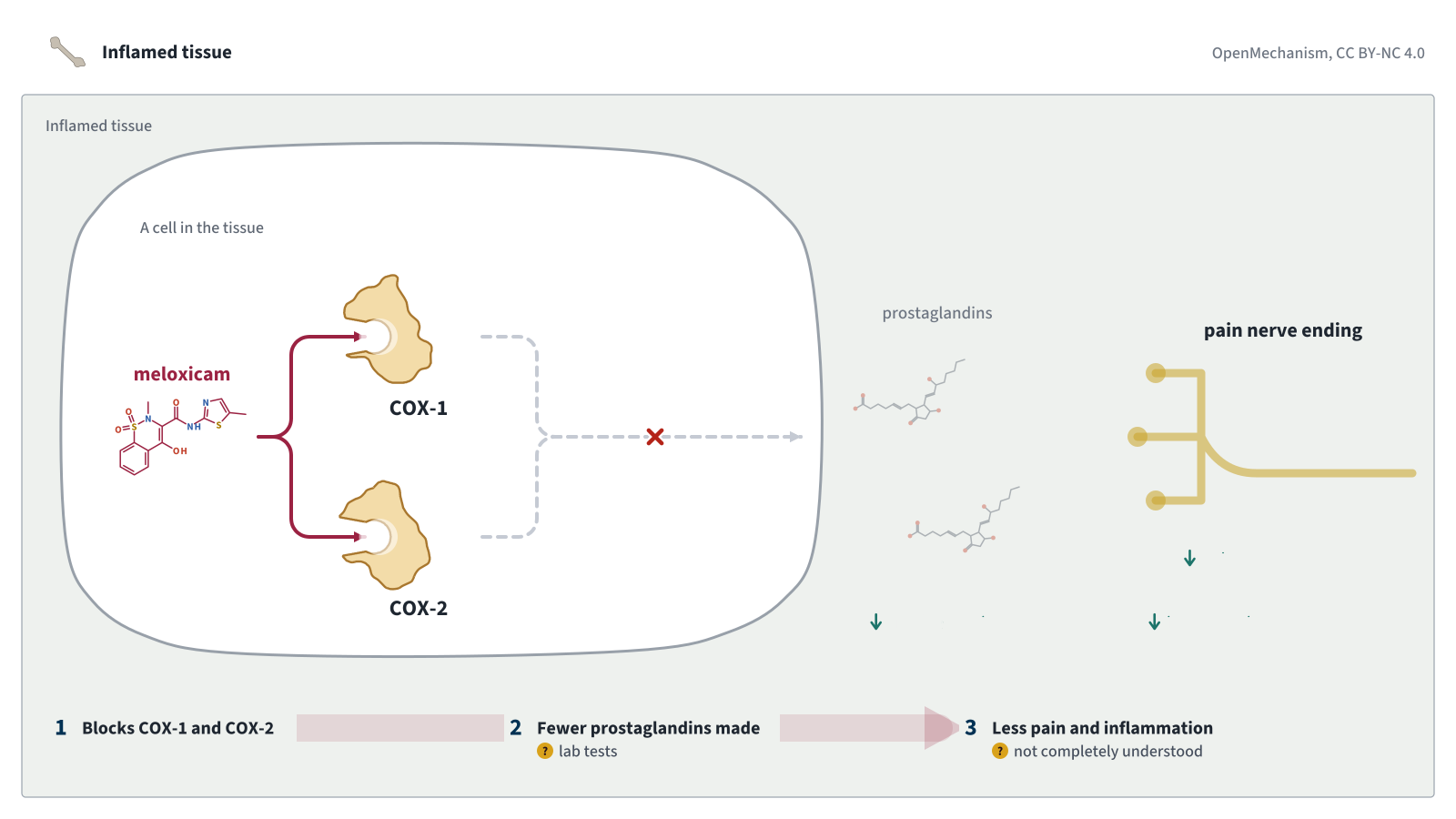
Meloxicam blocks the cyclooxygenase enzymes and , which make prostaglandins. Prostaglandins drive inflammation, and in animal models they make pain nerves more sensitive, so fewer prostaglandins may mean less pain and inflammation. The label says that, like that of other , meloxicam's mechanism is not completely understood. Its label lists it for the signs and symptoms of osteoarthritis and rheumatoid arthritis, and of pauciarticular or polyarticular course juvenile rheumatoid arthritis in patients who weigh at least 60 kg.
- Acts on
- Cyclooxygenase enzymes (COX-1 and COX-2)
- Where
- Tissues outside the brain and spinal cord
- Medicine type
- Small molecule
- Used for
- Muscles, bones & joints
- Drug class
- NSAIDs and other COX inhibitors
Step 2: lab tests
The meloxicam tablets label says: Meloxicam is a potent inhibitor of prostaglandin synthesis in vitro .
Source 1: Meloxicam tablets: FDA label, 1 Indications and Usage; 12.1 Mechanism of Action; Boxed Warning
Study: In Van Hecken and colleagues' 2000 randomized study, 76 healthy volunteers took diclofenac 50 mg three times a day, ibuprofen 800 mg three times a day, naproxen sodium 550 mg twice a day, meloxicam 15 mg once a day, rofecoxib 12.5 or 25 mg once a day, or placebo (doses the authors say include the high end of the approved range), and blood taken during treatment was tested for how much the prostaglandin-making enzymes were blocked; a laboratory test of blood from people, not a trial of pain relief: Mean inhibition of COX-2 (measured as the weighted average inhibition [WAI] of lipopolysaccharide [LPS]-induced PGE2 generation over 8 hours on day 6 vs. baseline) was -2.4%, 66.7%, 69.2%, 77.5%, 93.9%, 71.4%, and 71.5% for placebo, rofecoxib 12.5 mg, rofecoxib 25 mg, meloxicam, diclofenac, ibuprofen, and naproxen, respectively. Corresponding values for mean inhibition of COX-1 (measured as TXB2 generation in clotting whole blood) were -5.15%, 7.98%, 6.65%, 53.3%, 49.5%, 88.7%, and 94.9%.
Van Hecken A et al., J Clin Pharmacol 2000 (PMID 11028250)
Step 3: not completely understood
The meloxicam tablets label says: The mechanism of action of meloxicam, like that of other NSAIDs, is not completely understood but involves inhibition of cyclooxygenase (COX-1 and COX-2). … Because meloxicam is an inhibitor of prostaglandin synthesis, its mode of action may be due to a decrease of prostaglandins in peripheral tissues.
Source 1: Meloxicam tablets: FDA label, 1 Indications and Usage; 12.1 Mechanism of Action; Boxed Warning
Clinical study: In Yocum and colleagues' 2000 report of a 12-week randomized, double-blind trial in 774 people with a flare of hip or knee osteoarthritis, who took meloxicam 3.75, 7.5 or 15 mg a day, diclofenac 50 mg twice a day or placebo; the trial measured pain and osteoarthritis symptoms, not how meloxicam works: Meloxicam, at 7.5 and 15 mg/d, and diclofenac were statistically significantly more effective than placebo for all end points, while the 3.75-mg/d dosage of meloxicam did not always reach statistical significance for all end points.
Yocum D et al., Arch Intern Med 2000 (PMID 11041902)
Key terms in this drawing
- COX
- Cyclooxygenase. The enzymes, COX-1 and COX-2, that make prostaglandins.
- COX-2
- Cyclooxygenase-2. An enzyme that makes prostaglandins.
How it works
Blocks COX-1 and COX-2. Meloxicam has pain-relieving (analgesic), anti-inflammatory and fever-lowering (antipyretic) properties. How it works involves blocking the cyclooxygenase enzymes COX-1 and COX-2.1
Fewer prostaglandins made. In laboratory tests, meloxicam is a potent blocker of prostaglandin production, and the levels reached in treatment have had effects in the body.1
Less pain and inflammation. In animal models, prostaglandins make pain nerves more sensitive and strengthen the pain-causing action of bradykinin; prostaglandins also drive (mediate) inflammation. Meloxicam may work through fewer prostaglandins in the tissues outside the brain and spinal cord (peripheral tissues), but the label says that, like that of other NSAIDs, meloxicam's mechanism is not completely understood.1
For teachers: download this drawing.
See also
Condition pages: juvenile idiopathic arthritis, osteoarthritis and rheumatoid arthritis.
Other NSAIDs and other COX inhibitors: aspirin, celecoxib, diclofenac, ibuprofen and naproxen.
Explained: why NSAIDs can cause stomach ulcers and bleeding.
Body system: muscles, bones & joints.
Sources
- 1Meloxicam tablets: FDA label1 Indications and Usage; 12.1 Mechanism of Action; Boxed Warning
- 2ChEMBL CHEMBL599Target and action classification: Cyclooxygenase-2 inhibitor
- 3Comparative inhibitory activity of rofecoxib, meloxicam, diclofenac, ibuprofen, and naproxen on COX-2 versus COX-1 in healthy volunteersVan Hecken A et al. J Clin Pharmacol 2000 (abstract)
- 4Safety and efficacy of meloxicam in the treatment of osteoarthritis: a 12-week, double-blind, multiple-dose, placebo-controlled trial. The Meloxicam Osteoarthritis InvestigatorsYocum D et al. Arch Intern Med 2000 (abstract)
Also used for the drawing
The COX-1 and COX-2 outlines are traced from the crystal structures below.
- 5Ovine cyclooxygenase-1 (COX-1) with ibuprofenPDB 1EQG; Selinsky, B.S. et al. Biochemistry 2001; 40:5172-5180
- 6Human cyclooxygenase-2 (COX-2) with mefenamic acidPDB 5IKR; Orlando, B.J., Malkowski, M.G. J.Biol.Chem. 2016; 291:15069-15081
Spotted a mistake? Report an error (hello@openmechanism.com). Since launch, every published error we fix is listed on the corrections page.
Notes and limits
- A schematic teaching drawing: not to scale, not exact structures, binding poses or a complete pathway, and not a guide to dosing, treatment or how a person will respond.
- The steps are in the order that explains them; one step is said to cause the next only where the source says so.
- The meloxicam label has a boxed warning: NSAIDs raise the risk of serious clotting events in the heart and blood vessels, including heart attack and stroke, which can be fatal; the risk may come early in treatment and may increase with longer use. The same warning rules meloxicam out in the setting of heart bypass surgery (coronary artery bypass graft, CABG). NSAIDs also raise the risk of serious events in the stomach and intestines, including bleeding, ulcers and holes (perforation), which can be fatal and can come at any time during use and without warning symptoms; older people and people who have had peptic ulcer disease or bleeding in the stomach or intestines are at greater risk of these events.
- The label says the mechanism of action of meloxicam, like that of other NSAIDs, is not completely understood, and that its mode of action may be due to a decrease of prostaglandins in peripheral tissues.
All recorded limits are on the evidence page, and notes that apply to every page are on How to read a page. Version 1.0.1, medically reviewed by Daniel Tran, PharmD, on 13 November 2026.
Cite this page
Tran D. Meloxicam [Internet]. OpenMechanism; 2026 [updated 2026 Nov 13; cited 2026 Nov 13]. Available from: https://openmechanism.com/medicines/meloxicam