Why TNF blockers such as adalimumab raise the risk of tuberculosis
TNF blockers such as adalimumab and infliximab, antibodies used for rheumatoid arthritis and other inflammatory diseases, bind TNF, a signal of normal immunity that helps keep tuberculosis in check. On these medicines latent TB can reactivate, sometimes within weeks of starting, and often outside the lungs. Treating latent TB first lowers the risk but does not remove it.
- Kind
- Side effect
- Medicines
- Adalimumab, Infliximab
- Sources
- 8
Step 2: partly in mice
The Algood 2005 review says: Tumor necrosis factor (TNF) has been demonstrated to be required for formation of granulomas, in mouse models of tuberculosis, and for control of latent tuberculosis, in humans.
Clinical study: A study of tuberculosis after infliximab, from 70 reports to the FDA's MedWatch system; it counted the cases in people, and could not show how blocking TNF leads to them: There were 70 reported cases of tuberculosis after treatment with infliximab, for a median of 12 weeks. … The reported frequency of tuberculosis in association with infliximab therapy was much higher than the reported frequency of other opportunistic infections associated with this drug.
Keane J et al., N Engl J Med 2001 (PMID 11596589)
This study was picked with a literature search and is not yet checked by our reviewer.
For teachers: download this drawing.
Step by step
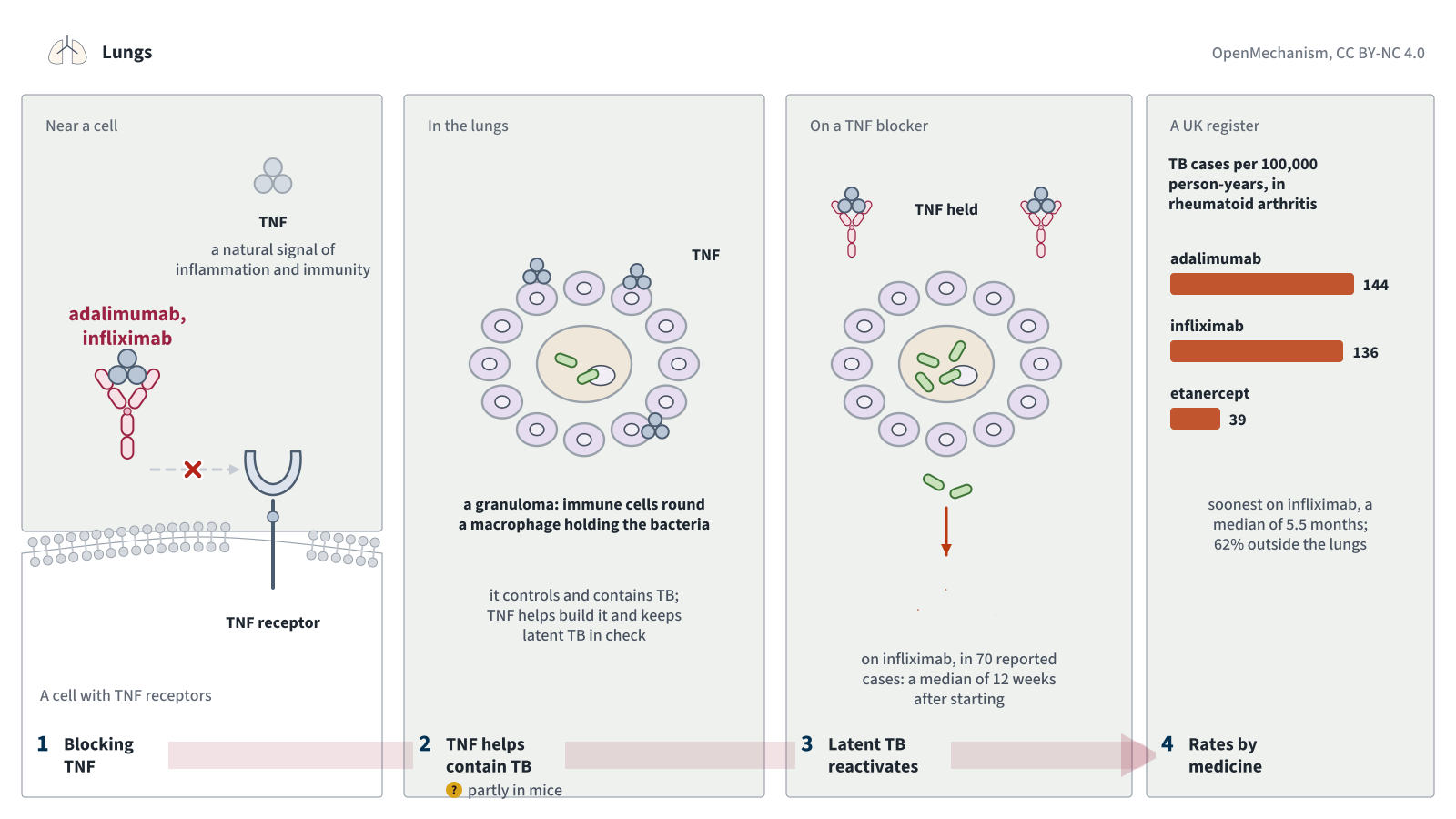
Blocking TNF. Adalimumab and infliximab are blockers, antibodies used for rheumatoid arthritis and other inflammatory diseases. TNF is a natural of normal inflammation and immunity; adalimumab binds it and blocks it from its receptors on cells, and infliximab binds both its free and its cell-bound forms.1,2,3
What the source says
“Adalimumab is a tumor necrosis factor blocker.”
Source 1“Adalimumab is a recombinant human IgG1 monoclonal antibody”
Source 1“Infliximab, a tumor necrosis factor (TNF) blocker, is a chimeric IgG1κ monoclonal antibody (composed of human constant and murine variable regions).”
Source 2“Infliximab, adalimumab, certolizumab pegol and etanercept are anti-TNF agents used to treat a range of inflammatory/autoimmune diseases, such as rheumatoid arthritis.”
Source 3“TNF is a naturally occurring cytokine that is involved in normal inflammatory and immune responses.”
Source 1“Adalimumab binds specifically to TNF-alpha and blocks its interaction with the p55 and p75 cell surface TNF receptors.”
Source 1“Infliximab neutralizes the biological activity of TNFα by binding with high affinity to the soluble and transmembrane forms of TNFα and inhibits binding of TNFα with its receptors.”
Source 2TNF helps contain TB. Immune cells that move into the lungs in response to tuberculosis organize into a granuloma, which controls and contains the infection. TNF has an important part in immunity to TB: it was needed to form granulomas in mice and to keep latent TB in check in people, and in lab and animal studies infected macrophages needed it to make the right chemokines, the signals that direct cells where to go.3,4
What the source says
“Inflammatory cells migrate to the lungs in response to Mycobacterium tuberculosis infection.”
Source 4“These infiltrating cells organize into a structure called a granuloma, which controls and contains infection.”
Source 4“Tumour necrosis factor (TNF) is a potent inflammatory cytokine that plays an important role in immunity to numerous bacterial infections, including Mycobacterium tuberculosis (Mtb), the causative agent of tuberculosis (TB) in humans.”
Source 3“Tumor necrosis factor (TNF) has been demonstrated to be required for formation of granulomas, in mouse models of tuberculosis, and for control of latent tuberculosis, in humans.”
Source 4“Chemokines are small molecules that direct the migration of cells within the body.”
Source 4“Our data support the notion that TNF is required for appropriate chemokine expression by M. tuberculosis-infected macrophages, both in vitro and in vivo.”
Source 4Latent TB reactivates. On a TNF blocker, latent TB can reactivate and new TB infections can take hold, even in people treated for TB before, and TB often spreads beyond the lungs or through the body. In 70 reported cases after infliximab, TB came a median of 12 weeks after starting, in 48 people after three or fewer infusions, and was outside the lungs in 40; cases cluster soon after infliximab is started, which fits the reactivation of a latent infection.1,5,6
What the source says
“Cases of reactivation of tuberculosis and new onset tuberculosis infections have been reported in patients receiving HUMIRA, including patients who have previously received treatment for latent or active tuberculosis.”
Source 1“Patients with TB have frequently presented with disseminated or extrapulmonary disease.”
Source 1“There were 70 reported cases of tuberculosis after treatment with infliximab, for a median of 12 weeks.”
Source 5“In 48 patients, tuberculosis developed after three or fewer infusions.”
Source 5“Forty of the patients had extrapulmonary disease (17 had disseminated disease, 11 lymph node disease, 4 peritoneal disease, 2 pleural disease, and 1 each meningeal, enteric, paravertebral, bone, genital, and bladder disease).”
Source 5“The clustering of reports shortly after initiation of treatment with infliximab is consistent with reactivation of latent infection.”
Source 6Rates by medicine. In a UK register of 10,712 people with rheumatoid arthritis on TNF blockers, TB came 144 times for every 100,000 person-years on adalimumab and 136 on infliximab, both antibodies, against 39 on etanercept. It came soonest on infliximab, a median of 5.5 months after starting, against 18.5 on adalimumab; 62% of the cases were outside the lungs.7
What the source says
“Data from the British Society for Rheumatology Biologics Register (BSRBR), a national prospective observational study, were used to compare TB rates in 10 712 anti-TNF treated patients”
Source 7“The rate of TB was higher for the monoclonal antibodies ADA (144 events/100,000 person-years) and INF (136/100,000 person-years) than for ETA (39/100,000 person-years).”
Source 7“The median time to event was lowest for INF (5.5 months) compared with ETA (13.4 months) and ADA (18.5 months).”
Source 7“25/40 (62%) cases were extrapulmonary, of which 11 were disseminated.”
Source 7“The rate of TB in patients with RA treated with anti-TNF therapy was three- to fourfold higher in patients receiving INF and ADA than in those receiving ETA.”
Source 7
See also
Medicine pages: adalimumab and infliximab.
Other side effects (immune system): why eculizumab raises the risk of meningococcal infections; why natalizumab raises the risk of PML, a brain infection; and all 65 side effects.
Conditions: tuberculosis, rheumatoid arthritis, Crohn disease, ulcerative colitis and psoriasis.
Sources
- 1Humira (adalimumab): FDA labelBoxed Warning; 1 Indications and Usage; 5.1 Serious Infections; 11 Description; 12.1 Mechanism of Action. Saved copy
- 2Remicade (infliximab): FDA label11 Description; 12.1 Mechanism of Action. Saved copy
- 3How tumour necrosis factor blockers interfere with tuberculosis immunityHarris J, Keane J. Clin Exp Immunol 2010 (abstract). Saved copy
- 4Tumor necrosis factor and chemokine interactions in the formation and maintenance of granulomas in tuberculosisAlgood HM, Lin PL, Flynn JL. Clin Infect Dis 2005 (abstract). Saved copy
- 5Tuberculosis associated with infliximab, a tumor necrosis factor alpha-neutralizing agentKeane J et al. N Engl J Med 2001 (abstract). Saved copy
- 6Granulomatous infectious diseases associated with tumor necrosis factor antagonistsWallis RS et al. Clin Infect Dis 2004 (abstract). Saved copy
- 7
- 8
Notes and limits
- Treating latent TB before a TNF blocker is started has been shown to lower the risk of reactivation, yet TB has still come back in some people treated for it.1
- How blocking TNF lets TB out is not settled. In monkeys with latent TB, TNF blockers, adalimumab among them, reactivated it in most animals, yet their granulomas looked like those of active TB without a blocker; some of these medicines also interfere with other innate and T-cell defenses.3,8
- Other serious infections are more likely too, invasive fungal infections among them; most people who had them were also taking other immune-suppressing medicines such as methotrexate or corticosteroids.1
Notes that apply to every page are on How to read a page.
Spotted a mistake? Report an error (hello@openmechanism.com). Since launch, every published error we fix is listed on the corrections page.
Cite this page
Tran D. Why TNF blockers such as adalimumab raise the risk of tuberculosis [Internet]. OpenMechanism; 2026 [updated 2026 Oct 21; cited 2026 Oct 21]. Available from: https://openmechanism.com/explained/tnf-blockers-and-tuberculosis